Autore: Redazione ArcheoMe

Pubblicabili da revisionare

NEWS | È scomparsa Edda Bresciani, stimata egittologa italiana

Edda Bresciani è scomparsa ieri, 29 novembre 2020, in seguito a un ricovero nella clinica Barbantini di Lucca. La grande egittologa ed archeologa è stata ricordata con affetto dalle parole dei colleghi dell’Università di Pisa, dove insegnava, e dal sindaco di Lucca, Alessandro Tambellini.

La nostra Redazione, addolorata per la grande perdita, vuole ricordare la Professoressa e la sua splendida carriera

Chi era Edda Bresciani

Edda Bresciani è stata archeologa ed egittologa, professoressa dell’Università di Pisa, nonché vero e proprio “mito” dell’Egittologia italiana.
Nata a Lucca il 23 settembre del 1930, dopo gli studi classici si iscrisse alla Facoltà di Lettere a Pisa. La Facoltà di Lettere, ricordava la Bresciani, era, all’epoca, l’unica considerata davvero adatta ad una donna, perché si riteneva fosse poco impegnativa intellettualmente. Tuttavia, la giovanissima Edda riuscì fin da subito a sovvertire l’ordine costituito, preparando la propria tesi di laurea su una materia che in Italia, negli anni ’50, era quasi sconosciuta: l’Egittologia, di cui all’epoca c’erano in Italia solo due cattedre, una a Milano, l’altra a Pisa, entrambe affidate a Sergio Donadoni.

Edda Bresciani
Edda Bresciani in un ritratto degli anni ’60

Medinet Madi e il Fayyum

La vita di Edda Bresciani non si legava soltanto alla cattedra pisana di Egittologia, ma anche, e forse soprattutto, alla regione del Fayyum, dove ha lavorato fino al 2011. Qui, dalla metà degli anni ’60 erano riprese le attività di scavo, dapprima con l’università di Milano, fino al 1969, poi con quella di Pisa. Già dal 1966 Bresciani era Direttrice responsabile della missione a Medinet Madi, il grande sito della regione del Fayyum, già investigato da Achille Vogliano negli anni ’30.
Medinet Madi è stato protagonista anche di una serie di progetti di cooperazione internazionale con l’Egitto per il  restauro e la musealizzazione. Negli anni 2000, oltre alle ricerche sul terreno, sono stati avviati due progetti: la realizzazione di un grande Centro visitatori e un progetto di restauro finalizzato alla creazione del Parco archeologico (progetto ISSEMM, in collaborazione con il Consiglio supremo delle Antichità egiziano e con il Ministero degli Esteri italiano). Dal 2011 Medinet Madi è un Parco archeologico amministrato dal governo egiziano.

Edda Bresciani
Edda Bresciani a Medinet Madi

Cercando un altro Egitto

Nel 1974 Edda ottenne per l’Università di Pisa la concessione di scavo alla necropoli di Saqqara, scavando la tomba di Bakenrenef, visir di Psammetico I – fondatore della XXVI dinastia saitica (664-624 a.C.) – che, nonostante fosse stata depredata già nel 1800, ha restituito splendidi reperti e pitture murali. Notevole il ritrovamento di una grande tela dipinta a tempera, risalente ad epoca romana, attualmente esposta al Museo del Cairo.
Dal 1978 diresse poi anche gli scavi a Gurna, presso Tebe, dove gli operai le regalarono una statuina, che la raffigura come un Faraone, con il suo nome scritto in geroglifici. Nello stesso anno fondò la rivista Egitto e Vicino Oriente, di cui era direttrice.  La sua personalità e la spontaneità con la quale si rapportava a colleghi e operai le valsero, nel Fayyum, l’appellativo di Mudira (dall’arabo mudir, “capo”), parola che, al femminile, fino ad allora non esisteva.

Archeologia e primavere arabe

Sebbene Edda Bresciani non avesse mai preso ufficialmente posizione nei riguardi dei vari rivolgimenti politici seguiti alla cosiddetta “stagione delle primavere arabe” dal 2011 in poi, l’archeologa toscana aveva continuato a gestire i rapporti bilaterali in ambito culturale lavorando per la conservazione e la tutela dei beni archeologici che aveva contribuito a riscoprire per quasi mezzo secolo. Numerose sono le onorificenze di cui l’egittologa è stata insignita: dalla Medaglia del Presidente della Repubblica ai benemeriti per la Scienza e la Cultura nel 1996, al “Campano d’Oro” dell’Università di Pisa nel 2012.

Archivio

NEWS | Nuove scoperte dal restauro del Torrione dell’Aquila

Il restauro del Torrione, danneggiato dal terremoto nel 2009, restituisce le prime interessanti scoperte archeologiche.

Dal restauro del Torrione emergono interessanti scoperte archeologiche. L’operazione, che sarebbe dovuta partire a inizio 2020, ha subito molti ritardi ed è finanziata da Fondazione Carispaq e Ance. L’indagine archeologica, iniziata tre settimane fa, contribuisce ad arricchire il dibattito sulla funzione e datazione del manufatto e sta dando risultati interessanti. Gli interventi al Torrione sono molto importanti, non solo perché approfondiscono la storia della città e rafforzano il carattere identitario. Questi infatti si inseriscono in un più ampio progetto urbanistico. Lo scopo finale è anche quello di offrire ai cittadini un’area piena di storia per la socialità, adeguandola con la giusta illuminazione e con panchine.

Una difficile interpretazione del monumento

Il Professore Fabio Redi, direttore scientifico dello scavo, coordina gli archeologi sul cantiere. Gli esperti hanno rinvenuto a circa 1,70 m dal piano stradale lo spiccato del monumento, vale a dire la superficie da cui si eleva la costruzione. Questo spiccato presenta una pianta regolare di forma ellittica, costruita in grossi conci di calcare massiccio. Il rinvenimento, che contribuisce ad arricchire la storia passata della città, subirà un restauro e sarà lasciato a vista fin dalla base interrata. Così sarà visibile ai cittadini il manufatto, rendendo possibile una migliore fruizione e una migliore vista del bene culturale. L’estensione e il materiale delle fondazioni dà modo agli archeologi di escludere che il manufatto avesse una funzione funeraria. Tuttavia, gli archeologi non possono ancora affermare con certezza la cronologia del manufatto. 


La storia del torrione

Non è dunque sicuro che la struttura appartenga all’acquedotto trecentesco di Santanza, piuttosto che a un’opera idraulica di epoca successiva. Sono quindi necessarie ulteriori indagini archeologiche, perciò sarà indispensabile estendere l’area di ricerca per abbassare ulteriormente il piano di calpestio e osservare bene lo spiccato originale del monumento. È interessante, però, la lettura proposta da Maurizio Leopardi, professore di Costruzioni idrauliche e idrologia all’Università dell’Aquila. Come riportato nella Cronaca Aquilana di Buccio di Ranallo (1294-1363), la costruzione dell’acquedotto di Santanza consentì la distribuzione di acqua a ogni castello. Il Torrione poteva essere dunque una “Macchina idraulica”, alimentata esclusivamente dalla spinta del carico idraulico.


BIBLIOGRAFIA

LEOPARDI M., L’approvvigionamento idrico della città dell’Aquila in otto secoli di storia, One Group.


English Version

EMINENTFIGURES | Fernanda Wittgens. An Italian “monument-woman”

Fernanda Wittgens was an art historian and the first female director of the Pinacoteca di Brera: we owe to her the rescue of most of the paintings in Milan’s museums during the Second World War.

Childhood and youth

Fernanda was born in Milan on April 3, 1903 from Margherita Righini and Adolfo Wittgens. On Sundat her father used to take her and her brothers and sisters to the museums of the city: this habit, almost certainly, instilled in Fernanda the interest and love for art.

Graduated from the classical high school, in 1925 the young girl obtained her master degree in art history at the Scientific-literary Academy in Milan, under the guidance of Paolo D’Ancona. After a period as a teacher at the Parini High School and the Regio Liceo Manzoni, in 1928 Fernanda Wittgens, thanks to her friend Mario Salmi, inspector at the Brera art gallery, was hired as an “adventitious worker” in Brera. The great culture and artistic sensibility allowed Fernanda to have an impressive career progression: in 1931, she become assistant to Ettore Modigliani, director of the Pinacoteca.

Emilio Sommariva, Ritratto di Fernanda Wittgens, 1936. Milano, Biblioteca Nazionale Braidense, Fondo Emilio Sommariva
Emilio Sommariva, Portrait of Fernanda Wittgens (1936)
Racial laws and war

Fernanda worked side by side with Modigliani until 1935, when the director was dismissed from his office because he was anti-fascist (following the racial laws of 1938, Modigliani was sentenced to confinement in the Marche region. Anyway Fernanda Wittgens continued to update him punctually on the events in Milan and the direction of the gallery).

In 1940 Fernanda Wittgens won the competition as director of the Pinacoteca di Brera becoming the first woman in Italy leading a museum (in 1941 she was followed by Palma Bucarelli PERSONAGGI | Palma Bucarelli, la Regina di Quadri). 

When the war began to threat Milan, the first thought of the director was to secure the masterpieces of Brera and other Milanese museums. In spite of the reduced staff, Wittgens managed to save all the masterpieces of Brera and numerous works of the Museo dell’Ospedale Maggiore and the Museo Poldi Pezzoli, transporting them to safe places and air-raid shelters. She worked on the transfer of the paintings until June 1943. On August, 7th and 8th the Pinacoteca di Brera was bombed by the Allies and 24 rooms out of 36 were destroyed, but, thanks to Fernanda, they were empty.

Pinacoteca courtyard
The courtyard of the Pinacoteca di Brera in 1942, with trucks loading the works of art
The trial of the ladies

During the war years, Fernanda Wittgens had worked tirelessly to help friends, family and people of Jewish descent to cross the italian border in order to escape racial persecution. In 1944, however, a young German Jew, whose expatriation Fernanda was organizing, denounced the woman to the Nazis. The famous art historian was jailed first in Como and then in Milan, in San Vittore. Together with Adele Cappelli, Zina and Mariarosa Tresoldi, who were also involved in helping Jews and anti-fascists, she was tried and sentenced to 4 years imprisonment in what the newspapers of the time called “the trial of the ladies”.

From the prison Fernanda Wittgens wrote to her relatives some letters full of pride and bravery. Trough her letters we can see a strong woman, not afraid at all because of the harsh prison conditions. Despite the dramatic situation she continued to firmly believe in her ideals and actions.

The Great Brera, Michelangelo and Leonardo

Released at the dawn of the liberation of Italy, a few months later Fernanda Wittgens is back in Brera, in her place as director, engaged in the reconstruction. Together with Modigliani, returned from confinement, she planned the idea of the “Great Brera”: a museum connected with the other great artistic institutions of Milan, such as the Academy of Fine Arts and the Observatory of Astronomy. The art gallery, enlarged and restored, was finally inaugurated in 1950.  Dr. Wittgens inaugurates a new concept of art gallery, a “living” museum with events, concerts, fashion shows, vernissage, a true cultural heart of the city.

In 1950 the director of Brera was appointed Superintendent of the Lombardy Galleries. Two years later she managed to get the city of Milan to buy Michelangelo’s Pietà Rondanini, recently on the art market.

Among Fernanda Wittgens’ successes is the rescue of Leonardo’s Last Supper. In the early 1950s, when no one believed that the grandiose mural could be saved from its state of decay (already deteriorated by time, it had suffered enormous damage during the war), the Superintendent nevertheless wanted to try and entrust its restoration to Mario Pelliccioli. The painting was finally reopened to the public on May 30, 1954.

Fernanda Wittgens
Fernanda Wittgens in her studio in Brera (1955)
Righteous among the Nations

Fernanda Wittgens died prematurely in 1957, only 54 years old.

A street in Milan, in the central San Lorenzo neighborhood, is dedicated to her. In 2014, for her aid to the Jews, she was named “Righteous Among the Nations”, a tree was planted in her name and a memorial stone was erected in the Garden of the Righteous in Milan.

Tradotto da: https://archeome.it/personaggi-fernanda-wittgens-una-monument-woman-italiana/

Pubblicabili da revisionare

ANTICO EGITTO | La divina Karnak

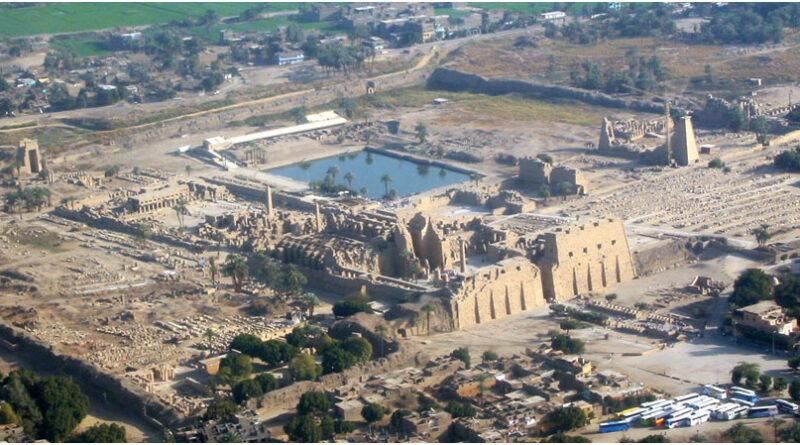
A pochi km da Luxor, camminando tra le strade impolverate di sabbia e costeggiando il fiume Nilo, ecco svettare d’innanzi ai nostri occhi il maestoso complesso templare di Karnak, risalente al Nuovo Regno, centro della diffusione del culto dell’Alto Egitto. Il “Tempio dei Templi” non è stato costruito a misura degli uomini ma degli dèi. È l’occhio sacro del signore dell’universo, Amon l’inconoscibile, che guida l’umanità, l’Uno che rimane l’Unico, Amon l’Infinito di potenza, misterioso d’origini nel suo splendore.  

Architettura meditativa

Il complesso è dedicato al culto del dio Amon-Ra, supremo dio del cielo e della fecondità, e costituisce una parte dell’imponente complesso templare di Karnak, che occupa un’area di circa 48 ettari. La sua costruzione si è sviluppata nell’arco di oltre mezzo millennio, dal XVI all’XI secolo a.C., ma in sostanza non è mai stata terminata. Nella grande impresa s’impegnarono vari faraoni, desiderosi di ampliarlo, arricchirlo e renderlo sempre più maestoso.

Il complesso di Karnak prende il nome da un termine arabo che significa “borgo fortificato”, che sostituisce il vecchio nome egiziano di Ipet-sut, “Quella che conta le sedi”, prima riservato alla parte centrale dell’insieme e poi esteso alla sua totalità. Questo enorme complesso templare fu il centro dell’antico culto religioso, mentre il potere amministrativo si concentrava a Tebe (l’attuale Luxor).

Al di là della funzione religiosa, il sito è stato anche centro amministrativo e sede per i faraoni durante l’epoca del Nuovo Regno. Karnak è probabilmente il più grande complesso monumentale mai costruito al mondo, sviluppatosi di generazione in generazione e risultante da una composizione di templi, santuari ed elementi architettonici unica in Egitto.

Karnak è divisa in tre sezioni: il precinto di Amon, quello di Mut e quello di Montu. La sua complessa disposizione sminuisce, dal punto di vista delle dimensioni, qualunque altro sito monumentale in Egitto. Il precinto di Amon contiene tutte le sezioni più famose del complesso di Karnak, compresa la vertiginosa Grande Sala ipostila.

Karnak 1789
Il tempio di Amon-Ra nel complesso di Karnak, come apparve alla spedizione napoleonica del 1789

Il primo nucleo del tempio risale al Medio Regno, con la costruzione della “Cappella Bianca” da parte di Sesostri I, piccolo vano cultuale atto a contenere la barca sacra. L’edificio di Amon-Ra richiese molte complesse fasi costruttive, iniziando con Tuthmosi I, che racchiuse il santuario con una cinta muraria. Hatshepsut eresse degli obelischi vicino il muro orientale, mentre con Tuthmosi III vennero aggiunti degli altri piloni.

Con quest’ultimo sovrano venne costruita la “Sala delle feste”, destinata alla celebrazione della festa sed; un’altra importante realizzazione fu la costruzione di un vano nel complesso chiamato “Sala degli Annali”, ove fu fatto incidere il resoconto delle vittoriose battaglie in Siria e Canaan.

Da soli di fronte al dio

Nella “Grande Sala Ipostila”, voluta da Sethi I e Ramesse II, troviamo il luogo in cui lo spirito circola nella foresta dell’inconscio, il vero labirinto, il luogo in cui l’adepto attende l’ispirazione che scenderà dall’alto dei capitelli delle innumerevoli colonne.

colonne sala ipostila
Colonne della grande Sala Ipostila

Le colonne sono l’immagine stessa dell’inizio del mondo. Esse difendono e dissimulano l’entrata del santuario e contribuiscono, grazie al magnetismo che irradiano, ad attirare la divinità sensibile alla bellezza delle origini. Le dimensioni della sala ipostila sono colossali: 134 gigantesche colonne, che schiudono i loro capitelli verso il cielo, sostengono architravi di 70 tonnellate sulle quali sono posti, con portate fino a sette metri, i pesanti lastroni di pietra del tetto.

Nella Sala Ipostila si attende e si medita: una tensione, una presenza inafferrabile riempie lo spazio, la luce cambia e conduce di fronte alle porte della misteriosa dimora, dopo le quali ci si ritroverà da soli con il dio e si potrà pregare alla sua purezza, alla sua legittimità. L’uomo attuale diviene uomo cosmico, supera i vari stadi e raggiunge la perfezione.


Pubblicabili da revisionare

ANCIENT EGYPT | The divine Karnak

A few kilometers from Luxor, walking through the dusty streets of sand along the river Nile, here stands before our eyes the majestic Karnak temple complex, dating from the New Kingdom, the center of the spread of the cult of Upper Egypt. The “Temple of Temples” was not built on a human scale but for the gods. It is the sacred eye of the lord of the universe, Amon the Unknowable, who guides humanity, the One who remains the One, Amon the Infinite power, with mysterious origins in its splendor.  

Meditative architecture

The complex is dedicated to the worship of the god Amon-Ra, supreme god of heaven and fertility, and it is a part of the impressive temple complex of Karnak, which occupies an area of about 48 hectares. Its construction developed over more than half a millennium, from the sixteenth to the eleventh century BC, but in fact it has never been completed. Various pharaohs were involved in the great enterprise, eager to enlarge it, enrich it and make it more and more majestic.

The complex of Karnak takes its name from an Arabic term meaning “fortified village”, replacing the old Egyptian name of Ipet-sut, “The one that counts the seats”, first reserved to the central part and then extended to its totality. This huge temple complex was the center of the ancient religious cult, while the administrative power was concentrated in Thebes (today’s Luxor).

Beyond the religious function, the site was also the administrative center and seat for the pharaohs during the New Kingdom. Karnak is probably the largest monumental complex ever built in the world, developed from generation to generation and resulting from a composition of temples, shrines and architectural elements unique in Egypt.

Karnak is divided into three sections: the precinct of Amon, Mut and Montu. Its complex layout throws a shade, in terms of size, on any other monumental site in Egypt. The precinct of Amon contains all the most famous sections of the Karnak complex, including the dizzying Great Hypostyle Hall.

Karnak 1789
The temple of Amon-Ra in the complex of Karnak, as it appeared to the Napoleonic expedition in 1789

The first nucleus of the temple dates back to the Middle Kingdom, with the construction of the “White Chapel” by Sesostris I, a small cultic chamber designed to contain the sacred boat. The building of Amon-Ra required many complex construction phases, starting with Tuthmosis I, who enclosed the sanctuary with a wall. Hatshepsut erected obelisks near the eastern wall, while with Tuthmosis III other pillars were added.

With this last sovereign the “Hall of the Feasts” was built, destined to the celebration of the sed feast; another important realization was the construction of a room in the complex called “Hall of the Annals“, where the account of the victorious battles in Syria and Canaan was engraved.

Alone in front of God

In the “Great Hypostyle Hall“, commissioned by Sethi I and Ramses II, we find the place where the spirit circulates in the forest of the unconscious, the true labyrinth, the place where the adept awaits the inspiration that will come down from the capitals of the countless columns.

colonne sala ipostila
Columns of the great hypostyle hall

The columns are the very image of the beginning of the world. They defend and conceal the entrance to the sanctuary and contribute, thanks to the magnetism they radiate, to attract the divinity, sensitive to the beauty of the origins. The dimensions of the hypostyle hall are colossal: 134 gigantic columns, which open their capitals towards the sky, support 70-ton lintels on which the heavy stone slabs of the roof are placed, with a capacity of up to seven meters.

In the Hypostyle Hall one waits and meditates: a tension, an elusive presence fills the space, the light changes and leads in front of the doors of the mysterious dwelling, after which one will find oneself alone with the god and can pray for his purity, his legitimacy. Today’s man becomes a cosmic man, goes through the various stages and reaches perfection.

Tradotto da : https://archeome.it/antico-egitto-la-divina-karnak/

English Version

BEHINDFASCISM | The University City, a State Art

The University City project was a symbol of fascism and the whole Rome. The complex, inaugurated on April 21, 1935, represented an important venture for the regime because Mussolini decided to concentrate the buildings in a single area, to examine and modify the different designs and to visit the site often. The complex became a work created for the people and was somehow sanctified by the people.

A collective design

Mussolini entrusted Marcello Piacentini, academic of Italy, with the task of creating this large complex of buildings that was to constitute not only the University of Rome but the largest study center in Italy and the Mediterranean. Together with Piacentini, many others were the architects called by the Duce to collaborate, so that it would be a collective design enterprise. In spite of the work of the various architects, a unity of style was created, since the classic type of basilica and common architectural elements were used, such as the use of the same windows and the same covering materials such as travertine and yellow or red plaster.

The architectural approach

The chosen plot of land, in a quadrangular shape, is located between Viale del Policlinico, Viale dell’Università and Viale Regina. The different institutes are grouped around a central empty space, the center of the project. An essential project, with monumental visions, avenues and gardens. The monumental entrance, formed by high and solemn propylaea, opens towards Viale del Policlinico, 60 m wide, bounded by the buildings of the different faculties. In front of the Avenue, on its axis and placed to close the long side of the Forum, stands the building of the Rectorate and the Library, which forms a unitary complex with the buildings of the Faculties of Humanities and Law. The tree-lined avenue flows into a large transversal space, a square measuring 68 x 240 m, similar in size to Piazza Navona. At both ends stand the Institutes of Mathematics by Giò Ponti and the Institute of Mineralogy, Geology and Paleontology by Giovanni Michelucci. In the rear part, near the Aula Magna, there was a large square used for meetings and various ceremonies. Many areas were used for parks and gardens, such as the quadriporticus built on the left side of the avenue. The pronaos, the travertine pillars, the large windows framed in red marble, the statue of Minerva placed in front of the atrium represent a harmony of form and values.

General plan
The great avenue seen from the Rectorate building
The entrance porch seen from the outside
Building technology

The construction of the buildings was caged in reinforced concrete with the foundations consisting of concrete poles. The external facades were covered with a curtain of lithoceramic and Roman travertine. There were many special applications, such as glass brick cladding, lightweight reinforced concrete floors or glass-cement canopies.

The Rectorate building with the statue of Minerva
Architecture as a style of the fascist era

The University City is a successful experiment of collaboration and coordination that will be re-proposed with the E42. The simple architecture does not renounce the modernity born in a classical and Mediterranean climate. A political and artistic compromise: the point of equilibrium will then be found according to the orientations and needs that the Regime required for the realization of modern architecture as a style of a fascist era, a State art.

Aerial view of the University City

Tradotto da: https://archeome.it/dietro-al-fascismo-la-citta-universitaria-unarte-di-stato/?fbclid=IwAR0sYuuDNYoXsczLCjuLfg36kbQET3WBm3HTpHNBKwYX3gge5gmSmiWlWpg 

Pubblicabili da revisionare

DIETRO AL FASCISMO | La Città universitaria, un’arte di Stato

Il progetto della Città universitaria era simbolo del fascismo e della Roma intera. Il complesso, inaugurato il 21 Aprile del 1935, rappresentò un’impresa importante per il regime perché Mussolini decise di concentrare gli edifici in un’unica zona, esaminare e modificare i diversi disegni e visitare spesso il cantiere. Il complesso diveniva un’opera creata per il popolo e dal popolo veniva in qualche modo santificata.

Una progettazione collettiva

Mussolini affidava a Marcello Piacentini, accademico d’Italia, il compito di realizzare questo grande complesso di edifici che doveva costituire non solo l’Università di Roma ma il più grande centro studi dell’Italia e del Mediterraneo. Insieme a Piacentini, molti altri erano gli architetti chiamati dal Duce a collaborare in modo che risultasse un’impresa di progettazione collettiva. Nonostante l’operato dei diversi architetti, viene realizzata un’unità di stile poiché si ricorre al tipo classico della basilica e ad elementi architettonici comuni, come l’uso delle stesse finestre e degli stessi materiali di rivestimento come il travertino e l’intonaco giallo o rosso.

L’impostazione architettonica

Il terreno scelto, a forma quadrangolare, è situato tra i Viali del Policlinico, dell’Università e della Regina. I diversi istituti si raggruppano intorno ad uno spazio vuoto centrale, centro del progetto. Un progetto essenziale, con visioni monumentali, viali e giardini. L’ingresso monumentale, formato da alti e solenni propilei, si apre verso il Viale del Policlinico, largo 60 m, delimitato dagli edifici delle diverse facoltà. Di fronte al Viale, sul suo asse e posto a chiudere il lato lungo del Foro, si erge l’edificio del Rettorato e della Biblioteca, che forma con gli edifici di Lettere e Giurisprudenza un complesso unitario. Il viale alberato confluisce in un ampio spazio trasversale, una piazza di 68 x 240 m, dimensioni simili a quelle di Piazza Navona. Alle due estremità si ergono gli Istituti di Matematica di Giò Ponti e l’Istituto di Mineralogia, Geologia e Paleontologia di Giovanni Michelucci. Nella parte posteriore, nei pressi dell’aula Magna, si apriva un vasto piazzale utilizzato per le adunate e le diverse cerimonie. Molte le zone destinate a parchi e giardini, come il quadriportico costruito sulla sinistra del viale. Il pronao, i pilastri di travertino, le grandi finestre incorniciate di marmo rosso, la statua della Minerva posta di fronte all’atrio rappresentano un’armonia di forma e di valori.

Planimetria generale


Il grande viale visto dall’edificio del Rettorato


Il portico d’ingresso visto dall’esterno


La tecnica costruttiva degli edifici

La costruzione degli edifici era ad ingabbiatura di cemento armato con le fondazioni costituite da pali di cemento. Le facciate esterne erano rivestite con cortina di litoceramica e travertino romano. Molte le applicazioni speciali, come rivestimenti di mattoni in vetro, solai leggeri in cemento armato o pensiline di vetro-cemento.

L’edificio del rettorato con la statua della Minerva


Architettura come stile di epoca fascista

La Città universitaria costituisce un esperimento di collaborazione e coordinamento ben riuscito che verrà riproposto con l’E42. L’architettura semplice non rinuncia alla modernità nata in un clima classico e mediterraneo. Un compromesso politico e artistico: il punto di equilibrio sarà poi trovato a seconda degli orientamenti e delle necessità che il Regime richiedeva alla realizzazione di un’architettura moderna come stile di un’epoca fascista, un’arte di Stato.

Veduta aerea della città universitaria


English Version

ARCHAEOLOGY | The Baths of Caracalla, wellness center of antiquity

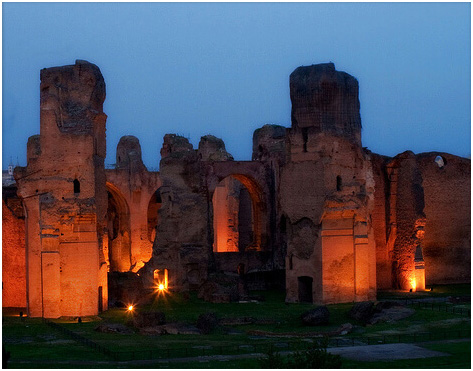
The Baths of Caracalla or Antoninian Baths were built by the Emperor Caracalla on the Aventine, between 212 and 217 A.D., as shown by the brick stamps. The external enclosure was, instead, the work of Elagabalus and Severus Alexander. Majestic and rich with precious ornaments, they were destined to the people of the nearby working-class quarters of the XII Regio and could contain about 1600 people. Polemius Silvius, in the V century, cited them as one of the seven wonders of Rome.

A unique complex

The baths were one of the favorite places of entertainment for the ancient Romans, where they regularly took care of their hygiene and improved their social relations.

From the structural point of view, they distinguished themselves from the “great imperial thermal baths” (a very common building typology, in fact, at the beginning of the V century A.D., there were 856 of them!) for a substantial novelty: the real thermal nucleus is clearly separated from all the other secondary and service rooms, that are not for bathing, which are located along the whole enclosure.

In the vast enclosure occupied by the Baths, citizens could not only use the public baths, but also devote their free time to sports, reading in the library, strolling through the gardens or paying homage to the god Mithras and other pagan gods by visiting the temple.

The Baths of Caracalla are an architectural and engineering marvel, especially when you consider their date of construction, with their water supply system, as well as heating and drainage. The wood-fired ovens, fed by slaves, were used to heat the floor and walls of the baths, as well as water.

The water supply was obtained from a branch of the Acqua Marcia: the Acqua Antoniniana, an aqueduct specially built in 212 A.D. and enhanced with a new spring. The heating of the water was provided by the fireplaces on the lower floors, the hypocaustics, which spread hot air in the cavities under the floor, supported by short brick pillars. Covered in marble and decorated with excellent works of art, those of Caracalla were the most sumptuous baths built in antiquity.

The thermal path
pianta Terme di Caracalla
Map of the Baths of Caracalla

One entered the central body of the building from four doors on the north-eastern facade. On the central axis you can observe different rooms in sequence: the calidarium, equipped with a large circular tank for immersion in hot water; here, to make the body absorb the moisture of vapors, the skin was sprinkled with water and a little soda, used instead of soap, cleansing with the strigilis, a metal scraper of curved shape suitable to remove the grease left on the skin by the combination of oils, ointments and sweat.

Continuing on, there was the tepidarium, equipped with tanks with lukewarm water to accustom the body slowly to the change in temperature, and then the frigidarium. This basilical hall (or cold room) is the focal point of the complex. Here the body was refreshed and invigorated, immersing itself in the four cold water tanks, placed at the corners of the room, which had to be covered. Finally, the natatio, where the ritual of bathing ended with a dip in the pool of very cold water.

At the sides of this central axis other rooms are arranged symmetrically around the two gyms. All the rooms were particularly well cared for and the spaces were enhanced with mosaic floors, walls covered with stuccoes, polychrome marble and, above all, hundreds of statues that decorated all the rooms. Sometimes special effects were also created. The mosaics, for example, often covered the interior and the bottom of the pools, perhaps with representations of fish and marine animals that the movement of the water made them seem alive!

ricostruzione
Reconstruction of the Baths of Caracalla

Tradotto da: https://archeome.it/archeologia-le-terme-di-caracalla-centro-benessere-dellantichita/

Pubblicabili da revisionare

ARCHEOLOGIA | Le Terme di Caracalla, centro benessere dell’antichità

Le Terme di Caracalla o Antoniniane furono edificate dall’imperatore Caracalla sull’Aventino, tra il 212 e il 217 d.C., come dimostrano i bolli laterizi. Il recinto esterno fu, invece, opera di Elagabalo e Alessandro Severo. Grandiose e cariche di ornamenti preziosi, furono destinate al popolo dei vicini quartieri popolari della XII Regio e potevano contenere circa 1600 persone. Polemio Silvio, nel V secolo, le citava come una delle sette meraviglie di Roma.

Un complesso unico nel suo genere

Le terme erano uno dei luoghi d’intrattenimento preferiti dagli antichi Romani, dove curavano regolarmente la loro igiene e miglioravano le proprie relazioni sociali.

Dal punto di vista strutturale, esse si distinguevano dalle “grandi terme imperiali” (una tipologia edilizia assai diffusa, difatti, agli inizi del V secolo d.C., se ne contavano 856!) per una sostanziale novità: il nucleo termale vero e proprio è nettamente separato da tutti gli altri ambienti secondari e di servizio, cioè non balneari, che sono dislocati lungo tutto il recinto.

Nel vasto recinto occupato dalle Terme, i cittadini potevano non soltanto utilizzare i bagni pubblici, ma dedicare anche il loro tempo libero allo sport, alla lettura in biblioteca, a passeggiare fra i giardini o rendere omaggio al dio Mitra e ad altre divinità pagane visitando il tempio.

Le Terme di Caracalla sono una meraviglia architettonica e d’ingegneria, soprattutto se si valuta la loro data di costruzione, con il loro sistema di rifornimento d’acqua, così come di riscaldamento e di drenaggio. I forni a legna, alimentati dagli schiavi, servivano per riscaldare il suolo e le pareti delle terme, oltre all’acqua.

L’alimentazione acquea fu ottenuta da un ramo dell’Acqua Marcia: l’Acqua Antoniniana, acquedotto appositamente costruito nel 212 d.C. e potenziato con una nuova sorgente. Al riscaldamento dell’acqua provvedevano i focolari nei piani inferiori, gli ipocausti, che diffondevano aria calda nelle intercapedini sotto il pavimento, sostenuto da corti pilastri di mattoni. Rivestite di marmo e decorate con eccellenti opere d’arte, quelle di Caracalla furono le terme più sontuose costruite nell’antichità.

Il percorso termale
pianta Terme di Caracalla
Pianta delle Terme di Caracalla

Si entrava nel corpo centrale dell’edificio da quattro porte sulla facciata nord-orientale. Sull’asse centrale si possono osservare in sequenza diversi ambienti: il calidarium, provvisto di una grande vasca circolare per immergersi nell’acqua calda; qui, per far assorbire dal corpo l’umidità dei vapori, ci si aspergeva la pelle con l’acqua e con un po’ di soda, utilizzata al posto del sapone, detergendosi con lo strigilis, un raschiatoio in metallo di forma arcuata adatto ad eliminare l’unto lasciato sulla pelle dalla combinazione di olii, unguenti e sudore.

Proseguendo vi era il tepidarium, dotato di vasche con acqua tiepida per abituare il corpo lentamente al cambio di temperatura, e il frigidarium. Questo salone basilicale (o sala fredda) è il punto focale del complesso. Qui si rinfrescava e rinvigoriva il corpo, immergendosi nelle quattro vasche di acqua fredda, poste agli angoli della sala, che doveva essere coperta. Infine, le natatio, dove si terminava il rito del bagno con un tuffo nella piscina d’acqua freddissima.

Ai lati di questo asse centrale sono disposti simmetricamente attorno alle due palestre altri ambienti. Tutte le sale erano particolarmente curate e gli spazi erano valorizzati con pavimentazioni in mosaico, pareti rivestite di stucchi, marmi policromi e, soprattutto, centinaia di statue che decoravano tutte le stanze. Talvolta si creavano anche effetti particolari. I mosaici, ad esempio, spesso rivestivano l’interno e il fondo delle vasche, magari con raffigurazioni di pesci e animali marini che il movimento dell’acqua faceva sembrare vivi!

ricostruzione
Ricostruzione delle Terme di Caracalla
English Version

THEATRE | The Greek pearl of Taormina, the Ancient Theatre

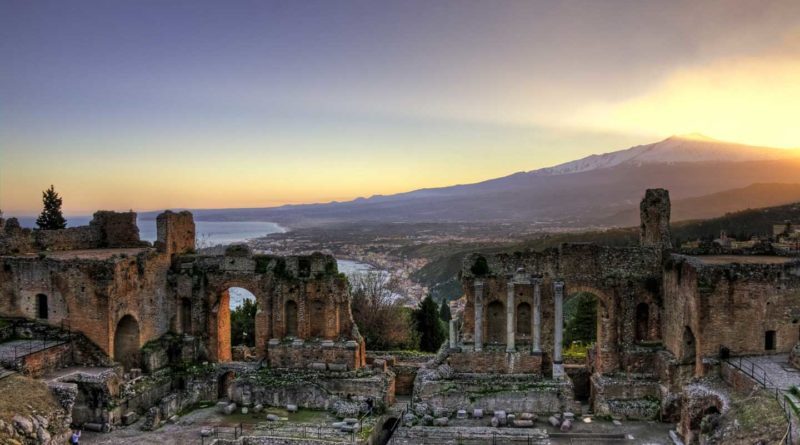
The Ancient Theatre of Taormina is the second largest ancient theatre in Sicily, after the one in Syracuse. 

It was probably built around the third century B.C., during the government of Hiero II, tyrant of Syracuse: this is testified by the engraving on some steps of the name of his wife, Philistis. The whole structure was later restored and enlarged in Roman times, more precisely in the imperial age: in fact, in the second century A.D. columns, statues and roofs were added.

The structure of the Ancient Theatre

Originally the theatre was composed only of a small central structure, then it reached a maximum diameter of 109 meters; it was also built the space for the orchestra with a diameter of 35 meters. The cavea had a capacity of 10,000 spectators (today 4,500) and is divided into 9 sectors. At the top of the steps there is a double portico, on the wall of which there are 36 niches, which probably in the past had housed some statues. In the late antique period the portico behind the scene was built with the three large openings, delimited by some niches and columns, brought back in situ in the 19th century by the architect Cavallari.

The Greek shows and the Roman venationes

During the late-imperial age, the theatre, born to host performances of tragedies and comedies, was intended for the performance of venationes. These were performances of gladiator and ferocious animal fights: the arena took the place occupied by the orchestra and the lower steps were replaced with a vaulted scenic corridor leading to a hypogeum in the center of the esplanade. From here gladiators were introduced and special effects machines were installed during the fight.

The Ancient Theatre today

The conformation of the Ancient Theatre of Taormina lends itself to many destinations. Since the ’50s it has hosted various forms of entertainment, from theatrical performances to concerts, from award ceremonies (such as the David di Donatello) to opera and ballet. Its season, being an open-air theatre, is mainly summer. It has hosted concerts by many contemporary artists such as Elton John, Mika, Duran Duran, Sting and Renato Zero, to name a few.

concert
Concert at the Ancient Theatre


The “Taormina Film Fest”, an international film festival that attracts VIPs from all over the world, deserves a mention.

A curiosity: in 2017 it was home to the G7 parade, the international intergovernmental economic organization composed of the seven major economic powers in the world.

The strengths

Why is the Ancient Theatre of Taormina the best known and most admired in the world?

Etna in eruption (Photo credits: ANSA/Carlo Papale)

It can be defined as a pearl set in a breathtaking scenery: behind the scene nature creates a spectacular backdrop with its colors; the blue of the sea meets the Etna massif, which not infrequently gives evocative scenery with its rivulets of lava; on the other side you can see Giardini Naxos, which in summer comes alive with lights and colors. Visiting it during summertime, at sunset, is an experience worth living.

Tradotto da: https://archeome.it/teatro-la-perla-greca-di-taormina-il-teatro-antico/