Autore: Redazione ArcheoMe

Pubblicabili da revisionare

DIETRO AL FASCISMO | Scipione l’Africano, il colosso d’argilla

Durante il ventennio fascista il teatro e, in particolare il cinema, dovevano adattarsi ad una nuova mentalità, quella del regime di massa. Uno degli esempi più importanti è sicuramente la produzione di “Scipione l’Africano”. Il film kolossal del 1936-1937, diretto da Carmine Gallone, esaltava la potenza imperiale di Roma identificata con quella fascista e sovrapponeva la figura di Mussolini vincitore sugli Etiopi a quella del condottiero romano.

Locandina di “Scipione l’Africano” (1936-1937)

Carmine Gallone, regista cosmopolita

Carmine Gallone fu definito dalla critica “regista cosmopolita” per i suoi lavori all’estero, svolti tra il 1926 e il 1935. Girò centinaia di film tra muto e sonoro. Ebbe grande padronanza delle innovazioni tecniche come il lungometraggio, il sonoro, il playback nei film d’opera, l’introduzione del colore e i cambiamenti di stile dai film veristi ai film storici.

Il regista Carmine Gallone

La trama di “Scipione l’Africano”

“Scipione l’Africano” ricostruiva le vicende della seconda guerra punica, dalla partenza di Scipione per l’Africa nel 207 a.C. alla battaglia di Zama del 202 a.C. Il console Scipione, adorato dal popolo romano, ottiene dal Senato il controllo della provincia di Sicilia e prepara la campagna militare contro l’esercito cartaginese. I veterani della battaglia di Canne raggiungono le truppe in partenza mentre un gran numero di volontari accorre da ogni parte. Nel frattempo, Annibale è bloccato nel Bruttium a causa della mancanza di viveri, così le sue truppe saccheggiano villaggi e raccolti. I soldati fanno irruzione nella villa di Velia, una nobile romana e la fanno prigioniera insieme al fidanzato Arunte e alla servitù. A Cirta, Sofonisba, la figlia di Asdrubale, spinge il marito Siface ad allearsi con i Cartaginesi. Scipione, dopo aver assediato Utica e sconfitto l’esercito di Asdrubale e Siface, si prepara ad affrontare Annibale, che lascia l’Italia per difendere Cartagine. Velia e Arunte riescono a fuggire e a raggiungere l’accampamento di Scipione. I due condottieri si affrontano, Scipione su un cavallo bianco, Annibale su di uno nero. Gli elefanti ostacolano i soldati romani, ma l’unione tra cavalleria e fanteria garantisce la vittoria. Annibale fugge insieme a pochi altri sopravvissuti mentre Scipione, avendo così vendicato la disfatta di Canne, fa ritorno a Roma, dove viene celebrato con una festa notturna.

Scena tratta da “Scipione l’Africano” (1937)

Il giudizio della critica

Scipione l’Africano” fu realizzato in dieci mesi di lavoro e costò circa otto milioni di lire. Costituiva il maggior sforzo organizzativo realizzato dall’industria cinematografica per l’impiego di masse, per la fastosità degli interni e per le imponenti ricostruzioni. Nonostante ciò, fu considerato dalla critica dell’epoca un totale fallimento per diversi motivi: rappresentava un film d’opera sia per la costruzione drammaturgica e le comparse (come il coro) che per la musica e la recitazione teatrale; non esisteva collaborazione tra i vari, anzi troppi, aiuto-registi; altri puntavano il dito contro la produzione e non il regista, considerato soltanto un coordinatore. Negativa era considerata l’interpretazione di Annibale Ninchi nel ruolo di Scipione, non amato dalla folla, poco carismatico. Non riusciva a trasportare sullo schermo la figura forte e audace del condottiero romano, al contrario del personaggio di Annibale interpretato da Camillo Pilotto.
La cattiva interpretazione della figura di Scipione accentuò di conseguenza il carattere melodrammatico del film. Si leggeva chiaramente la differenza con i kolossal americani, che erano basati su regole ferree e divisioni di compiti supervisionati dal produttore. Giudizi abbastanza duri su “Scipione l’Africano” si riscontravano anche nella critica moderna. Carlo Lizzani scriveva:

Scipione l’Africano è il classico colosso d’argilla che vorrebbe glorificare impossibili parentele fra fascismo e romanità. Tanto è ridondante il film, quanto provinciale e penosa l’illusione di Mussolini di rassomigliare ai Cesari.

Scipione l’Africano (1937). Carlo Nicchi, Fosco Giachetti, Francesca Bragiotti

Un progetto di stampo politico

Il film, voluto da Mussolini, doveva essere una sfida produttiva e spettacolare, in competizione con la cinematografia americana, e fu l’occasione per mettere in risalto la conquista d’Etiopia e l’impero coloniale nato ad opera del Duce. Scipione non doveva essere solo un film, ma un kolossal in grado di essere superiore a tutte le altre pellicole girate fino a quel momento. Il progetto Scipione era semplicemente un progetto a stampo politico, non era stato creato per lo spettacolo e Gallone, ingenuamente, accettò consigli e suggerimenti da tutti, soprattutto da coloro i quali vedevano il mondo del cinema e, in generale, dello spettacolo solo come un mezzo di propaganda per il consenso politico. Ciò spiegava il motivo per il quale Mussolini scelse come regista proprio Gallone: regista con esperienza, soprattutto estera, capace di adattarsi ad ogni circostanza e soprattutto politicamente accondiscendente.

Mussolini sul set del film

Mussolini come Scipione l’Africano

“Scipione l’Africano” era un film realizzato per celebrare i fasti dell’antica e della nuova Roma e due importanti personalità Scipione e Mussolini che, nonostante il divario cronologico, avevano compiuto la medesima impresa. Mentre Scipione aveva sconfitto una delle massime potenze della propria epoca, Mussolini aveva usato tecnologie avanzate per distruggere un esercito, sotto quel punto di vista, arretrato. Dopo la vittoriosa impresa africana, il fascismo si presentava come una nuova potenza imperiale. Una potenza che aveva cambiato le sorti dell’Italia, che da paese arretrato diveniva potenza economica e militare. L’impresa africana soddisfaceva le masse, perché in quelle regioni subalterne avrebbero trovato il lavoro e la terra che da tempo cercavano. Il continente africano era visto come un mito sognato da molto tempo e ottenuto solo grazie a Benito Mussolini. La vittoria africana risollevò il morale nazionalistico, ma sul piano storico ci furono esiti negativi in merito ai rapporti internazionali. L’Italia si andava allontanando dalle democrazie occidentali avvicinandosi sempre più alla Germania nazista di Hitler; la seconda guerra mondiale spazzerà via il ricordo delle conquiste coloniali, che erano state fin da subito paragonate alle conquiste dell’Impero Romano. Scipione era considerato un film che univa gli Italiani e che spronava al consenso politico nei confronti del fascismo e del Duce.

27 ottobre 1937. Il pubblico in attesa di assistere alla visione del film davanti al teatro Barberini di Roma

La contrapposizione tra società romana e cartaginese

La realizzazione di Scipione l’Africano portava inevitabilmente al lancio della figura del condottiero romano e, di conseguenza, Mussolini diveniva il massimo protagonista. La figura del Duce si caricava di un alone mistico, quasi di una luce divina. Il film inseriva al suo interno una notevole quantità di simboli e metteva anche in contrapposizione la società romana con quella cartaginese: i Romani erano presentati come modello di disciplina, mentre i cartaginesi come persone “odiose” che non rispettavano la tregua e feroci con le donne. La società cartaginese era priva di principi morali e dominata soltanto dal dio denaro, come al tempo di Mussolini era considerata l’Inghilterra. Al contrario, la società romana, dopo la presa del potere da parte di Scipione, era compatta e costruttiva, basata sul consenso popolare. Scipione come Mussolini, era considerato un predestinato, un capo naturale che aveva un rapporto privilegiato con il popolo.

Una classicità fasulla

Scipione fu un insuccesso su più fronti. Il film rappresentava la fine del filone dei “film di massa” e Garrone, nonostante la lunga e soddisfacente carriera rimarrà etichettato, per sempre, come il regista di Scipione l’Africano. La produzione di Scipione mostra come il mito di Roma antica sia stato largamente utilizzato dalla propaganda fascista e come sia stato modificato e plasmato secondo le sole idee di Mussolini. Un uso del passato, però, che rischiava di ridurre la storia a mito, che conduceva a una classicità fasulla, svuotata di contenuto e ridotta a semplice estetica celebrativa.

English Version

BEHIND THE FASCISM | Scipio the African, the clay giant

During the Fascist period, theatre and in particular cinema, had to adapt to a new mentality, that of the mass regime. One of the most important examples is certainly the production of Scipio the African. The blockbuster film of 1936-1937, directed by Carmine Gallone, exalted the imperial power of Rome identified with that of Fascism and superimposed the figure of Mussolini victorious over the Ethiopians on that of the Roman general.


Poster of Scipio the African (1936-1937)

Carmine Gallone, a cosmopolitan director

Carmine Gallone was defined by critics as a “cosmopolitan director” for his productions abroad, carried out between 1926 and 1935. He made hundreds of silent and sound films. He had great mastery of technical innovations such as feature films, sound, playback in opera films, the introduction of colour and style changes from realist to historical films.


The director Carmine Gallone

The plot of Scipio the African

Scipio the African reconstructed the events of the Second Punic War, from the departure of Scipio for Africa in 207 BC to the Battle of Zama in 202 BC. The consul Scipio, adored by the Roman people, obtains control of the province of Sicily from the Senate and prepares the military campaign against the Carthaginian army. Veterans of the Battle of Cannae join the departing troops as large numbers of volunteers flock from all over. Meanwhile, Hannibal is stuck in the Bruttium due to lack of food, so his troops plunder villages and crops. The soldiers break into the villa of Velia, a Roman noble and take her prisoner together with her fiancé Arunte and the servants. In Cirta, Sofonisba, the daughter of Hasdrubal, pushes her husband Syphax to ally with the Carthaginians. Scipio, after having besieged Utica and defeated the army of Hasdrubal and Syphax, prepares to face Hannibal, who leaves Italy to defend Carthage. Velia and Arunte manage to escape and reach Scipio’s camp. The two generals face off, Scipio on a white horse, Hannibal on a black one. Elephants hinder Roman soldiers, but the union of cavalry and infantry guarantees victory. Hannibal escapes along with a few other survivors while Scipio, having thus avenged the Battle of Cannae, returns to Rome, where he is celebrated with a night party.


Scene from Scipio the African (1937)

The critics’ opinion

The making of Scipio the African was done in ten months of work and cost about eight million lire. It constituted the greatest organizational effort made by the film industry for the use of masses, for the splendour of the interiors and for the impressive reconstructions. Despite this, it was considered by the critics of the time a total failure for several reasons: it represented an opera film both for its dramaturgical construction and extras (such as the choir) and for its music and theatrical acting; there was no collaboration between the various, indeed too many, assistant directors; others pointed the finger at the production and not the director, considered only a coordinator. The interpretation of Annibale Ninchi in the role of Scipio was considered negative, not loved by the crowd, not very charismatic. He could not bring the strong and daring figure of the Roman leader onto the screen, unlike the character of Hannibal played by Camillo Pilotto. The bad interpretation of the figure of Scipio consequently accentuated the melodramatic character of the film. The difference with the American blockbusters, which were based on strict rules and divisions of tasks supervised by the producer, was clear. Hard enough judgments on Scipio the African were also found in modern criticism. Carlo Lizzani wrote:

Scipio the African is the classic clay giant who would like to glorify impossible relationships between fascism and Roman times. The film is as redundant as it is provincial and painful is Mussolini’s illusion of resembling the Caesars.

Scipio the African (1937). Carlo Nicchi, Fosco Giachetti, Francesca Bragiotti

A political project

The film, wanted by Mussolini, had to be a productive and spectacular challenge, in competition with American cinema, and it was an opportunity to highlight the conquest of Ethiopia and the colonial empire created by the Duce. Scipio was not supposed to be just a film, but a blockbuster capable of being superior to all the other films shot up to that moment. The Scipio project was simply a political project, it was not created for the show and Gallone, naively, accepted advice and suggestions from everyone, especially from those who saw the world of cinema and, in general, of the show only as a propaganda medium for political consensus. This explained the reason why Mussolini chose Gallone as his own director: a director with experience, especially foreign, able to adapt to any circumstance and above all politically compliant.


Mussolini on the set of the film

Mussolini as Scipio the African

Scipio the African was a film made to celebrate the glories of ancient and new Rome and two important personalities: Scipio and Mussolini who, despite the chronological gap, had accomplished the same feat. While Scipio had defeated one of the greatest powers of his time, Mussolini had used advanced technologies to destroy a backward army, from that point of view. After the successful African feat, fascism presented itself as a new imperial power. A power that had changed the fate of Italy, which from a backward country became an economic and military power. The African feat pleased the masses, because in those subaltern regions they would find the job and land they had long sought. Africa was seen as a long-dreamed myth and achieved only thanks to Benito Mussolini. The African victory raised nationalist morale, but on the historical level there were negative outcomes with regard to international relations. Italy was moving away from Western democracies, getting closer and closer to Hitler’s Nazi Germany; the Second World War will sweep away the memory of the colonial conquests, which were immediately compared to the conquests of the Roman Empire. Scipio was considered a film that united the Italians and spurred political consensus towards Fascism and the Duce.


27 October 1937. The audience waiting to watch the film in front of the Barberini Theatre in Rome

The contrast between Roman and Carthaginian society

The creation of Scipio the African inevitably led to the launch of the figure of the Roman leader and, consequently, Mussolini became the main protagonist. The figure of the Duce was charged with a mystical halo, almost a divine light. The film inserted within it a considerable amount of symbols and also put Roman society in contrast with the Carthaginian one: the Romans were presented as a model of discipline, while the Carthaginians as hateful people who did not respect the truce and were ferocious with women. Carthaginian society was devoid of moral principles and dominated only by the god of money, as England was considered in the time of Mussolini. On the contrary, Roman society, after Scipio’s seizure of power, was compact and constructive, based on popular consensus. Scipio like Mussolini, was considered a predestined, a natural leader who had a privileged relationship with the people.


A bogus classicism

Scipio was a failure on several fronts. The film represented the end of the film made for the masses trend and Garrone, despite his long and satisfying career, will remain forever labelled as the director of Scipio the African. Scipio’s production shows how the myth of ancient Rome was widely used by fascist propaganda and how it was modified and shaped according to Mussolini’s ideas only. A use of the past, however, that risked reducing history to a myth, leading to a bogus classicism, emptied of content and reduced to a simple celebratory aesthetic.

https://archeome.it/wp-admin/post.php?post=8472&action=edit

Pubblicabili da revisionare

ARCHEOLOGIA | L’area archeologica di Fiesole (FI)

Gli scavi nell’area archeologica di Fiesole comprendono un teatro romano, le terme, un tempio etrusco-romano e un museo archeologico, che custodisce reperti datati dal III sec. a.C. al II sec. a.C.

L’area archeologica, delimitata a nord dalle mura etrusche, conserva le tracce della storia fiesolana: sul tempio etrusco di IV secolo a.C. i Romani, dopo aver conquistato la città nel I secolo a.C., costruirono un altro tempio e arricchirono l’area con il teatro e le terme. Presso la zona sacra del tempio, una necropoli testimonia il successivo utilizzo dell’area.

Il Teatro romano

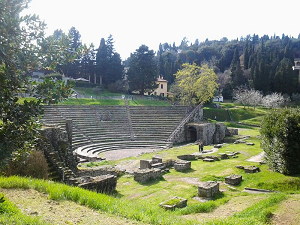
Costruito tra l’inizio del I secolo a.C. e gli inizi del I d.C., è stato il primo edificio dell’area a destare interesse e ad essere scavato: le sue rovine devono essere sempre state visibili, se nel Medioevo e nei secoli successivi il luogo veniva indicato dai paesani come “Buca delle Fate”, a testimonianza dei suggestivi racconti che volevano che le Fate Fiesolane, simbolo di un tempo felice, si fossero nascoste in oscure cavità sottoterra, per non vedere l’orribile scempio che fecero i Fiorentini dopo aver conquistato la città nel 1125.

Nel 1809 il Barone prussiano Friedman von Shellersheim, scavando alla ricerca di oggetti preziosi, sostenne di aver trovato presso le antiche strutture del teatro due ricchi corredi, ma la notizia rimane difficilmente verificabile. Gli scavi per la messa in luce del teatro furono ripresi in modo sistematico nel 1870 e si conclusero tra il 1882 e il 1900, con la ricostruzione della parte sinistra delle gradinate (cavea), anche in vista della fruizione da parte del pubblico.

L’edificio si presentava con un’ampia cavea semicircolare, ricavata in parte nella roccia della collina, e quattro vomitoria, da cui si accedeva alla galleria crypta coperta, che doveva sostenere un porticato o un altro ordine di posti, del quale, però, non rimangono tracce. La cavea era divisa in quattro settori per mezzo di strette scalette, che permettevano al pubblico di prendere posto più facilmente. In basso si trova l’orchestra e, di fronte, lo spazio dedicato alla rappresentazione teatrale; un muro con nicchia centrale, il pulpitum, delimitava frontalmente il palcoscenico, proscenium, dietro al quale si ergeva la scaena frons, di cui non rimangono strutture architettoniche, ma solo la fondazione e alcune decorazioni marmoree.

Le Terme

Dietro al teatro vi sono i ruderi delle terme, risalenti ai tempi di Silla (I secolo a.C.), restaurate ed ingrandite in epoca adrianea. Furono scoperte nel 1891, quando, finalmente, si poté dare una funzione alle tre arcate da sempre visibili: esse, difatti, costituivano la terrazza delle terme verso valle.

Le terme si trovano lungo le mura e sono costituite dai tre classici ambienti del calidarium, tepidarium e frigidarium, più altre vasche e stanze. Una piscina rettangolare e due vasche (una delle quali a immersione) servivano per i bagni pubblici: sul loro fondo furono trovate molte anfore, usate per depurare l’acqua, raccogliendo le impurità che andavano a fondo.

Si trovano i resti di locali per il riscaldamento dell’acqua e la produzione di vapore, che, a mezzo di condutture di piombo o di terracotta, si distribuiva nei vari locali. Nel calidarium, caratterizzato dal pavimento in cocciopesto, arrivava acqua bollente, mentre nel tepidarium (costituito da tre vasche) era raccolta l’acqua tiepida e, infine, nel frigidarium si trovava acqua fredda; il frigidarium è suddiviso da una struttura ad archi (che è stata ricostruita) che ha una forma semicircolare e si trova accanto alle latrine. Forse esisteva anche un criptortico che separava le vasche. Alcune delle strutture sono state ricostruite in seguito agli scavi.

Il Tempio

Il tempio etrusco-romano venne costruito tra la seconda metà del IV secolo a.C. e il II sec. a.C., sebbene l’area fosse in uso per rituali sacri almeno dal VII secolo a.C. Fu scavato all’inizio del Novecento e molto probabilmente corrisponde all’antico Capitolium fiesolano.

La cella è la parte più antica ed è divisa in tre parti: ciò ha fatto supporre che il tempio fosse dedicato a Giove, Giunone e a Minerva (quest’ultima attribuzione quasi certa, come suggerirebbe un bronzetto ellenistico raffigurante un gufo trovato nei paraggi e ora esposto nel museo). Davanti al tempio c’è una piccola ara in pietra arenaria decorata (IV secolo a.C. – III secolo a.C.). In epoca repubblicana il tempio venne ricostruito, innalzato e ingrandito sia sulle ali che sulla parte frontale, in parte riutilizzando le murature dell’edificio precedente. La gradinata, ben conservata, ha sette scalini e giunge allo stilobate su cui sorgevano le colonne del portico, sormontato dal frontone del tempio. La parte più lunga dello stilobate fa supporre che il porticato allacciasse il tempio al Collegium.

A sinistra si vedono le basi di tre colonne residue del porticato che circondava la cella. Fra questi ruderi sono state ritrovate monete di bronzo e d’argento (III secolo a.C. – X secolo d.C.). In questo luogo, inoltre, sono stati ritrovati i resti di un sepolcreto barbarico di epoca longobarda (VII-VIII secolo d.C.), costruito su un’area della cella, e i ruderi di un tempio cristiano, sorto sui resti di quello pagano intorno al III secolo d.C.


English Version

ARCHAEOLOGY | The archaeological area of Fiesole – Florence

The excavations in the archaeological area of Fiesole include a Roman theatre, the baths, an Etruscan-Roman temple and an archaeological museum, which houses finds dating from the third century BC to the second century BC

The archaeological area, bordered to the north by the Etruscan walls, preserves traces of Fiesole history: on the Etruscan temple of the 4th century BC, the Romans, after having conquered the city in the 1st century BC, built another temple and enriched the area with theatre and baths. Near the sacred area of the temple, a necropolis show the subsequent use of the area.


Roman Theatre

Built between the beginning of the first century BC and the beginning of the first century AD, it was the first building in the area to arouse interest and to be excavated: its ruins must have always been visible, if in the Middle Ages and in the following centuries the place was indicated by the villagers as “Buca delle Fate”, as evidence of some suggestive stories telling the Fairies of Fiesole, symbol of a happy time, had hidden themselves in dark cavities underground, in order not to see the horrible havoc that the Florentines made after having conquered the city in 1125.

In 1809 the Prussian Baron Friedman von Shellersheim, digging in search of precious objects, claimed to have found two rich sets in the ancient layouts of the theatre, but the news remains difficult to verify. The excavations for bringing the theatre to the light were systematically resumed in 1870 and ended between 1882 and 1900, with the reconstruction of the left side of the steps (cavea), also in view of public use.

The building had a large semicircular cavea, partly carved into the rock of the hill, and four main entrances (vomitoria), which gave access to the covered crypta gallery, which was to support a portico or another order of seats, of which, however, no traces remain. The cavea was divided into four sectors by means of narrow stairs, which allowed the public to take place more easily. Below is the orchestra and, opposite, the space dedicated to the theatrical representation; a wall with a central niche (the pulpitum) frontally delimited the stage (proscenium), behind which stood three doored stage front (the scaena frons), of which no architectural layouts remain, but only the foundation and some marble decorations.


The Roman Baths

Behind the theatre there are the ruins of the baths, dating back to Sulla’s times (1st century BC), restored and enlarged in the Hadrian period. They were discovered in 1891, when, finally, it was possible to let three arches operating that have always been visible: they, in fact, constituted the terrace of the baths towards the valley.

The baths are located along the walls and consist of the three classic rooms of the calidarium, tepidarium and frigidarium, plus other tubs and rooms. A rectangular pool and two basins (one of which immersed) were used for public baths: on their bottom many amphorae were found, used to purify the water, collecting the impurities that went to the bottom.

There are the remains of rooms for water heating and the production of steam, which was distributed in the various rooms by means of lead or terracotta pipes. In the calidarium, characterized by the cocciopesto floor, boiling water arrived, while in the tepidarium (consisting of three basins) lukewarm water was collected and, finally, in the frigidarium there was cold water; the frigidarium is divided by an arched layout (which has been rebuilt) which has a semicircular shape and is located next to the latrines. Perhaps there was also a cryptorticus that separated the basins. Some of the layouts were rebuilt following excavations.


The Temple

The Etruscan-Roman temple was built between the second half of the fourth century BC and the second century BC, although the area was in use for sacred rituals at least from the 7th century BC. It was excavated at the beginning of the 20th century and most likely corresponds to the ancient Fiesolano Capitolium .

The cell is the oldest part and is divided into three parts: this has led us to suppose that the temple was dedicated to Jupiter, Juno and Minerva (the latter is an attribution almost certain, as suggested by a Hellenistic bronze depicting an owl found nearby and now exhibited in the museum). In front of the temple there is a small decorated sandstone altar (4th century BC – 3rd century BC). In the Republican era the temple was rebuilt, raised and enlarged both on the wings and on the front, partly by reusing the walls of the previous building. The staircase, well preserved, has seven steps and reaches the stylobate on which stood the columns of the portico, surmounted by the pediment of the temple. The longest part of the stylobate suggests that the portico connected the temple to the Collegium.

On the left you can see the bases of three residual columns of the portico that surrounded the cell. Among these ruins were found bronze and silver coins (3rd century BC – 10th century AD). In this place, moreover, the remains of a barbarian burial ground from the Lombard period (7th-8th century AD) were found, built on an area of the cell, and the ruins of a Christian temple, built on the remains of the pagan one around the 3rd century AD

https://archeome.it/wp-admin/post.php?post=8701&action=edit

Pubblicabili da revisionare

NEWS | Nuove ipotesi per la lettura del complesso di Iulia Felix a Pompei

Risale al periodo ellenistico (III-II sec. a.C.) l’urbanizzazione nell’enigmatica area dei Praedia di Iulia Felix
I praedia di Iulia Felix

I Praedia di Iulia Felix sono un complesso situato nella Regio II a Pompei, da alcuni anni oggetto di ricerche archeologiche dell’Università di Pisa e della Scuola IMT Alti Studi di Lucca. I Praedia sono composti da un’abitazione privata (domus), un giardino con fontane, terme e un vasto parco. Il sito è molto importante: infatti, è collocato in un settore delimitato da una porta urbica, dalla necropoli di Porta Nocera, dall’Anfiteatro e dall’arteria stradale più importante della città, via dell’Abbondanza.

Le ultime scoperte

Durante la terza campagna di scavo, che si è conclusa pochi giorni fa, gli archeologi hanno fatto più chiarezza sul sito. Se gli scavi precedenti avevano portato alla luce la fase di prima età imperiale, quest’ultimo scavo ha aperto diversi orizzonti di indagine. Nella zona settentrionale del parco si è rinvenuta traccia di una più antica lottizzazione dell’area, certamente databile al periodo ellenistico. Questo dà la conferma che, prima dei praedia, ci fosse un più articolato assetto urbano. Il recupero di materiali votivi di età arcaica e classica impone anche una riflessione relativa ai luoghi di culto nelle fasi più antiche di Pompei.

Ulteriori informazioni sono disponibili sul sito del progetto, la pagina Instagram e Twitter.

PraediaProject: un prezioso contributo all’edilizia domestica di Pompei

Dal 2016 l’Università di Pisa ha avviato lo scavo dell’area dei Praedia di Giulia Felice. Il progetto Praedia, acronimo di Pompeian Residential Architecture Enviromental, Digital and Interdisciplinary Archive, si è svolto in collaborazione con il Parco Archeologico di Pompei, il Laboratorio Smart della Scuola Normale Superiore di Pisa (Sns) e l’Istituto Nazionale di Geofisica e Vulcanologia (Ingv). Lo scopo è quello di indagare il settore dell’edilizia domestica di Pompei con un approccio multidisciplinare. Coordinatori del progetto sono Riccardo Olivito, ricercatore presso gli Alti Studi di Lucca, e Anna Anguissola, professoressa presso l’Università di Pisa e collaboratrice col laboratorio LARTTE nell’ambito del progetto “Solone”.

BIBLIOGRAFIA

Paesaggi domestici. L’esperienza della natura nelle case e nelle ville romane Pompei, Ercolano e l’area vesuviana, a cura di A. Anguissola, M. Iadanza, R. Olivito, Roma, L’Erma di Bretschneider 2020, Studi e Ricerche del Parco Archeologico di Pompei, 42

English Version

THEATRE | Contemporary theatre and theatrical pedagogy. Tribute to Gigi Proietti

The experiments of the twentieth century led to the evolution of the theatrical medium, from staging a show to a powerful personal training tool, primarily for the actor.

The educational power of the theater has been the subject of study and, to date, is increasingly applied in the pedagogical and scholastic fields. The peculiarity of theatrical art is to involve the individual in his entirety as a person: his physicality and plasticity, his emotional sphere, necessary to impregnate the scenic gesture with truth and, last but not least, its moral sphere and scale of values he believes in.

The actor is first of all a human being, stripped naked on stage, who communicates with other human beings in the audience. It has something to tell, which unites everyone in the condition of men: the conflict and the emotions that are experienced in everyday life.


The Theatre – Education

In this sense, the phase dedicated to the laboratory becomes fundamental and grows in importance. The staging of the show is not the aim.

The purpose of the theatre is to lead the actor, child or adult, to discover himself, his abilities and his limits, and communicate and express himself in front of others.

During the twentieth century the figure of the actor became central, he is subject as much as the text. What interests us is the study of the person and the sphere of emotions. From Freud’s psychoanalysis to Stanislavski and Barba’s trainings, everything has shifted the focus of attention on man as such.


The Theatrical Pedagogy

The theatre mixes with the human sciences, with which it interpenetrates. Pedagogy places the human being at the center of its studies, with the aim of bringing it to growth in order to express all its abilities.

The conviction of pedagogical research is that each person has his own potential, of which he is not always aware, and the pedagogue’s task is to work to bring to light the possibilities of the individual, in a path aimed at knowledge and self-conquest.

In the theatrical field, the actor, with the help of the director and the training, is encouraged to express his personality and to grow by activating his own expressive and creative means, in an individual path, but inserted in a group. The goal is the individual, but the journey takes place in the relationship with the other, different in its uniqueness.

Often the identity of the group is strengthened, in a climate of mutual respect and listening, whose path is common; it behaves like a flock of birds that move in harmony according to nature and, inside which each specimen is unique and occupies its place, free to move in flight: all together contribute to the enchantment of the dance in the sky.

The company of actors, or rather the ensemble of the group, is stimulated to mutual knowledge, cooperation and sharing. It is an exciting, highly educational and creative path. Heterogeneity is not a weakness, but a strength: this is why it is valued. The director moves the ranks and leads the ensemble in the right direction.

In this sense, he goes from a mere director of a show to a teacher. The director-teacher must also be a theatrical pedagogist, in order to listen to the students and lead them to their full potential.

The Theatre goes off the stage and enters the schools

In recent years, the MIUR has recognized theater as having its powerful educational, pedagogical and didactic value, including it in all respects among the activities to be proposed at school.

In addition to insert a workshop at school, this translates into bringing schoolchildren to the theatre, to experience the workshop in which each child can have their say and give voice to their emotions.

The benefits are on multiple levels, as they embrace the child’s intellectual, rational and emotional sphere, his logical, symbolic and creative thinking. All inserted in a group context, with the rules to follow for the respect of the other, thus learning to live in sociality.

The child feels welcomed, accepted in his uniqueness and stimulated to think outside the box. Everyone feels safe in being able to have their say without fear of being judged.

Cultivating such an inclusive and assertive environment brings enormous benefits to the growth and training of tomorrow’s adults, in a society where standardization is king, where today’s adults have very often stopped communicating face to face and emotions they are censored and diversities marginalized or banned.


“Welcome to the Theatre, where everything is fake but nothing is fake”: Tribute to Gigi Proietti

The world of the theatre mourns the disappearance of a sacred monster of the stage: Gigi Proietti passed away on the day he would have turned 80, over 50 of which he spent on the Italian stage.

Proietti has profoundly marked the history of national contemporary theater. A multifaceted artist, he has ranged from theater, his first and unattainable love, to cinema, TV and dubbing, giving his voice to numerous extraordinarily different characters. We must acknowledge his talent for engaging in varied expressive channels, always keeping his style high: comic, dramatic, original and never vulgar. He was able to distinguish himself for the refinement and, at the same time, the sincerity of his acting, because, as he once said: “In the theater everything is fake but nothing is fake”. Thanks Gigi!!


Pubblicabili da revisionare

NEWS | Neonati oggi come 70mila anni fa, lo studio rivoluzionario sui Neanderthal

I Neanderthal iniziavano lo svezzamento dei loro neonati intorno al quinto o sesto mese d’età, un periodo del tutto simile a quanto avviene per l’uomo moderno. Ciò emerge dall’analisi di tre denti da latte appartenuti a bambini vissuti tra 70.000 e 45.000 anni fa nell’Italia nord-orientale, teatro di altre recenti scoperte sui Neanderthal.

I tempi dello svezzamento

Le linee di accrescimento sui tre denti digitalizzati

In modo simile a quanto avviene negli alberi, infatti, il processo di crescita dei denti produce delle linee di accrescimento dalle quali è possibile ottenere informazioni attraverso analisi istologiche. Combinando queste informazioni con i dati sulla composizione chimica, gli studiosi sono riusciti a stabilire che i bambini a cui sono appartenuti i denti hanno iniziato a mangiare cibo solido tra i cinque e i sei mesi d’età.

“Se facciamo un confronto con altri primati è molto probabile che l’alto livello di risorse energetiche richiesto per il processo di crescita del cervello umano porti alla necessità di una precoce introduzione di cibi solidi nella dieta dei neonati” Federico Lugli, ricercatore dell’Università di Bologna e co-autore dello studio

Neanderthal e Sapiens, non così diversi

Queste nuove informazioni permettono di escludere che il numero ridotto della popolazione dei Neanderthal potesse essere legato a tempi di svezzamento più lunghi rispetto a quelli dell’Homo Sapiens.

“I risultati di questo studio mostrano che i Neanderthal e l’Homo Sapiens condividono una richiesta energetica simile nel corso della prima infanzia e un simile ritmo di crescita. Questi elementi suggeriscono che i neonati di Neanderthal dovevano avere un peso simile a quello dei nostri neonati: ciò indicherebbe anche una simile storia gestazionale, un simile processo di sviluppo nelle prime fasi di vita e forse anche un possibile intervallo tra le gravidanze più breve di quanto si è pensato finora” Stefano Benazzi, professore dell’Università di Bologna, tra i coordinatori dello studio

I Neanderthal non erano, poi, grandi viaggiatori…

Insieme alle informazioni sulla dieta e sul processo di crescita dei bambini, l’analisi dei reperti ha permesso di ottenere anche indicazioni sugli spostamenti dei gruppi di Neanderthal che abitavano tra le attuali provincie di Vicenza e Verona presso il Riparo del Broion.

L’analisi degli isotopi dello stronzio presenti nei denti studiati indica, infatti, che questi bambini hanno passato gran parte del tempo nelle vicinanze del loro luogo di origine: un comportamento che denota una mentalità moderna, collegata probabilmente ad un utilizzo attento delle risorse che avevano a disposizione in quella ricca regione, nonostante l’abbassamento generalizzato delle temperature in quel periodo.

Lo studio è stato pubblicato sulla rivista PNAS con il titolo Early life of Neanderthals. Vi hanno partecipato studiosi di diversi enti ed istituti: Università di Bologna, University of Kent (Regno Unito), Goethe University Frankfurt (Germania), Università di Ferrara, Università di Modena e Reggio Emilia, Istituto di Geologia Ambientale e Geoingegneria (IGAG–CNR), Centro Internazionale di Fisica Teorica “Abdus Salam”, Università di Firenze, Sapienza Università di Roma, Natural History Museum of London (Regno Unito).

Pubblicabili da revisionare

NEWS | Dal Parlamento l’ok per la riproduzione delle foto di Beni Culturali

Il Parlamento si è espresso totalmente favorevole, ma tarda l’approvazione del Mibact.

Il Parlamento è sul punto di approvare finalmente il libero riutilizzo delle immagini di beni culturali nel pubblico dominio. Questo importante traguardo è la conseguenza delle pressioni e dell’opera di sensibilizzazione di Wikimedia Italia, di ANAI, Associazione Italiana Biblioteche – AIB e ICOM Italia. Finora, infatti, non era possibile scattare né pubblicare una foto di un bene pubblico fatta in un luogo d’arte. Ad impedirlo era l’articolo 108 del Codice dei Beni Culturali e del Paesaggio. 

Con il nuovo Decreto cultura, firmato dal Consiglio dei Ministri lo scorso 22 maggio, viene ammessa la possibilità di effettuare liberamente foto all’interno dei musei con qualsiasi dispositivo elettronico. 

Il Decreto Cultura rende libera la riproduzione di beni culturali. Questo è lecito, purché non ci sia contatto fisico con il bene, né l’esposizione dello stesso a sorgenti luminose (flash o illuminazione artificiale), né l’uso di stativi o treppiedi. E’ libera anche la divulgazione, con qualsiasi mezzo, delle immagini di beni culturali. Tutto questo è possibile se e solo se viene fatto senza scopo di lucro. Questo decreto rende molto più facile la vita a tantissimi studenti, ricercatori, tesisti e amanti del sapere. La riproduzione e divulgazioni di beni culturali pubblici è, infatti, essenziale per lo studio e la ricerca, così come per la manifestazione del pensiero e la promozione della cultura.

English Version

ARCHAEOLOGY | The Archaeological Site of Contrada Diana

The Archaeological Site of Contrada Diana is located in Lipari, in a plain south of the Vallone Ponte and north of the Vallone S. Lucia. The large fenced area near the Palazzo Vescovile, bounded to the south by the former via Diana (now via G. Marconi), and other small adjacent archaeological sites belong to the main unearthed park. The entire archaeological area was established in 1971 by the then Superintendence of Antiquities of Eastern Sicily. In 1987, however, following the birth of the Superintendency of Cultural Heritage in Messina, it became the archaeological heritage of the province of Messina.

Systematic archaeological excavations have been carried out since 1948. For about twenty years, starting in 1954, the investigations were led by Luigi Bernabò Brea and Madeleine Cavalier, who helped found the site and, above all, the Archaeological Museum. The entire area of the site preserves memory of the entire history of the island and has returned evidence of the prehistoric, Greek and Roman age. Among these, of particular interest are the Greco-Roman necropolis and the remains of the city walls, to which are added two thermal complexes.

The necropolis of Contrada Diana

The heart of the Archaeological Site of Contrada Diana is the large necropolis. The first site to be excavated, for over sixty years of excavation it has yielded nearly 3,000 burials. The tombs were neatly arranged, in rows, and superimposed on several orders: the most recent, in fact, are located above the older ones. All the burials have a kind of N-S orientation and each of them was accompanied by an internal and an external furnishing. Eight types of burials have been identified: they are mainly burials in sarcophagi, more rarely in defunctionalized amphorae. The external furnishing, first placed inside a large vase, starting from the middle of the 4th century BC, is placed inside a shell of raw clay. In the imperial age, from the 1st to the 5th century AD, in addition to the reuse of old Greek burials, the tombs also took on a monumental form with enclosures and familiar hypogea.

The funeral rite was mixed and included both burial and cremation, with a clear prevalence of the first over the second. The rich grave goods, preserved inside the Aeolian Regional Archaeological Museum, were composed of figured and non-figured ceramics, metal jewels and objects, terracotta statuettes and masks, which reproduce characters from Greek and Roman comedy and tragedy.

The Walls

Archaeological excavations have brought to light the remains of two city walls, one dating back to the period of the first foundation and the other to the reconstruction of the mid-4th century BC. The oldest walls were found in 1954, under what is now Piazza Luigi Savior of Austria. These are polygonal walls, with large blocks of perfectly hewn lava stone, built with the aim at protecting the Greek settlement, which extended between the Civita hill and the Castle.

What is visible in Contrada Diana is the reconstruction of the first half of the fourth century BC: it is a 50 m long stretch, which highlights the presence of square protective towers. The new and wider curtain was adapted to the expansion of the Greek town. This second construction technique involved a filling of compact stones, lined, on both sides, with isodomic blocks of stone coming from Monte Rosa di Lipari.

With the arrival of the Romans, the Greek city was destroyed and obliterated by the remains of the Roman reoccupation. In the second half of the 1st century BC, the citizens built a new parallel line of fortification, which is 6.50 m from the previous one: it is the agger of Sesto Pompeo, an irregularly shaped work, composed only of dry stone and blocks of bare. The new walls were part of the fortifications commissioned by Sextus Pompeius during the civil war of 36 BC against Octavian. The walls, as well as the necropolis, are implanted in an area that had been the seat of the prehistoric village, pertaining to the culture of Capo Graziano: in fact, they cut the remains of ancient oval huts, built with the technique of the wall dry.


The Roman Baths

Besides, the Roman Baths are added of via Mons. Bernardino Re and via Franza. The first is located almost in front of Palazzo Vescovile and shows the remains of public spaces, with floor mosaics and drainage channels, dating back to the imperial age. Furthermore, the remains of a horseshoe-shaped tank, the frigidarium, and some adjacent spaces referred as tepidarium and calidarium are clearly visible. In via Franza, nestled in what scholars interpret as a working district, there is a more modest spa building. This is made up of three rooms, equipped with a cocciopesto floor, one of which, due to the presence of the characteristic tile columns under the floor, has been recognized as a calidarium. This second spa building dates back to the late imperial age.

https://archeome.it/wp-admin/post.php?post=3149&action=edit


Area of the Archaeological Site of Contrada Diana and Lipari Castle

Archivio

NEWS | Scoperto un complesso insediamento preistorico a Montecilfone (CB)

Dallo scavo l’insediamento risulta abitato in modo continuo dall’età preistorica a quella medievale.

Dal sito archeologico nel Comune di Montecilfone, tuttora in fase di scavo, stanno emergendo interessanti scoperte. Come riportano il Sindaco Giorgio Manes e la Soprintendenza archeologica del Molise, gli archeologi hanno già identificato l’esistenza di un insediamento antico, con una stratificazione complessa. Il luogo è rimasto attivo e abitato per un periodo molto esteso, che va dalla preistoria all’età medievale.

Lo scavo archeologico è preventivo: gli archeologi hanno iniziato le indagini in occasione dei lavori per la realizzazione del metanodotto Larino-Chieti. La Soprintendenza Archeologica Belle arti e Paesaggio del Molise, la cui Direttrice è la Dottoressa Dora Catalano, ha la direzione scientifica dello scavo.

I risultati dello scavo

Lo scavo, ancora da completare, ha già dato molti frutti. Tra i rinvenimenti di particolare interesse vi sono un tracciato viario, i resti di un tempio di età romana e due fornaci a pianta rettangolare. In particolare, le fornaci si sovrappongono a un abitato databile all’età preistorica, epoca risalente all’8.000 a.C. Durante lo scavo gli archeologi hanno anche trovato la sepoltura di un infante di età neolitica: insieme allo scheletro sono stati rinvenuti un corredo vascolare e i resti di due ovini.

La scoperta è di grande spessore storico e culturale, perché testimonia l’antica origine della popolazione del territorio. Per questo il Comune di Montecilfone ha avviato già alcuni progetti in vista della creazione di un complesso museale: il fine è quello di valorizzare e tutelare il sito, nonché di conservare i reperti, sia quelli già scoperti, sia quelli futuri.