Autore: Redazione ArcheoMe

Pubblicabili da revisionare

NEWS | Viaggio indietro nel tempo, l’invito di Maiuri agli scavi di Paestum

Giugno 1931. Il Prefetto di Salerno invita gli amministratori della provincia alla conferenza sui “Nuovi scavi di Paestum“, tenuta dall’allora Soprintendente Amedeo Maiuri.

È quello che si legge nel documento custodito dalla famiglia Soprani da circa 90 anni, la figlia Enrica lo ha voluto condividere con Gabriel Zuchtriegel, direttore del Parco Archeologico di Paestum e Velia.

“Durante il periodo di lockdown, io e mio fratello Leopoldo abbiamo deciso di fare ordine in un deposito dove da anni accumuliamo cose. In una cassa metallica ben chiusa abbiamo trovato alcuni documenti degli anni ’30 e ’40 conservati da nostro papà Antonio, classe 1909, nato a Ravenna, ma trasferitosi definitivamente a Salerno per amore di nostra madre. Con estremo piacere ho pensato di consegnare al direttore di Paestum l’originale dell’invito del Prefetto per l’incontro con il prof. Maiuri nella certezza che avrebbe saputo valorizzare un ricordo di famiglia per noi così importante” – ricorda la giornalista Enrica Soprani.

Maiuri e Paestum, l’inizio di tutto

L’invito ha aperto una finestra temporale sulla prima stagione degli scavi archeologici a Paestum, la grande scoperta dei primi anni Trenta riguardò la grecità con il rinvenimento del Santuario di Hera e delle sue spettacolari metope. Alcuni anni dopo iniziò la progettazione del nuovo museo di Paestum, interrotta dallo scoppio del secondo conflitto mondiale.

Oggi continuano gli scavi al Parco Archeologico, mentre il sito resta per ora chiuso al pubblico per il contenimento dei contagi da COVID-19. A Paestum, i lavori si stanno concentrando sull’altare e sulle fondazioni del tempio c.d. di Nettuno, la cui storia si sta rilevando molto complessa

English Version

ARCHAEOLOGY | The wonders of the Archaeological Museum Luigi Bernabò Brea in Lipari

Luigi Bernabó Brea and Madeleine Cavalier

The Regional Aeolian Archaeological Museum Luigi Bernabò Brea, born from a previous Antquarium and located on the plateau known as “Il Castello” (The Castle), was inaugurated in 1954.

Its arrangement was strongly desired by the scholar Bernabò Brea, to whom it was later dedicated, and by the famous Madeleine Cavalier. The latter, after having carried out prehistorical excavations and research in Liguria, was his research partner since 1951, when she took over the scientific direction of the excavations in Lipari and of all the archaeological activity in the Aeolian Islands. The collaboration between the two significantly allowed so much the expansion of the previous museum collection that it was necessary to open new centres. Today, the Archaeological Museum of Lipari consisting of six pavilions that contain respectively: Prehistory, Epigraphy, Minor Islands, Classical Age, Vulcanology and Paleontology of the Quaternary which are located in as many buildings. The exhibition makes use of a rich and exhaustive information that spread across captions in Italian and English. It documents the development of human settlements and the development of the successive civilizations in the Aeolian Archipelago.

The Prehistoric Section

This Section is located in an eighteenth century building which, built on the ruins of the Norman monastery, was the seat of the “Palazzo Vescovile” (Bishop’s Palace). The finds preserved in it show the succession of cultures from the Neolithic age (end of the 5th millennium BC) to the Late Bronze Age (11th-10th century BC). The materials come from excavations carried out in the area of “Il Castello”and in the areas that have given their names to successive cultures. From Piano Conte, for example, we get the typical ceramics of the homonymous Middle Eneolithic culture; from Castellaro Vecchio, on the other hand, the traces of the most ancient Neolithic settlements come. To these are added the artifacts found in Contrada Diana and Spatarella. In this section, for the Bronze Age, the finds from the settlements of the culture of Capo Graziano (Filicudi) and the culture of Milazzese (Panarea) are also exhibited.

The exhibition itinerary of the Prehistoric Section of the Museum continues with the evidence of Ausonius I and Ausonius II, whose handcrafted ceramics seem similar to those of the Late-Apennine and to the Protovillanovian culture of the Italian peninsula. Finally, the itinerary ends with the interesting votive offerings, found inside the bothros dedicated to Aeolus, dating back to the Cnidian foundation of Lipàra (580-576 BC).

The Epigraphical Section of the Museum

The Epigraphical Section of the Archaeological Museum of Lipari is also located in the former “Palazzo Vescovile”, inside Room X. This exhibits numerous memorial stones and funerary stelae from the Greek and Roman age, found in the archaeological area of Contrada Diana. The inscriptions bear the names of the deceased, to which, at times, dedicatory or auspicious formulas are added. The large number of finds made it necessary to place the numerous stelae also in the adjacent garden, where they are accompanied by numerous sarcophagi from the same necropolis.

The Minor Islands Section

This section, on the other hand, is located in a small building opposite the Pre-Historic Section. Inside its showcases, there are numerous finds, coming from the archaeological contexts of the smaller islands and datable between the Upper Neolithic and the Middle Bronze Age. The highlight of this exhibition is the reconstruction of a Bronze Age hut. This reproduction, which occupies the central area of the pavilion dedicated to the archaeology of the smaller islands, was made possible through the joint study by archaeologists and archaeobotanists.

The Classical Section of the Museum


Room XIX with reconstruction of the excavation trench of the Bronze Age necropolis

The Classical Section is certainly the largest and occupies the largest number of rooms inside the main twentieth-century building of the Museum. Through the three floors dedicated to it, the finds are exhibited in order to reconstruct the rich historical-cultural framework of the Greco-Roman city. Beyond Room XX, in which the different types of burial are exemplified (sarcophagi and vases of medium and large dimensions), there is Room XIX, which offers a faithful reconstruction of the excavation trench of the Bronze Age necropolis, located below the former Piazza Monfalcone. On the upper floors are exhibited the numerous finds from the rich funeral objects, including the magnificent masks, divided by age and type: they are masks of Greek and Roman comedy and tragedy. Other exhibition spaces are dedicated to the numismatics and jewellery objects.


The great pyramid of the amphorae of Wreck A Roghi on display in room XXVII

Finally, the large room dedicated to underwater archeology is part of the Classical Section. In this room Greek and Roman ships are showcased unfortunately shipwrecked in the waters of the Archipelago, as well as materials from various eras, coming from port dumps in landing areas that have now disappeared. The visitor is immediately attracted by the pyramid-like display of the wreck amphorae of A. Roghi of Capo Graziano , which occupies the centre of Room XXVII. Subsequently, the visitor continues the exhibition itinerary through the finds from different eras, masterfully displayed in chronological order.

The Vulcanological Section

The Vulcanological Section is based in a 14th century building, next to the Minor Islands Section, which was later enlarged in the 17th century. The collection is named after the great vulcanologist Alfred Rittmann and showcases the geomorphology of volcanic origin of the Aeolian archipelago. The exhibition itinerary leads the visitor to observe a series of geological samples – including the famous obsidian – and the plastic reconstructions, which have the didactic purpose of getting him in touch with the productive and economic aspects of the various human settlements that have occurred on the islands .

The Paleontology of the Quaternary Section

Finally, this Section currently occupies a small room located in the south-western sector of “Il Castello”. The collection includes a series of sediments and fossils that must have been present on the various islands of the Aeolian Archipelago during the Quaternary. Of considerable interest is a fragment of the shield of a terrestrial turtle, incorporated in the pyroclasts of Valle Pera di Lipari and dating back to a time period between 127,000 and 104,000 years ago.

https://archeome.it/wp-admin/post.php?post=3346&action=edit

Pubblicabili da revisionare

NEWS | Donne cacciatrici nella preistoria, uno studio lo dimostra

I resti di una donna trovati in un sito preistorico sulle Ande hanno dimostrato che anche le donne praticavano la caccia

Sin dai primi anni di scuola siamo abituati a sentirci dire che le comunità preistoriche si dividevano i compiti quotidiani a seconda del genere: i maschi, forti e robusti, erano dediti alla caccia, mentre le donne, fisiologicamente più deboli, alla raccolta di piante e frutti.

A rimescolare le carte in tavola e a confutare la tradizionale ricostruzione, a lungo ritenuta vera, è stato uno studio pubblicato sull’ultimo numero di Science Advances. Questa rivista è una costola dell’autorevole rivista scientifica Science, è open access e fruibile online. Lo studio si intitola Cacciatrici delle antiche Americhe e descrive il ritrovamento di una sepoltura di 9.000 anni fa. Il luogo del ritrovamento è Wilamaya Patjxa, un sito archeologico nel sud del Perù. 

La sepoltura della cacciatrice
sepoltura cacciatrice
La sepoltura di Wilamaya Patjxa, nel sud del Perù. Fonte: Science Advances/Randall Haas, University of California, Davis.

Nella sepoltura gli archeologi hanno trovato ossa umane. Queste, grazie alle analisi del laboratorio, sono state poi attribuite ad una donna. Dallo studio dei resti i ricercatori hanno, quindi, scoperto che la donna aveva un’età compresa tra i 17 e i 19 anni.

Nella sepoltura c’erano una ventina di punte di lancia, nonché altri strumenti in pietra per la caccia. Intorno ai resti della cacciatrice vi erano resti di un coltello e varie altre lame, strumenti usati per tagliare la carne e conciare la pelle degli animali. Alcuni di questi oggetti si trovavano vicini e ammassati accanto ad una delle gambe della donna: secondo gli archeologi, in origine avrebbero dovuto essere contenuti in un porta-oggetti di pelle, che con il tempo si è disintegrato.

Una vecchia ipotesi a lungo ritenuta infondata

Questo non è il primo studio relativo all’argomento. Nel 1966 a Chicago si tenne un importante convegno di antropologia: si intitolava “Man the Hunter”, cioè “L’uomo cacciatore”. Durante l’evento gli studiosi si convinsero che, tra i nostri antenati, le donne si dedicassero alla raccolta di frutti e piante commestibili, mentre gli uomini alla caccia. La caccia, inoltre, all’epoca venne enfatizzata come l’attività più importante, non solo per la sopravvivenza delle comunità, ma anche per lo sviluppo socio-culturale degli ominidi. Secondo i relatori del convegno, cacciando, gli uomini sarebbero stati spinti a cooperare e comunicare tra loro: si sarebbe sviluppato, dunque, il linguaggio e la tecnologia per costruire nuove armi più efficaci.

Oggi sappiamo, invece, che il merito del progresso del genere homo è dato dalla caccia, attività non solo propria dell’uomo, ma anche della donna: possiamo, dunque, confermare che entrambi i sessi sono stati equamente essenziali al progresso del genere umano.

Pubblicabili da revisionare

PERSONAGGI | Antonia Ciasca, il Mediterraneo tra Etruschi e Fenici

La rubrica di novembre
Vogliamo dedicare la rubrica Personaggi del mese di novembre alle donne che hanno fatto la storia dell’archeologia e della cultura in Italia iniziando da una archeologa che, senza dubbio, ha lasciato una traccia indelebile negli studi sul Mediterraneo fenicio e punico. 

Ritratto di Antonia Ciasca realizzato da Lorenzo Nigro (per gentile concessione dell’autore)


Antonia Ciasca
Antonia Ciasca è stata una delle archeologhe più in vista del panorama italiano e mediterraneo del secondo Novecento. Etruscologa e studiosa della civiltà Fenicia, allieva di giganti quali Massimo Pallottino e Sabatino Moscati, ha lasciato il segno nella storia degli scavi dell’isola di Mozia, in Sicilia.
Nacque a Melfi (PZ) il 21 Marzo 1930 da Raffaele Ciasca (storico e Senatore della Repubblica Italiana) e Carolina Rispoli (scrittrice, saggista e romanziera). A seguito dei trasferimenti del padre, docente universitario, frequentò le scuole prima a Genova e poi a Roma, dove conseguì la maturità classica.

Tra Etruschi e Fenici
A Roma si laureò presso l’Università La Sapienza, dove fu allieva di Massimo Pallottino e partecipò agli scavi del centro etrusco di Pyrgi (Santa Severa). Pyrgi, famosissimo centro in cui, pochi anni dopo verranno ritrovate le lamine d’oro con l’iscrizione bilingue in etrusco e fenicio, è un primo filo sottile che, unendo mondo etrusco e punico, avvicinò la neo-dottoressa Ciasca agli studi sui Fenici.
Divenne presto assistente di Sabatino Moscati, all’epoca docente di epigrafia semitica, e con lui iniziò il percorso che la porterà in Oriente, partecipando, nel 1959, alla missione archeologica a Ramat Rahel, in Israele.

MAM Missione archeologica a mozia
Un ritratto giovanile di Antonia Ciasca con la kefiya palestinese (dalla pagina http://www.lasapienzamozia.it )


Dal 1963, per sei anni consecutivi, diresse gli scavi della prima missione archeologica italiana a Tas Silg (Malta): qui identificò il santuario di Astarte, noto dalle fonti classiche (ne parla Cicerone) come un notissimo luogo di culto in cui approdavano fedeli da tutto il Mediterraneo.
L’anno successivo divenne direttrice della missione archeologica a Mozia (TP), sito al quale dedicherà gran parte della sua attività lavorativa. A Mozia Antonia Ciasca scelse di iniziare le sue ricerche da un luogo simbolo della civiltà fenicia e punica: il Tofet, luogo di sepoltura dei bambini e, secondo alcuni testi antichi, luogo dove gli infanti venivano sacrificati al dio Baal Hammon. Allo stesso tempo, però, cominciò a scavare in modo sistematico l’abitato della città punica, avviando le prime scoperte riguardanti l’urbanistica dell’isola. Archeologa brillante e metodica, Antonia Ciasca pubblicava annualmente i resoconti preliminari delle ricerche sul terreno, dimostrando di padroneggiare il metodo stratigrafico in maniera encomiabile.
La sua devozione al lavoro la portò, nel 1966, a soli 36 anni, ad assumere, prima in Italia, la neonata cattedra di Antichità Puniche all’Università La Sapienza.

Organizzazione
Un’immagine storica degli scavi del Tofet di Mozia

Mozia nel contesto del Mediterraneo occidentale
Gli studi e le ricerche a Mozia indussero la studiosa lucana a partecipare a scavi e ricerche in altri centri punici del Mediterraneo, onde poter avere una più ampia visione della cultura punica che l’isola siciliana andava restituendo. Nel 1975 Ciasca si recò a Tharros (Sardegna), negli anni ’80 in Algeria e Tunisia, a Cap Bon e Ras ed-Drek; infine, nel 1998 riprenderà, con immuntato vigore, le ricerche a Tas Silg.

Un’archeologa eccezionale
Antonia Ciasca pare fosse di carattere molto riservato. I suoi collaboratori la descrivono come una donna allegra ma silenziosa, che amava l’archeologia più di ogni cosa e trascorreva ore nel suo studio a catalogare e studiare i reperti.
L’archeologa melfitana concepiva la ricerca come un continuo lavoro di lima e cesello. Risultati evidenti della sua opera di archeologa sono centinaia di stele e di urne rinvenute nel Tofet di Mozia, oggi custodite sull’isola presso il Museo Whitaker, gli imponenti tratti di mura e le torri scavate nel tratto nord-est della cinta difensiva della città.
Antonia Ciasca si spense a Roma il 1° Marzo del 2001. A lei è dedicata un’aula nell’edificio della facoltà di Lettere dell’Università La Sapienza. Per volere della famiglia, l’intero patrimonio librario della studiosa è stato donato al Dipartimento di Scienze dell’Antichità, dove, attualmente, costituisce il cosiddetto “Fondo Ciasca”, gestito direttamente dalla Missione Archeologica a Mozia dell’Università La Sapienza che, nel segno di Antonia Ciasca, continua brillantemente le ricerche ancora oggi.

English Version

EMINENT FIGURES | Antonia Ciasca, The Mediterranean between Etruscans and Phoenicians

The November column

We would like to dedicate the November Eminent Figures column to the women who have made the history of archaeology and culture in Italy, starting with an archaeologist who, without a doubt, has left an indelible mark in her studies on the Phoenician and Punic Mediterranean.

Antonia Ciasca

Antonia Ciasca was one of the most prominent archaeologists in the Italian and Mediterranean panorama of the second half of the 20th century. Etruscologist and scholar of the Phoenician civilization, student of giants such as Massimo Pallottino and Sabatino Moscati, she left her mark on the history of the excavations on the island of Mozia in Sicily.

She was born in Melfi (PZ) on 21 March 1930 from Raffaele Ciasca (historian and Senator of the Italian Republic) and Carolina Rispoli (writer, essayist and novelist). Following the relocation of her father, a university lecturer, she attended schools first in Genoa and then in Rome, where she obtained her classical high school diploma.

Between Etruscans and Phoenicians

In Rome she graduated from the University La Sapienza, where she was a pupil of Massimo Pallottino and Sabatino Moscati and participated in the excavations of the Etruscan centre of Pyrgi (Santa Severa). Pyrgi, a very famous centre in which, a few years later, gold foils with bilingual inscription in Etruscan and Phoenician were found, is a first thin thread which, uniting the Etruscan and Punic worlds, brought the new Ph.D. Ciasca closer to studies on the Phoenicians.

She soon became assistant professor to Sabatino Moscati, at the time teacher of Semitic epigraphy, and with him began the path that would take her to the East, until she became one of the field archaeologists, in 1959, of Ramat Rahel’s archaeological expedition in Israel.

A youthful portrait of Antonia Ciasca with Palestinian kefiya (from http://www.lasapienzamozia.it )

Since 1963, for six consecutive years, she directed the excavations of the first Italian archaeological mission in Tas Silg (Malta): here she identified the sanctuary of Astarte, known by classical sources (Cicero speaks of it) as a well-known place of worship where the faithful from all over the Mediterranean landed.

The following year she became director of the archaeological mission in Mozia (TP), a site to which she dedicated a large part of her work. In Mozia Antonia Ciasca chose to start her research from a place that was a symbol of Phoenician and Punic civilization: the Tophet, the burial place of children and, according to some ancient texts, the place where infants were sacrificed to the god Baal Hammon. At the same time, however, he began to systematically excavate the inhabited area of the Punic city, starting the first discoveries concerning the urban planning of the island. A brilliant and methodical archaeologist, Antonia Ciasca published annually the preliminary reports of her researches in the field, showing that she mastered the stratigraphic method in a commendable way. Her devotion to work led her, in 1966, when she was only 36 years old, to take up, first in Italy, the newborn chair of Punic Antiquities at La Sapienza University.


A historical image of the excavations of the Tophet of Mozia


Mozia in the context of the Western Mediterranean

The studies and research in Mozia led the Lucanian scholar to participate in excavations and research in other Punic centres in the Mediterranean, in order to have a wider vision of the Punic culture that the Sicilian island was returning. In 1975 Ciasca went to Tharros (Sardinia), in the 80’s to Algeria and Tunisia, to Cap Bon and Ras ed-Drek; finally, in 1998 she resumed the research in Tas Silg.

https://archeome.it/wp-admin/post.php?post=8437&action=edit

Archivio

NEWS | Domus romana emerge da Ascoli Piceno

Gli archeologi hanno riportato alla luce una domus romana e un tratto dell’antica Ausculum

Una domus romana e un tratto del decumano massimo, uno dei due principali assi viari della città romana di Ausculum, sono riemersi dagli scavi. Si rende sempre più chiaro l’assetto urbanistico dell’antica città romana, fondata più di 2.000 anni fa. Il luogo di ritrovamento è Ascoli Piceno, in corso Trieste. Lo scavo si è reso necessario durante indagini archeologiche preventive, in vista dei lavori di ripavimentazione della strada nel centro storico. Le ricerche sono sotto la direzione della Soprintendenza Archeologia, Belle Arti e Paesaggio delle Marche

Il decumano e la domus

Il segmento del decumano riportato alla luce rivela il tratto urbano della via consolare Salaria, che attraversava la città in senso est-ovest. La via Salaria, lunga 242 km, passa per Rieti e Ascoli Piceno e collega Roma a Castrum Truentinum (Porto d’Ascoli) sulla costa adriatica. I nuovi scavi hanno evidenziato un tratto di basolato in grossi conci di travertino, delimitato su un lato dal marciapiede e realizzato con un battuto di laterizio. E’ stato possibile, quindi, datare la strada tra il I e il IV sec. d.C. Tra gli elementi di maggior interesse, una soglia e i solchi lasciati dalle ruote dei carri, ancora ben visibili. Della domus sono stati trovati i resti di sei stanze decorate con pregevoli intonaci affrescati, ben conservati. L’edificio, che ha subito varie ristrutturazioni, potrebbe risalire al II sec. a.C., cioè a un momento precedente al definitivo controllo di Roma sulla città di Ascoli.

Pubblicabili da revisionare

ANTICO EGITTO | Hatshepsut e la damnatio memoriae

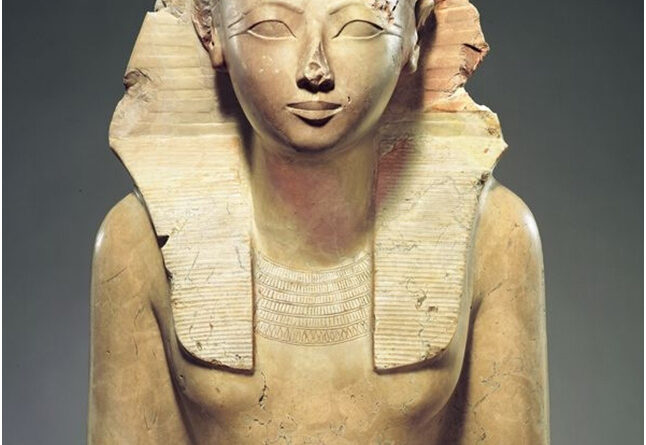
Hatshepsut fu la donna-faraone che regnò sull’Egitto tra il 1473 e il 1458 a.C. Il suo nome è legato al programma edilizio culminato con la costruzione del grande Tempio di Deir el-Bahari a Tebe Ovest.

Deir el-Bahari
Deir el-Bahari, vista dall’alto

La vita

“Hatshepsut”, esclamò sua madre Ahmes dandola alla luce, ovvero “Ha il volto delle Nobili Dame”; figlia di Thutmosi I, sin da piccola si dimostrò più dotata dei suoi fratellastri, ma per accedere al trono dovette sposare il maggiore di loro Thutmosi II, debole di fisico e di mente, che la lasciò presto vedova. Assunse, allora, la reggenza al posto di Thutmosi III, ma via via andava acquistando sempre più le caratteristiche di un re: infatti, si faceva rappresentare con la barba posticcia tipica dei faraoni.

Per la sua incoronazione la regina fece scrivere un testo di carattere mitologico, nel quale giustificava il suo avvento al trono per volere degli déi; inoltre, in questo testo affermava di essere il risultato dell’unione tra sua madre e il dio Amon e che suo padre Thutmosis I l’avesse nominata suo successore prima della sua morte.

Nonostante l’apparente successo del suo regno e una sepoltura nella Valle dei Re, i monumenti a lei dedicati sono stati deturpati dopo la sua morte con una drastica damnatio memoriae, apparentemente voluta dal suo co-sovrano, nonché figliastro/nipote, Thutmosis III.

damnatio memoriae hatshepsut
Iscrizione dalla Cappella di Anubi, Deir el-Bahari: a sinistra, i nomi di Hatshepsut cancellati; a destra, quelli di Thutmosis III lasciati intatti.

Il fatto che una donna fosse divenuta faraone d’Egitto era molto insolito. Nella storia dell’Egitto, durante il periodo dinastico, ci sono state solo due o tre donne che riuscirono effettivamente a governare come faraoni, piuttosto che ad esercitare il potere come ”la grande moglie“ di un re.

Hatshepsut avviò una nuova corrente artistica, indisse una riforma teologica, amministrò, con rara efficacia, le finanze statali e organizzò spedizioni molto proficue, come quelle nella misteriosa terra di Punt, da cui le navi egizie tornavano piene di incensi e strani animali. Un attivismo che intaccava i già delicati equilibri politico-religiosi e che le procurò pericolosi nemici: il giovane pupillo, i sacerdoti di Osiride e tutti coloro che mal sopportavano l’influenza di Senenmut, il potente consigliere che, forse, fu qualcosa di più per la regina.

L’architettura

La regina operò nel tempio di Karnak, in cui fece costruire delle cappelle, un santuario per la barca sacra ed erigere due obelischi; Deir el-Bahari fu il sito prescelto dalla sovrana dove collocare il suo tempio funerario, mentre la sua tomba fu realizzata nella valle dei Re.

Il tempio funerario, noto anche come djeser-djeseru (“santo fra i santi”), è un tempio situato a ridosso delle alture rocciose di Deir el-Bahari, sulla riva occidentale del Nilo, vicino alla Valle dei Re. Esso è dedicato alla divinità solare Amon Ra e si trova vicino al tempio del faraone Montuhotep II.

Il complesso sfrutta una rivoluzionaria soluzione planimetrica di divisione della struttura su diversi livelli, in armonia con lo scenario roccioso sottostante. Il tempio è considerato il punto di maggior contatto tra l’architettura egizia e quella classica: esempio dell’architettura funeraria del Nuovo Regno, segna un punto di svolta, abbandonando la geometria megalitica dell’Antico Regno per passare ad un edificio che permetta il culto attivo.

English Version

ANCIENT EGYPT | Hatshepsut and the damnatio memoriae

Hatshepsut was the pharaoh-woman who reigned over Egypt between 1473 and 1458 BC. Her name is linked to the building program that culminated with the construction of the great Temple of Deir el-Bahari in West Thebes.


Her life

Hatshepsut, exclaimed her mother Ahmes giving birth to her, in other words “She has the face of the Noble Ladies”. Daughter of Thutmose I, from an early age she proved to be more gifted than her half-brothers, but to access the throne she had to marry the eldest of them Thutmose II, physically and mentally weak, who soon left her a widow. He then assumed the regency in place of Thutmose III, but gradually he was acquiring more and more the characteristics of a king: in fact, he was represented with the false beard typical of the pharaohs.

For her coronation the queen had a mythological text written, in which she justified her coming to the throne at the behest of the gods. Furthermore, in this text she claimed to be the result of the union between her mother and the god Amun and that her father Thutmose I had named her his successor before his death.

Despite the apparent success of her reign and a burial in the Valley of the Kings, the monuments dedicated to her were marred after her death with a drastic damnatio memoriae, apparently desired by her co-ruler and stepson or grandson, Thutmose III.

The fact that a woman had become pharaoh of Egypt was very unusual. In the history of Egypt, during the dynastic period, there were only two or three women who actually managed to rule as pharaohs rather than to exercise power as the “great wife” of a king.

Hatshepsut launched a new artistic movement, called for a theological reform, administered state finances with rare effectiveness and organized very profitable expeditions, such as those in the mysterious land of Punt, from which Egyptian ships returned full of incense and strange animals. An activism that undermined the already delicate political-religious equilibrium and that procured her dangerous enemies: the young pupil, the priests of Osiris and all those who could not stand the influence of Senenmut, the powerful adviser who, perhaps, was something more for the Queen.


Architecture

The queen worked in the temple of Karnak, where she had chapels built, a sanctuary for the sacred boat and erected two obelisks. Deir el-Bahari was the site chosen by the sovereign to place her mortuary temple, while her tomb was built in the valley of the Kings.

The Mortuary Temple, also known as djeser-djeseru (“holy among the saints”), is a temple located close to the rocky heights of Deir el-Bahari, on the west bank of the Nile, near the Valley of the Kings. It is dedicated to the solar deity Amun Ra and is located near the temple of Pharaoh Mentuhotep II.

The complex exploits a revolutionary planimetric solution of dividing the structure on different levels, in harmony with the underlying rocky scenario. The temple is considered the point of greatest contact between Egyptian and classical architecture: an example of the funerary architecture of the New Kingdom, it marks a turning point, abandoning the megalithic geometry of the Old Kingdom to move to a building that allows worship active.


Deir el-Bahari, view from above

damnatio memoriae hatshepsut
Inscription from the Chapel of Anubis, Deir el-Bahari: on the left, the names of Hatshepsut deleted; on the right, those of Thutmosis III left intact.

Archivio

NEWS | Dagli scavi di Castrum Novum emerge l’antico foro romano

A Santa Marinella (RM) gli archeologi hanno scoperto il foro dell’antica colonia romana di Castrum Novum

Si è appena conclusa a Santa Marinella, presso Torre Chiaruccia (RM), la campagna di ricerca archeologica nel sito dell’antica colonia romana di Castrum Novum. Gli scavi sono a cura del Museo Civico del Mare e della Navigazione Antica di S. Severa. Il Direttore degli scavi Flavio Enei, archeologo, ha coordinato i lavori.

All’altezza del km 64.300 della via Aurelia, a ridosso del mare, gli archeologi hanno scoperto l’area del foro. Il foro era il centro pulsante di ogni città romana. Molto probabilmente intorno al foro di Castrum Novum si aprivano ambienti pubblici, portici, un’aula rettangolare e un probabile sacello. Sono emersi anche i resti del podio di un tempio, posto su un lato dello stesso foro. L’indagine estensiva ha esplorato diverse fasi dell’insediamento, comprese tra il III secolo a.C. e la fine del V – inizi VI secolo d.C. 

La storia di Castrum Novum

Castrum Novum fu una colonia romana fondata appunto nel III secolo a.C. e abbandonata nel VI secolo d.C.

Scoperta nel 1600, solo un secolo dopo viene scavata per la prima volta, grazie alla Reverenda Camera Apostolica. Gli scavi portarono alla luce numerose statue, ora custodite principalmente nel Museo Pio-Clementino presso i Musei Vaticani.

Parte di strada riemersa dagli scavi del 2019 a Castrum Novum. Fonte: “Castrum Novum: relazione campagna di scavi 2019”.

Le ricerche a Castrum Novum sono proseguite grazie al Gruppo Archeologico del Territorio Cerite, a partire dal 2015, con la collaborazione di istituzioni scientifiche ed universitarie italiane ed europee.

I ritrovamenti della campagna del 2019 hanno riguardato l’esposizione della porta di accesso Est alla città e parte del relativo Decumano. Lungo il suo fronte sono stati messi in luce i resti di basi di colonne e capitelli che documentano l’esistenza di un lungo portico appartenente ad un importante edificio pubblico. 


English Version

HISTORY | His Majesty, Etna

The superb peak of Mount Etna that soars up to the sky, and its valleys that are already all black, and its snows that shine with the last rays of the sun, and its woods that tremble, that murmur, that stir. G. Verga, Story of a Capinera

This is how Verga describes Etna, the highest active volcano in Europe with its 3326 mt. Declared World Heritage Site by UNESCO in 2013, the Mongibello (another name of the Sicilian volcano), rises majestically and bursting on the Ionian coast. From its top you can admire a wonderful panorama, which includes not only the Ionian coast and the sea, but also Calabria, the Nebrodi mountains, the mountainous ridge of the Madonie and the inland areas of Sicily.

Called by the Greeks Αἴτνη (Aítnē), the Romans Aetna, and the Arabs Mongibello, Etna has inspired legends, myths, stories and tales in anyone who saw it.

It is quite difficult to reconstruct the etymology of the name, which seems to derive from the Greek toponym Aitna (Aἴτνα-ας, a name also attributed to the centre of Catania), which derives from the verb αἴθω (aitho, “to burn”). Another possible origin is from the noun “sicano” aith-na (“burning”). Perhaps the most evocative denomination is that of the Arab authors who called it Jebel al-burkān (“mountain of the volcano”), Jebel Aṭma Ṣiqilliya (“sum mountain of Sicily”) or Jebel an-Nār (“mountain of fire”). From these expressions it is possible to trace the dialectal name “Mongibello”, which seems to derive from the fusion of the Latin word Mons (“mountain”) and the Arabic word Jebel, with the same meaning. Today, instead, Sicilians often refer to the volcano with the appellation “a Muntagna”.

Etna (geologically a volcanic stratum) has its origins around 570,000 years ago, in the Quaternary period (during the middle Pleistocene), when construction and destruction processes took place, which started violent eruptive activities. Today Etna is one of the main places for geology studies: in fact, in Catania there is the important National Institute of Geophysics and Volcanology which monitors its activities. In this regard, the presence of the Astronomical Observatory at an altitude of 2900 mt. cannot not be forgotten. This one, no longer in operation today, is one of the oldest in Italy.

To inspire more the works of ancient and modern writers, poets and directors is precisely its grandeur and its unpredictable behaviour.

Particularly suggestive are the explanations of the eruptive activity of the volcano, described by ancient authors such as Thucydides, Diodorus Siculus and Pindar. For example, it is said that the god of the winds Aeolus had reclosed, after a bitter fight, some winds in the caves below Etna.

Hesiod, Aeschylus and Virgil, instead, tell that the reason for the eruptions is linked to the rebellions of some giants like Enceladus. This one, defeated by the gods after a war, was buried under an enormous heap of land, the island of Sicily. Under Etna would be found, therefore, his head and the crater would coincide with his mouth. The eruptions would be the cries of pain of the defeated giant. The ancients, however, also thought that in the belly of the Mountain there was the workshop of Hephaestus (or Vulcan), god of fire, metallurgy and blacksmith of the gods.

The Volcano

Today there are four slopes of Mount Etna that can be visited, but the most easily reached are the northern slope (Linguaglossa) and the southern slope (Nicolosi).

Characterized today by a variegated flora and a very rich fauna, Etna represents a unique place in the world. It satisfies, in fact, the interest of mountain and winter sports enthusiasts (alpine skiing, cross-country skiing, ski touring, snowboarding), nature lovers and hikers (Etna Park). Moreover, the most demanding “palates” can enjoy unique dishes and taste the famous “Nero dell’Etna” wine, both during local festivals (Sagra del Pistacchio di Bronte, etc.) and in very characteristic places. For art lovers it is possible to buy works of the typical Etnean handicraft and to admire in the ethnic villages (Bronte, Randazzo, Maletto, Milò, Paternò, Adrano, just to name a few), numerous sanctuaries, churches, fountains or the wonderful buildings built in lava stone.


BIBLIOGRAPHICAL REFERENCES 

– Patanè, S. La Delfa, J. Tanguy, L’Etna e il mondo dei volcani’, Catania, Giuseppe Maimone editore, 2004.

– AA VV, Etna, myth of Europe, Catania, Giuseppe Maimone publisher, 2000.

– Etna Cooperativa Etna Sud – Environment, history, traditions, 1990, Tringale Editore.

– Carlo Gemmellaro, La vulcanologia dell’Etna (anastatic reprint by Salvatore Cucuzza Silvestri), Catania, Giuseppe Maimone Editore, 1989.

– Pierre Grimal, Mythology, Garzanti, 2005.