After some works done by the Navarolo di Casalmaggiore Consortium of Reclamation, some graves have emerged in San Martino dell’Argine, in the province of Mantua.
Excavations and archeological discovery
The 11 tombs have been brought to light in a range of about 350 metres; three of them present a covering, made of gabled bricks, known as “cappuccina”; these tombs appear to be divided into 4 seemingly separated cores.
Tomb with “cappuccina” covering.
The inhumation burials have unearthed adults and a few children. The complete absence of a funerary equipment makes it complicated to have a precise chronological dating, but the employment of reused bricks, especially inside the more structured graves, suggests the early medieval age. This hypothesis is supported by the discovery of holes belonging to wooden buildings and to ancient canals, which contain ceramic fragments.
Inhumation burial.
Occasional traces of prehistoric presence in the area have emerged from the diggings as well, and they are confirmed by the existence of a drainage well that contains small ceramic mixture fragments, confirming the flint retrieval during the initial investigations of 2020. The findings will allow to improve the knowledge of the area history, which will be useful to better understand the population dynamics of the Mantuan area.
Mayor Alessio Renoldi’s words
“Seeing those tombs buried for about 1.500 years in San Martino was both a surprise and an emotion. They’re invaluable pieces of history which confirm very early settlements in our territory, and this cannot help but arouse curiosity about the origins of our country. Obviously, we will try to make the best out of these discoveries, and we will provide as many information as possible to the citizens. I also hope that further investigation may bring out more fragments of history and knowledge of the town.”
On Wednesday 9th February, at 11:00 A.M, the statue of goddess Athena arrived in Sicily at the Antonio Salinas Archeological Regional Museum.
Partnership between Greece and Sicily
Alberto Samonà, Regional Councillor for Cultural Heritage and Sicilian Identity
This statue will be given to the Salinas Museum for four years after a close cooperation agreement with the Greek authorities which was strongly desired by Alberto Samonà, Regional Councilor for Cultural Heritage and Sicilian identity.
Last month, the partnership between the sicilian museum and the Acropolis Museum of Athens had already allowed the return to Greece of a Parthenon frieze fragment (the so-called “Fagan Artifact”), which was conserved at the Salinas Museum. However, the arrival of this statue marks the first time that an artifact from the Athenian Museum comes to Sicily for a long-term exposure.
Return ceremony of the “Fagan artifact” at the Athens Acorpolis Museum, to which Councilor Alberto Samonà took part.
Accompanying the precious exhibit, which dates to the 5th century B.C., will be Lina Mendoni, Minister of Culture and Sport of Greece, and Nikolaos Stampolidis, director of the Athenese museum. They will entrust it to the Sicilian region, to the presence of Alberto Samonà and Caterina Greco, director of the Salinas Museum. For the important cultural occasion, senator Lucia Borgonzoni, Undersecretary of Culture, will also be present.
The Statue
This headless statue, made of pentelic marble, depicts the Goddess Athena: the 60 cm tall figure is dressed in a peplum, complete with a belt on the waist. The deity was probably adorned with a banner transversely placed on the chest which, likely during ancient times, was decorated in the center by a gorgon, which has been lost.
Statue of the Goddess Athena
The figure puts the body weight on the right leg, while using the left arm, in a sort of synchrony, to lean on what was supposed to be a spear. The whole thing is sinuous and smooth thanks to the skillful use of clothing, which is typical of the attic style of the last quarter of the 5th century B.C.
In the heart of the Etruscan necropolis of Monterozzi, ten graves have emerged. They can be dated between the Villanovan and the archaic age, that is the period that saw the full affirmation of Tarquinia, to which the myths about the foundation of the Etruscan civilization are related. The discovery of this new burial group goes back to last fall. However, researchers have shown the artifacts to the public on the 14th of January.
Monterozzi Necropolis, Tarquinia
The excavations of Tarquinia
The necropolis of Monterozzi, the most important of Tarquinia and the most ancient one of Etruria, is located on the eponymous hill, about one kilometer from the city. The decision to start a digging campaign was made by the Archeological Superintendence, Fine Arts and Landscape for the province of Viterbo and southern Etruria and goes back to last fall, after ploughing works on a private land led to the opening of a series of cavities of archeological interest. During the excavations, a group of ten Etruscan tombs was brought to light. They can be dated between the Villanovian age and the archaic one and they’re located a few meters away from the Tomba Dei Tori and from the Auguri one. Unfortunately, in ancient times, the tombs were sacked by thieves who stole the precious metals, leaving ceramics and other grave goods in situ because they were considered of low value.
The Gemina grave
Early restoration works on the artifacts allow to fully comprehend the richness of the funerary equipment of the Gemina grave. This tomb aroused great interest from an architectural point of view. The monument consists of two flanked chambers facing south-west towards two open-air vestibules accessed through a staircase. The covering of both chambers is of the slit type. Nenfro plates were used to seal the doors. Alongside the left wall of both chambers, there is the carved bed on which the deceased was placed. The closing slabs, which were previously perforated by the first visitors, were accurately sealed again after the looting, as a sign of respect towards the deceased. However, over time, the maneuver led to the collapse of the northern chamber.
Carved bed from the Gemina grave
The equipment
The funerary equipment consists of vascular shapes made of splint-polished mixture with carved and configured decorations; several bucchero vases; pots painted in Etruscan-geometric style, including some attributed to the Palm Painter; euboian cups a chevrons: various wood fragments made of iron and gold, which suggest the presence of precious objects, and a female statuette.
Female statuette
The Dating
Daniele Federico Maras, an official working for the Superintendence of Tarquinia, suggested the first half of the 7th century B.C. as chronological frame, placing the tomb context in the decades preceding Tarquinius Priscus, who is traditionally known as the fifth king of Rome (between 616 and 579 B.C.).
Plinius the Elder, in his Naturalis Historiae, talks about 185 varieties of wine which all differ in sensory perceptions: white, red, rose, still, sparkling, dry, sweet, aromatized. Even Hippocrates, the most famous medic of the ancient times, makes a list based on their qualities and on the effects they produce on the body. But… have you ever heard of salted wine?
Salted wine: what does it mean?
There are four main flavors which can determine the taste of a wine and they can be perceived by the taste buds on the tongue: sweet, sour, bitter and salted. By definition, a salted wine should give a feeling of sapidity that is higher than other taste qualities. Usually, alcohol, sourness and volatile substances tend to cover this flavor, which becomes noticeable only in the case of unusual sapidity values. Some wines, especially if farmed on soil exposed to salty winds, can have a natural, salted taste. However, during the winemaking process, in order to correct the taste, increase the wine conservation, or to make it more “noble”, ancient sources suggest adding the most disparate ingredients: from honey to flower petals, from seawater to minced oysters, from wood splinters to resin, even chalk, clay and tar.
The salted wine of Kos
Cato The Elder, in his Liber de agri cultura, which was written during the second quarter of the 2nd century B.C., is one of the first to describe the production process of one of the most famous salted wines of the antiquity. In fact, the island of Kos boasted an important wine production in the ancient times, so much that a part of the wine purchases for the roman legions came from the Dodecanese islands. This wine, like the one of Rhodes and Chian, was preserved in particular amphorae, and it was so precious that some forged copies, which were passed off as Kos wine, have been discovered.
In order to prepare the famous Greek wine of Kos, according to the recipe of Cato, it is necessary to draw offshore seawater in a day of calm sea, about two months before the harvest. After having decanted it a couple of times in clean jars and excluding the bottom deposits, only the ripest berries will be added. Three days later, the grapes are taken, pressed and fermented.
The second terrace of the Asclepius sanctuary on the island of Kos
Experimental Archeology and enology
In these years, there have been several attempts to produce the wines by following the descriptions of the sources. Starting from the stories of Plinius the Elder and using a winemaking technique that is not too different from the Kos one, the wine of Chian has been replicated at the Elba Island. In this case, though, the berries of a particular white grape variety, the Ansonica, are placed inside handmade pots and immersed at sea for a few days. The seawater works on the berries, eliminating the bloom, a waxy substance that covers them, accelerating the dehydration of the grapes which leads to a perfect ripening. This process has also been documented in a short movie, “Vinum Insulae”, produced by Cosmomedia.
The Special Superintendence of Rome has discovered a roman bridge on the Tiburtine during road extension works.
The discovery
Documentation of historical maps of Renaissance age showed the existence of a bridge on the Ditch of Pratolungo. However, traces of the roman-age structure had not yet been brought to light; preventive archeology investigations related to road widening works made by the Municipality have revealed the presence of the structure, which has been found at the 12th kilometre of the Tiburtine.
The excavations, which are still in progress, are carried out with the scientific direction of Fabrizio Santi, archeologist of the Special Superintendence of Rome and by archeologists Mara Carcieri and Stefania Bavastro of Land S.r.l.
Ditch Of Pratolungo
Chronology and final works
The history of the structure makes the discovery extremely exceptional: the bridge, which allowed to cross the ditch of Pratolungo, dates to the 2nd century B.C., during the mid-republican age; the dating seems to be confirmed by some ceramic findings, which are yet to be systemically analyzed, and by the type of masonry, made of big tuff blocks.
The bridge will be covered at the end of the investigation, not before an accurate survey and mapping. This will allow, along with the analysis of the specimen, a detailed study and understanding of this important discovery.
Discovery of the roman-age bridge
The Special Superintendent’s words
“It’s a discovery of great archeological interest”, explains Daniela Porro, Special Superintendent of Rome, “as well as historical and topographical. The research will continue in the next days in order to obtain a complete knowledge of the structure and its stages of use. Once again, Rome gives us important evidence of its past, which will allow to better understand its ancient history”.
Some trophies, including two helmets, a Chalcidian one and one of the Negau type, both in great state of conservation, have been found at the Acropolis of Elea-Velia.
The archaeological investigation
On top of the ancient city, the excavations have brought to light the remains of a rectangular structure of remarkable size (18 x 7 meters of length). This building, which is made of mud bricks, is located under the temple dedicated to the Goddess Athena and it is what remains of the most ancient archaic religious place devoted to the deity. The results of the archaeological investigation, as the archaeologist Francesco Ullano Scalza states, have allowed to clarify the topography, the architecture, the intended use and the chronology of the various stages of the Acropolis.
“The structure of the most ancient temple dates back to 540-530 B.C., which is right after the years of the Battle of Alalia – notes Massimo Osanna, General Manager of the Museums and Avocant Director of the Archaeological Park of Paestum and Velia – while the most recent temple, which was thought to be of Hellenistic age, dates back at first glance to 480-450 B.C., and then it underwent a restructuring during the 4th century B.C. Therefore, it’s possible that the Phocaens on the run from Alalia might have erected it shortly after their arrival, as they were used to, after having acquired the necessary land from the locals in order to settle and resume the prosperous trades for which they were known. And to the relics that they offered to their goddess to propitiate her benevolence, they added the weapons they had taken from their enemies during that epic battle which had, in fact, changed the balance of power in the Mediterranean Sea.”
Stratigraphic Sequence
The Trophies
Several trophies, such as painted ceramics marked by the IRE engraving, which means “holy”, and various weapon fragments, have been found inside the temple: among these, we have the pieces of a big, decorated shield and two beautiful helmets, an Etruscan one of the “cap” type, also known as Negau (from the Slovenian area where it was found for the first time), and a Chalcidian one. These two helmets are now being studied in a laboratory, and inscriptions are sought within them that may help reconstruct their history.
“The archaeological findings at the acropolis of Elea-Velia suggest a religious use of the structure. Likely, in this place there were kept the relics that were offered to the goddess Athena after the battle of Alalia, the naval battle that was fought between the Greek refugees of Phocaea and an alliance of Carthaginians and Etruscans, around 541 and 535 B.C. just off the Tyrrhenian Sea, between Corse and Sardinia. Cleared from the earth just a few days ago, the two helmets have yet to be cleaned and studied in a laboratory. Inside them, there might be some inscriptions, which are quite frequent in ancient armors, and these could help us to accurately reconstruct their history, perhaps even the identity of the warriors that wore them. Of course, these are just initial considerations, but they clarify many unknown details of that Eleatic history which happened more than 2500 years ago” – declares Osanna.
Negau-type helmet
Velia
Greek name of the ancient Velia, Elea was one of the richest Poleis of the Magna Graecia. It was an ally of Rome during the Punic Wars, and it became a Roman municipality in 88 B.C. Its decline started from this moment: Rome cut it out of the trade routes, forcing the city (known as Velia) to reduce itself until it became a small fishermen village. During the 9th century, Velia was definitively abandoned in order to avoid malaria and the raids of Saracen pirates, except for the acropolis where the population took refuge and built a strong fortification. This small, fortified town took the name of Castellammare della Bruca and survived until the end of 1600. The first to realize the cultural and historical importance of the place was the archaeologist François Lenormant: the existence of an archaic structure which was antecedent to the main temple of the Acropolis was speculated since the 1920s. Unfortunately, due to the excavations that started during the last century, the surviving settlement of medieval age has almost been destroyed.
We’re closing the weekly column “Eminent Figures” by talking about another woman, this time English, who can be considered the first modern archaeologist and explorer and an example for all those who aspire to investigate the past and understand the present. We remind readers that “Eminent Figures” will continue every two months in ArcheoMe magazine, available from February 2021.
Gertrude Margareth Lowtian Bell was born on July 14, 1868 in Washington Hall, England, the daughter of an upper middle class English family, owners of several coal mines in County Durham.
Curious and not at all docile (contrary to what was expected of a girl of her social extraction at the time), after graduating from Oxford in Modern History in 1887, she wanted to continue her studies in antiquity and art history, despite the family’s opposition.
A youthful portrait of Gertrude Bell
The first trip to Iran
She never married and turned down several suitors when, in 1892, she finally obtained permission from her father to spend time in Iran as the guest of her maternal uncle, Sir. Frank Lascelles, British ambassador in Tehran. He described his trip to Iran in the book Persian Pictures: in Iran he was able to visit many archaeological sites of ancient Persia and learned to read and write Persian.
Persian was only one of the foreign languages mastered by Gertrude Bell: in fact, in her life she had the opportunity to learn, in addition to French, also Turkish, Arabic and even Italian.
Arabs of the desert
Back in Europe, she spent the following years to deepen the study of languages and archaeology and to travel around Europe and the Middle East. In 1899 she traveled to Palestine and Syria and the following year she settled in Jerusalem. From there, Bell spent many years traveling through the Syrian-Palestinian region and meeting the many Arab tribes that lived there. She had the opportunity to live side by side with the nomadic peoples of the desert, learning their names and customs and getting to know personally the most influential tribal leaders (with whom she used to converse about Islamic poetry and exchange gifts).
Gertrude Bell in front of her tent in Babylon, 1909
In her book Syria: the desert and the sown she described her expeditions through photos and reports, helping to introduce the European public to a civilization until then considered barbaric and elusive. From the letters that the explorer wrote to her family we know that she used to travel with many servants and with a rich luggage, which included, in addition to a tent with a travel bed, a portable bathtub (which Gertrude used as much as possible).
In 1907 she began excavations with paleo-Christian archaeologist William Ramsay and two years later visited Karkemish, Babylon and Najaf. At Karkemish she met a student of Sir Leonard Woolley, T.E. Lawrence, a few years before he became the legendary Lawrence of Arabia.
Ha’il
It was the journey to Arabia in 1913, however, that definitively consecrated Gertrude Bell to history and legend: alone, with her caravan this time reduced to a minimum, with a few trusted men, Gertrude Bell crossed the Arabian desert to the stronghold of Ha’il, an inhospitable place for Westerners and reached until then only by another woman, Lady Anne Blunt.
The Great War and the Arab revolt
At the outbreak of World War I, Bell applied for an operational post in the ranks of British intelligence in the East, but was turned down. She enlisted, therefore, as a volunteer in the Red Cross.
The following year, however, she was summoned to Cairo, at the Arab Bureau, with the unofficial task of providing information on the Arab tribes of which the British intended to foment the revolt in anti-Ottoman function.
In 1916 Bell was sent to Basra, in what is now southern Iraq, occupied by the British two years earlier, as an advisor to Percy Cox, the official in charge of managing the British dominions in Iraq: she was the only woman to have taken on the role of political officer in the British armed forces and was later appointed liaison officer at the Arab Bureau. After the capture of Baghdad, in 1917, Gertrude Bell settled permanently in Iraq. We know from her private correspondence that after the Arab revolt she was deeply disappointed by the behavior of the British. In fact, the British army had taken advantage of the uprising of the Bedouins, but had then disregarded the promise of independence of a great Arab nation.
Gertrude Bell and Lawrence of Arabia in 1909
In Iraq
Until 1921 she was still active, together with Lawrence, in seeking an arrangement that would lead to the independence of the states into which the Middle East had been divided after the Sykes-Picot agreements.
In Baghdad Gertrude Bell lived until her death, in a splendid residence overlooking the Tigris. The Iraqis called her al-khatun (feminine of the word khan, “chief”, “sovereign”) and someone called her “the uncrowned queen of Iraq”. Friend and confidant of King Faysal I of Egypt, in 1926 she founded, on the sovereign’s mandate, the Iraq Museum, one of the largest archaeological museums in the Arab world.
In the letters of the last years the great explorer complains more and more about the illnesses and the unhealthy climate of Iraq (probably she had contracted malaria). She appears to be a lonely woman, disillusioned by the colonial aggressiveness of the English, fatigued by years of work without rest.
She died on July 12, 1926, perhaps by suicide with an overdose of sleeping pills. She was buried in the British cemetery in Baghdad, in the district of Bab al-Sharji. The Queen of the Desert, the first great archaeologist of the Near East, a friend of the Arabs, had opposed the division of the Middle East between the British and the French, the installation of the conservative Salafists Al-Saud as the custodians of Mecca and remained extremely doubtful about the Zionist project in Palestine, but left life and work too soon to know that History would have agreed with her.
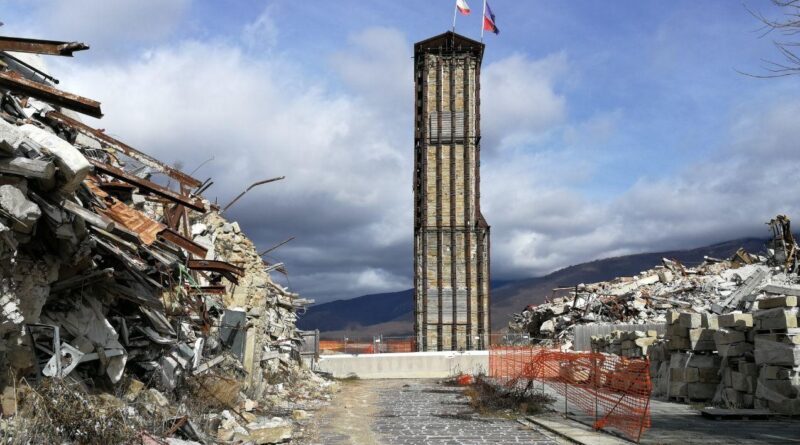
The historical center of Amatrice after the earthquake
The high number of earthquakes in 2016 is irreparably linked to the seismic sequence that began on August 24 with a 6.0 magnitude shock, which devastated the historic centers of Amatrice, Accumoli, Arquata and Pescara del Tronto, causing 299 victims and incalculable damage to the cultural and artistic heritage of Central Italy. With the earthquake at 3.36 am began a seismic swarm in a very large area, which affected 4 regions (Lazio, Abruzzo, Umbria and Marche) and 7 provinces (Rieti, L’Aquila, Perugia, Terni, Macerata, Ascoli and Teramo).
Many were the problems that the operators of the Ministry of Cultural Heritage and Tourism had to face, in a vast territory between the valley of the Tronto river, the Sibillini mountains, the Laga mountains and the Alto Aterno mountains, areas characterized by harsh climatic conditions and often lacking of adequate infrastructures.
Four years after the first quake, the pain for the victims has not disappeared, nor the void left by the huge damages inflicted to the cultural heritage of these towns, which have seen the collapse of their churches, their historical buildings, their bell towers and all the symbols of a jealously guarded historical memory. The landscape of these places has been changed forever, with consequences not only in the artistic landscape, but also in the environmental, economic and social one. Even though the earthquakes have razed the physical places to the ground, they have not been able to wipe out the tenacity of the local populations, who have learned to get back up and resist the recurring natural calamities, testifying resilience and attachment to their land.
The cultural heritage of Amatrice
Amatrice deserves to be remembered for its archaeological evidence and for the flourishing artistic and architectural production that enriched every glimpse of the country, which became part of I Borghi più belli d’Italia in 2015. The Amatrician basin is located in a strategic area, as it is crossed by the Via Salaria, which connects the Adriatic area with Sabina and Lazio. In ancient times, the high valley of the river Tronto, in which the current municipalities of Amatrice and Accumoli are located, was an integral part of the Augustan Regio V, called Picenum.
The archaeological evidences document a massive exploitation of this territory, especially in the Roman age, and the most important ancient settlement is represented by the complex located in Torrita. The first excavations that interested the archaeological area took place between 1954 and 1956; at the beginning the structures were interpreted as pertaining to the vicus Phalacrinae, the birthplace of the emperor Vespasian, later identified in the municipality of Cittareale (RI). Recently, the complex of Torrita has been interpreted as part of a rustic villa or, given its location at the crossing point between the Velino and Tronto valleys, as a post station (mansio), which must have been at a short distance from the route of the Salaria. On the basis of building techniques, the structure has been dated between the beginning of the first century BC and the third-fourth century AD.
After the seismic event and thanks to the preventive archaeology interventions demanded by the competent Superintendence, some remarkable archaeological discoveries have been recorded in the locality of Palazzo, in the close proximity of the area of Grisciano, fraction of Accumoli. The investigations, which began on June 20, 2018, have brought to light wall structures, covering an area of 1000 square meters and constituting a fundamental monumental evidence of the Roman age of the territory. The hope is that the retrieved heritage can be enhanced to give new strength to the cultural identity of these areas.
Archaeological area of Torrita (Amatrice)
The devastation and the face of the town after the earthquake
Since the first hours of August 24, 2016, the town of Amatrice becomes the emblem of devastation: the historical center, as well as the hamlets of the town, appear completely destroyed. The priority is to save as many lives as possible. At a later stage, plans also begin to be studied to safeguard the historical and cultural roots of the earthquake zone.
In the first week of September there were the first rescues: the works kept in the Civic Museum ‘Nicola Filotesio’ of Amatrice were extracted from the rubble and initially stored inside a lorry with air-conditioned rooms. Around August 30, 2016, the Deposits Unit identified and set up a temporary depot in an industrial shed owned by the Scuola Allievi del Corpo Forestale dello Stato in Cittaducale (RI), an area a few kilometers from the earthquake sites. In this way, an extremely functional space comes to life, continuously supervised by the Ministry. At the same time, the basement was restructured to create a laboratory for emergency intervention and restoration of the works.
Complex of the Church of S. Francesco in Amatrice after the seismic eventCittaducale (RI) Depot
In May 2019, a framework agreement is signed by the Office of the Special Superintendent for the areas affected by the earthquake of August 24, 2016 of MiBACT, together with the Soprintendenza Archeologia, Belle Arti e Paesaggio of the provinces of Rieti, Latina and Frosinone, the Soprintendenza Archivistica e Bibliografica of Lazio, the Fondazione Varrone, the Municipalities of Rieti, Amatrice, Accumoli and Cittaducale and the Diocese of Rieti, for the promotion of reconstruction and restoration activities. The aim is to achieve a new usability of the cultural heritage hard hit by the earthquake and at the same time to convey a message of hope, commitment and rebirth.
On January 13, 2020 at Palazzo Dosi, in the city of Rieti, the Varrone Lab was inaugurated: it is a laboratory dedicated to the restoration of works recovered from Accumoli and Amatrice. A very important event for the process of rediscovery and enhancement of the cultural heritage of these areas. The Superintendence of Archaeology, Fine Arts and Landscape of the provinces of Rieti, Latina and Frosinone identified 48 assets, kept in the internal deposit of Cittaducale, that required particularly incisive restoration work. For others, which were in a good state of conservation, it was decided to carry out maintenance and cleaning operations. This path will find its “happy ending” in the exhibition that will soon be inaugurated at Palazzo Dosi.
In Amatrice, meanwhile, a very particular museum has been created, which tries to fill the material absence of the works, exploiting the infinite possibilities of virtual reality, augmented reality and videomapping. It is a multimedia pavilion that shows digital reproductions of various objects of historical and artistic interest, which can be viewed thanks to the MuDA AR app. The hope is that the areas hit by the earthquake will be rediscovered for their beauty and return to the center of attention not only for the tragic events by which they were devastated. This will be the purpose of the column that will begin in the new magazine of ArcheoMe from February 2021 that, on a bimonthly basis, will tell us about Amatrice and other lands affected by tragic earthquakes.
The Valley of the Queens, the southernmost of the Theban necropolises, is the place where, starting from the 18th Dynasty, the princes and princesses of royal blood were buried, together with people who lived at court; later, starting from the time of Ramses II, the queens who were given the title of “royal brides” too. Later, during the XX Dynasty, Ramses III restored the tradition and had the tombs of some of his sons set up in the Valley.
The Necropolis of the Queens
Originally, the Egyptians indicated it as ta set neferu, an expression that lends itself to various interpretations, but that can probably be translated as “the place of beauty”, which is the most common interpretation.
The necropolis is located at the bottom of a valley, surrounded by steep hills, behind the hill of the present village of Qurna. In it there are about 70 tombs, looted in ancient times and then reused by local communities.
The site was chosen because it was considered sacred and, therefore, suitable for its function of royal necropolis, both for its proximity to the Theban peak and for the presence at the bottom of the valley of a cave-waterfall whose shape and natural phenomena connected to it could suggest a religious and funerary concept. The cave would, in fact, have represented the belly or womb of the Celestial Cow, one of the representations of the goddess Hathor, from which flowed the waters that announced the imminent rebirth of the dead buried in this privileged place.
Champollion in 1800, during one of his trips, documented about a dozen of them, the only ones available at that time.
In 1904, an Italian discovered in the Valley of the Queens, in West Thebes, what is probably the most beautiful tomb in Egypt. The Italian was Ernesto Schiaparelli, the director at that time of the Egyptian Museum of Turin, while the tomb belonged to the famous Nefertari, the Great Royal Bride of Ramses II (1279-1212 BC).
Ernesto Schiaparelli
Despite the work of looters, who left very little of the original equipment, the QV66 remains a jewel for its architectural structure, comparable to those found in the Valley of the Kings and, above all, for the magnificent pictorial cycle that adorns the walls and ceiling.
Pictorial decoration from the Tomb of Nefertari (QV66)
The plan of the tomb is quite articulated, because it has many similarities with that of Ramses in the Valley of the Kings. It has a long entrance staircase, a large central chamber and an access staircase through which one enters the sarcophagus room, which has four pillars and four adjoining rooms.
It was only in 1970 that in the Valley began a series of annual missions carried out by the Centre National de la Recherche Scientifique (CNRS) in Paris, the Louvre Museum, the Centre d’Études et Documentation sur l’Ancienne Egypte (CEDAE) and the Egyptian Antiquities Organization, now the Supreme Council of Antiquities.
To the excavations of Schiaparelli we owe the discovery of all the most important tombs of the site, such as those belonging to the sons of Ramses III, Seth-her-khepshef (QV 43), Kha-em-waset (the QV 44), Amon-(her)-khepshef (QV 55).
The beauty of this valley, you savor it at sunset, sitting on a stone, waiting for the sun to come down through the rocky clefts, that from the ochre color pass through the varieties of the pink color, but from the silence sacred to the pharaohs here appears on my head the circling of the Hawk God…
To the kind readers, we give appointment with the column on Ancient Egypt, in the new bimonthly magazine of Archeome from February 2021.
In the Alegoría de la Muerte, an oil painting by the artist Tomás Mondragón from 1856, the scene depicted is divided into two symmetrical parts: on the left is a rich, well-dressed woman accompanied by the customs and traditions of her time; on the right, however, in her reflected image in the mirror, what we all have in common, a skeleton. Life and death have always been conceived as two distinct realities. This is manifest in the separation of cemeteries from cities, of the world of the living from that of the dead.
Alegoría de la Muerte, oil painting by the artist Tomás Mondragón, 1856.
The great archaeothanatologist (an archaeologist who studies death and the modifications of the body that occur after burial) Henry Duday uses the powerful image of the painting – by detaching it from the Mexican context of its creation – to emphasize the concept of how archaeoanthropology can “overturn perspectives”: we start from death, from the analysis of skeletons, to reconstruct history, the lives of people from the past, to better understand our present.
What is Archeo-anthropology?
When we talk about an ancient funerary context, in which the tomb is the central element of an archaeological excavation, what we think of, and what we encounter most easily, are the bone remains. These materials are, in their own right, to be considered on a par with the other objects that characterize a burial. Artifacts, architectural and funerary structures are a material manifestation of man; human remains are the only representatives of the “maker”, of those who made these artifacts. They constitute the last biological link with our ancestors, as well as an additional and complementary source of information about the life of ancient communities.
Archaeo-anthropology is the branch of Archaeology that deals with the analysis and recovery of human bones, following specific criteria of application. This is the starting point of a work that continues in the laboratory.
How can we listen to what human bones have to tell us?
We will try to answer this and other questions by looking at the studies, research and analysis that have developed over time around human remains, during their discovery and after their recovery, and to illustrate how they have brought to light significant aspects of our past.
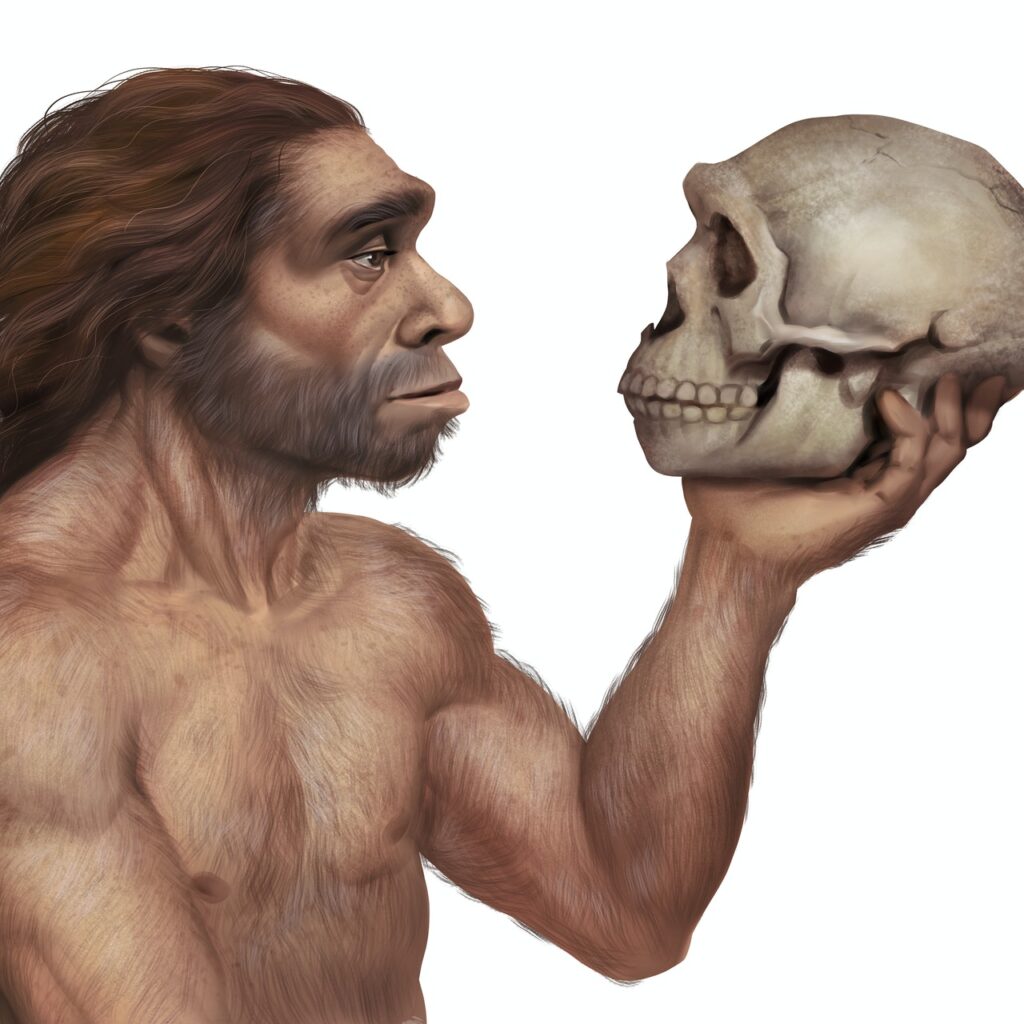
A Neanderthal holds a skull
Extravagant burials and unusual beliefs
We will focus on “singular” cases, expressions of curious funerary beliefs; cases that indicate the presence of different ways or places of burial in relation to the different age classes of the deceased or their social level; the role and explanation in death of intimate mother-son, woman-man or sibling relationships; a special focus will be placed on the most recent studies. We will focus on funerary practices, on the choices of burial and the substrate of beliefs related to them. All this always starting from the skeleton, the real protagonist of the stories and events that will be told, which is able to “reincarnate” the life of the past, even after death.
A skeleton in the mirror
The main objective of the column is to push the reader to approach the skeletons with a new look, in order to understand their importance in the archaeological field. To move away from the idea that they are only simple piles of bones, or the macabre expression of the past, instead of the main witnesses of the time that was. The reader will be encouraged to reconstruct, in his own mind, starting from the flesh, then from the clothes, the beliefs, the customs, the life of these men buried long ago.
It will be just like turning Mondragón’s picture upside down: starting from the reflected image of the skeleton, to get to the other side of the mirror and see what it was in order to reconstruct the man, the humankind and its stories, from the past, from prehistory and protohistory, up to the periods closest to us.
The column Archaeo-anthropology will begin in the new magazine of ArcheoMe from February 2021 that, on a bimonthly basis, will accompany us throughout the year….see you soon.
Per fornire le migliori esperienze, utilizziamo tecnologie come i cookie per memorizzare e/o accedere alle informazioni del dispositivo. Il consenso a queste tecnologie ci permetterà di elaborare dati come il comportamento di navigazione o ID unici su questo sito. Non acconsentire o ritirare il consenso può influire negativamente su alcune caratteristiche e funzioni.
Funzionale
Sempre attivo
L'archiviazione tecnica o l'accesso sono strettamente necessari al fine legittimo di consentire l'uso di un servizio specifico esplicitamente richiesto dall'abbonato o dall'utente, o al solo scopo di effettuare la trasmissione di una comunicazione su una rete di comunicazione elettronica.
Preferenze
L'archiviazione tecnica o l'accesso sono necessari per lo scopo legittimo di memorizzare le preferenze che non sono richieste dall'abbonato o dall'utente.
Statistiche
L'archiviazione tecnica o l'accesso che viene utilizzato esclusivamente per scopi statistici.L'archiviazione tecnica o l'accesso che viene utilizzato esclusivamente per scopi statistici anonimi. Senza un mandato di comparizione, una conformità volontaria da parte del vostro Fornitore di Servizi Internet, o ulteriori registrazioni da parte di terzi, le informazioni memorizzate o recuperate per questo scopo da sole non possono di solito essere utilizzate per l'identificazione.
Marketing
L'archiviazione tecnica o l'accesso sono necessari per creare profili di utenti per inviare pubblicità, o per tracciare l'utente su un sito web o su diversi siti web per scopi di marketing simili.
Per fornire le migliori esperienze, utilizziamo tecnologie come i cookie per memorizzare e/o accedere alle informazioni del dispositivo. Il consenso a queste tecnologie ci permetterà di elaborare dati come il comportamento di navigazione o ID unici su questo sito. Non acconsentire o ritirare il consenso può influire negativamente su alcune caratteristiche e funzioni.
Funzionale
Sempre attivo
L'archiviazione tecnica o l'accesso sono strettamente necessari al fine legittimo di consentire l'uso di un servizio specifico esplicitamente richiesto dall'abbonato o dall'utente, o al solo scopo di effettuare la trasmissione di una comunicazione su una rete di comunicazione elettronica.
Preferenze
L'archiviazione tecnica o l'accesso sono necessari per lo scopo legittimo di memorizzare le preferenze che non sono richieste dall'abbonato o dall'utente.
Statistiche
L'archiviazione tecnica o l'accesso che viene utilizzato esclusivamente per scopi statistici.L'archiviazione tecnica o l'accesso che viene utilizzato esclusivamente per scopi statistici anonimi. Senza un mandato di comparizione, una conformità volontaria da parte del vostro Fornitore di Servizi Internet, o ulteriori registrazioni da parte di terzi, le informazioni memorizzate o recuperate per questo scopo da sole non possono di solito essere utilizzate per l'identificazione.
Marketing
L'archiviazione tecnica o l'accesso sono necessari per creare profili di utenti per inviare pubblicità, o per tracciare l'utente su un sito web o su diversi siti web per scopi di marketing simili.