art

Archivio

NEWS | Banksy, l’opera “Game Changer” battuta a 19,4 milioni

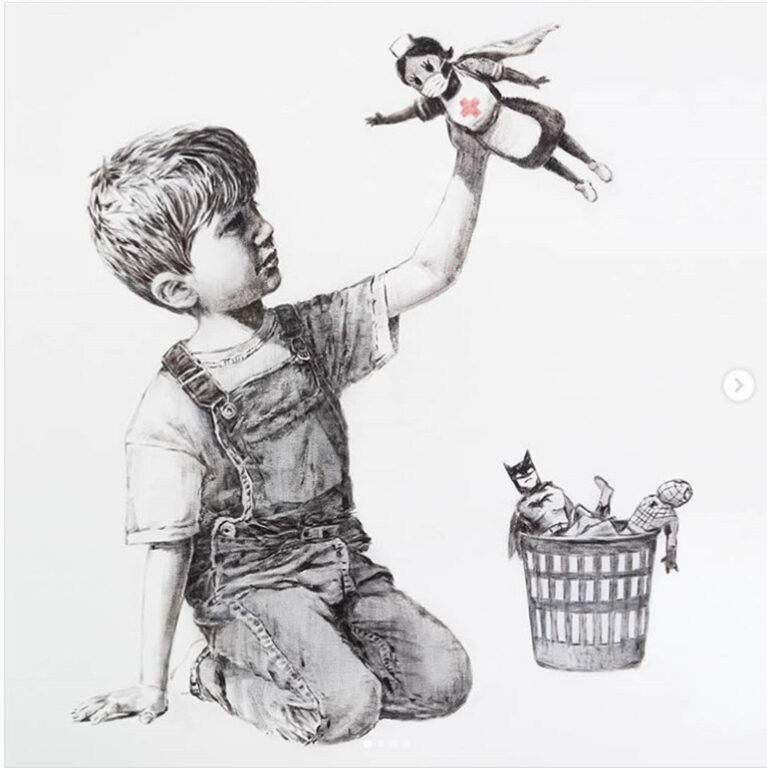
L’opera “Game Changer” dello street artist Banksy è stata battuta all’asta da Christie’s a Londra alla cifra di 16.758.000 sterline (19.422.522 euro), nell’ambito della 20th Century Art Evening Sale. Il dipinto è apparso lo scorso 6 maggio presso l’ospedale universitario di Southampton

bansky
L’opera di Banksy intitolata “Game Changer”

La cifra ricavata dalla vendita dell’opera sarà utilizzata per sostenere progetti di beneficienza e per sostenere gli operatori sanitari del Servizio Sanitario Nazionale della Gran Bretagna. Una riproduzione di “Game Changer” rimarrà visibile nell’ospedale inglese. Banksy ha rappresentato un bambino inginocchiato che gioca: nella mano stringe una bambola vestita da infermiera con mascherina e mantello, in secondo piano un bidone in cui sono stati gettati invece i tradizionali supereroi.

La donazione dell’artista

L’anonimo artista di Bristol ha deciso di donare e mettere in vendita la sua opera in occasione della commemorazione dell’ anniversario del primo lockdown anti Covid nazionale nel Regno Unito, il 23 marzo 2020. La base di partenza dell’asta era di 2,5 milioni di euro ed è stato quindi battuto alla cifra record di oltre 19 milioni di euro.  Una cifra vertiginosa che, come anticipato, sarà devoluta in beneficenza. Nobile gesto dell’anonimo artista. 

Bansky
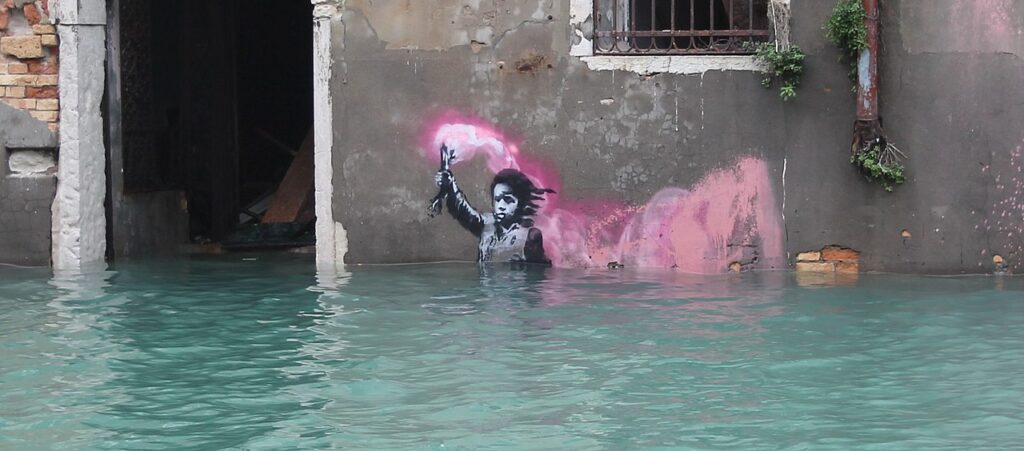
Banksy, “Naufrago Bambino”, realizzato a Venezia nel 2019

Di certo, non ci troviamo di fronte al lavoro più brillante e originale dello street artist, noto per le sue opere polemiche e politiche.

“Game changer”, difatti, risulta pervasa da una patina stancamente buonista e populista, tuttavia non si può non considerare il contesto ospedaliero in cui è stata realizzata e soprattutto il difficile momento storico che il mondo intero sta ancora vivendo. Dunque la lettura dell’opera è immediata. Il messaggio arriva forte, chiaro, non si lascia spazio a fraintendimenti: gli eroi tradizionali sono stati accantonati. Nuovi eroi, umani e senza super poteri, diventano il simbolo della lotta contro un nemico invisibile e pericoloso

Bansky
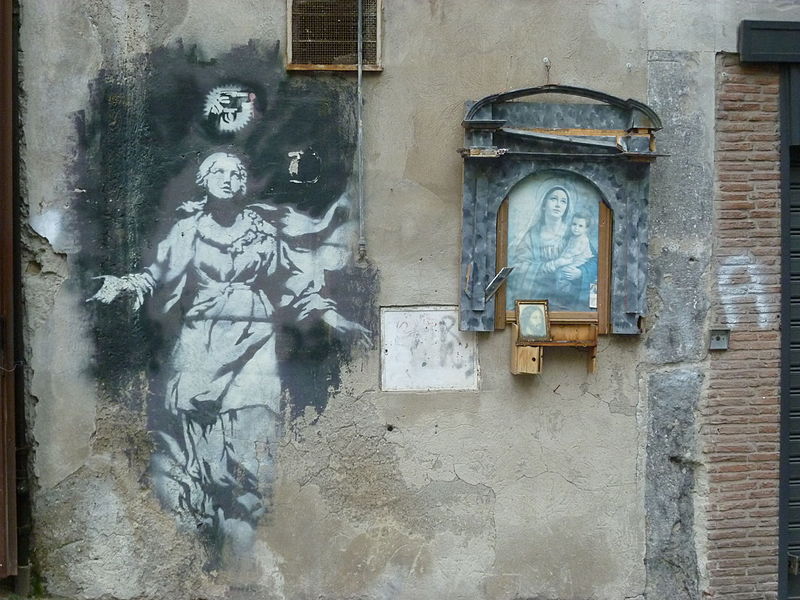
Banksy, “Madonna con la pistola”, Napoli
English Version

EMINENTFIGURES | Fernanda Wittgens. An Italian “monument-woman”

Fernanda Wittgens was an art historian and the first female director of the Pinacoteca di Brera: we owe to her the rescue of most of the paintings in Milan’s museums during the Second World War.

Childhood and youth

Fernanda was born in Milan on April 3, 1903 from Margherita Righini and Adolfo Wittgens. On Sundat her father used to take her and her brothers and sisters to the museums of the city: this habit, almost certainly, instilled in Fernanda the interest and love for art.

Graduated from the classical high school, in 1925 the young girl obtained her master degree in art history at the Scientific-literary Academy in Milan, under the guidance of Paolo D’Ancona. After a period as a teacher at the Parini High School and the Regio Liceo Manzoni, in 1928 Fernanda Wittgens, thanks to her friend Mario Salmi, inspector at the Brera art gallery, was hired as an “adventitious worker” in Brera. The great culture and artistic sensibility allowed Fernanda to have an impressive career progression: in 1931, she become assistant to Ettore Modigliani, director of the Pinacoteca.

Emilio Sommariva, Ritratto di Fernanda Wittgens, 1936. Milano, Biblioteca Nazionale Braidense, Fondo Emilio Sommariva
Emilio Sommariva, Portrait of Fernanda Wittgens (1936)
Racial laws and war

Fernanda worked side by side with Modigliani until 1935, when the director was dismissed from his office because he was anti-fascist (following the racial laws of 1938, Modigliani was sentenced to confinement in the Marche region. Anyway Fernanda Wittgens continued to update him punctually on the events in Milan and the direction of the gallery).

In 1940 Fernanda Wittgens won the competition as director of the Pinacoteca di Brera becoming the first woman in Italy leading a museum (in 1941 she was followed by Palma Bucarelli PERSONAGGI | Palma Bucarelli, la Regina di Quadri). 

When the war began to threat Milan, the first thought of the director was to secure the masterpieces of Brera and other Milanese museums. In spite of the reduced staff, Wittgens managed to save all the masterpieces of Brera and numerous works of the Museo dell’Ospedale Maggiore and the Museo Poldi Pezzoli, transporting them to safe places and air-raid shelters. She worked on the transfer of the paintings until June 1943. On August, 7th and 8th the Pinacoteca di Brera was bombed by the Allies and 24 rooms out of 36 were destroyed, but, thanks to Fernanda, they were empty.

Pinacoteca courtyard
The courtyard of the Pinacoteca di Brera in 1942, with trucks loading the works of art
The trial of the ladies

During the war years, Fernanda Wittgens had worked tirelessly to help friends, family and people of Jewish descent to cross the italian border in order to escape racial persecution. In 1944, however, a young German Jew, whose expatriation Fernanda was organizing, denounced the woman to the Nazis. The famous art historian was jailed first in Como and then in Milan, in San Vittore. Together with Adele Cappelli, Zina and Mariarosa Tresoldi, who were also involved in helping Jews and anti-fascists, she was tried and sentenced to 4 years imprisonment in what the newspapers of the time called “the trial of the ladies”.

From the prison Fernanda Wittgens wrote to her relatives some letters full of pride and bravery. Trough her letters we can see a strong woman, not afraid at all because of the harsh prison conditions. Despite the dramatic situation she continued to firmly believe in her ideals and actions.

The Great Brera, Michelangelo and Leonardo

Released at the dawn of the liberation of Italy, a few months later Fernanda Wittgens is back in Brera, in her place as director, engaged in the reconstruction. Together with Modigliani, returned from confinement, she planned the idea of the “Great Brera”: a museum connected with the other great artistic institutions of Milan, such as the Academy of Fine Arts and the Observatory of Astronomy. The art gallery, enlarged and restored, was finally inaugurated in 1950.  Dr. Wittgens inaugurates a new concept of art gallery, a “living” museum with events, concerts, fashion shows, vernissage, a true cultural heart of the city.

In 1950 the director of Brera was appointed Superintendent of the Lombardy Galleries. Two years later she managed to get the city of Milan to buy Michelangelo’s Pietà Rondanini, recently on the art market.

Among Fernanda Wittgens’ successes is the rescue of Leonardo’s Last Supper. In the early 1950s, when no one believed that the grandiose mural could be saved from its state of decay (already deteriorated by time, it had suffered enormous damage during the war), the Superintendent nevertheless wanted to try and entrust its restoration to Mario Pelliccioli. The painting was finally reopened to the public on May 30, 1954.

Fernanda Wittgens
Fernanda Wittgens in her studio in Brera (1955)
Righteous among the Nations

Fernanda Wittgens died prematurely in 1957, only 54 years old.

A street in Milan, in the central San Lorenzo neighborhood, is dedicated to her. In 2014, for her aid to the Jews, she was named “Righteous Among the Nations”, a tree was planted in her name and a memorial stone was erected in the Garden of the Righteous in Milan.

Tradotto da: https://archeome.it/personaggi-fernanda-wittgens-una-monument-woman-italiana/

English Version

ARCHITECTURE | The Gothic in Sicily, the affirmation of a new style

Between the 13th and 15th centuries Sicily experienced a long period of political instability, during which numerous sovereigns reigned, including the Hohenstaufen of Swabia (1198-1266), the Angevins (1266-1282), the Aragonese (until 1516) and the Spanish (until 1713). They shared a welcoming spirit in a remote land, creating masterpieces which were disregarded in the rest of the peninsula. This is how the Gothic style developed in Sicily.

The military buildings of the Hohenstaufen family

Under the domination of Henry VI (1194-1197) and, above all, of Frederick II, whose reign lasted even longer (1198-1250), the numerous religious buildings and palaces inherited from the Normans were preserved. These rulers marked their era with the construction of strongholds, designed by architects from northern Europe: Gothic style arrived in Sicily in the 13th century in the form of fortified architecture.

The castles of Syracuse (Castello Maniace), Catania (Castello Ursino) and Augusta date back to this period, as do the fortifications of Enna’s castle, the strategic centre of the island, occupied since the Byzantine era, of which eight imposing towers remain. These buildings were characterised by a strongly geometrical plan (square structure with angular or median towers), portals or pointed arch windows, bare and austere walls, dominated by slits and merlons; finally, there were also rooms with ogival vaults.

The 14th century and the chiaramontano style

An important contribution to the development of Gothic architecture in Sicily was made by the Chiaramonte family. Powerful Sicilian lords for almost the whole fourteenth century, they established themselves thanks to the weakening of royal power. They also demonstrated their influence through the numerous constructions of civil and religious buildings; on these, they imposed as their artistic seal, which later became the family mark, the zigzag moulding, applied to portals, columns and mullioned windows, borrowed from the Arabs and adopted by the Normans.

From the second half of the 13th century, when the Sicilian population of Arab origin converted to Christianity, the Arab architectural influence in the construction of religious buildings and civil dwellings disappeared. The decorative zigzag motifs, imported from the East to Sicily, were applied by the Normans in many buildings: in Palermo, in the columns of the Palatine Chapel of the Palazzo dei Normanni, in the mullioned windows of the Monastery of San Salvatore in Cefalù and in the upper façade of the Cathedral.

In Agrigento and in several centres of the same province, this style, called “chiaramontano”, had a greater presence than other Sicilian sites; this is because the state owned city of Girgenti, for a certain period, was under the direct jurisdiction of the Chiaramonte family, who made it the artistic peak of 14th century architecture.

Among the buildings included in the so-called “chiaramontano style” Palazzo Chiaramonte is worth of special mention. It is called “lo Steri” and it is located in Piazza Marina in Palermo. It was the residence of an important Sicilian family; also worthy of notice is its façade of refined beauty, crowned by slits and decorated only with splendid windows with pointed arches. On the inside, there are various rooms and chapels with ogival vaults, a large room and ceilings with frescoes, recalling biblical and chivalrous scenes, attributed to the three Sicilian painters Simone da Corleone, Cecco di Naro and Darenu da Palermo.

All the subsequent urban palaces were built on the basis of these examples, characterised by mullioned and three-light windows, surmounted by drain arches both openworked and decorated with polychrome geometric motifs.

Gothic-Catalan art of the XV century

Catalan Gothic art developed in Sicily following the Spanish domination of the island from the end of the 14th century with the reign of the Aragonese. This development, clearly behind other European countries, was endorsed by the Catalan-Aragonese confederation, which became one of the greatest powers in the Mediterranean from the 13th century onwards. At the behest of the confederation, interest in a relatively sober Gothic style spread on the island, characterised by refined figures, a sense of proportion, breadth of form and large windows, open onto smooth, bare façades.

To this period belong the palaces Santo Stefano and Corvaja, in Taormina, the portal of the Cathedral of Palermo and the Bellomo palace in Syracuse. It seems useful to mention the artist Matteo Carnelivari, who, towards the end of the 15th century, designed the plans for the Abatellis, Aiutami Cristo palaces and, probably, also those of the Church of Santa Maria della Catena, in Palermo. These are the most representative creations of Gothic-Catalan art, characterized by Byzantine, Arab and Norman elements deriving from the most ancient local tradition.

Tradotto da: https://archeome.it/architettura-il-gotico-in-sicilia-laffermazione-di-un-nuovo-stile/

English Version

THEATRE | The curtain falls to the theatre Vittorio Emanuele of Messina in 2020

The curtain fell before their start on many of plays and ballets scheduled in the 2019/2020 artistic season of the theatre Vittorio Emanuele of Messina. Like all other national theatres, even the historic one in the city of the Strait closed its doors for the second time this year, in compliance with the new Prime Minister’s Decree that establishes and tightens measures to contain the spread of COVID-19. The theatre season showed a great start in October last year with Bram Stoker’s “Dracula”, directed by Sergio Rubini together with Luigi Lo Cascio. Full house and a warm welcome from the audience.

Before the closing of the theatres last March, the brilliant and hilarious “Massimo Lopez and Tullio Sollenghi show” amused, entertained and even touched the loyal visitors of the former trio, now a duo, of italian comedians, for two hours and non-stop.

Indeed, the curtain fell but not the desire to go back to sit on the red armchairs, enjoy the darkness in the audience in the moments before the start of a show, as much a play, ballet as opera, and then witness the magic that only the stage of a theatre can give to fans of the genre. The shows, scheduled for the 2020/2021 season, are for now suspended and postponed to a later date. Let us hope that it will be as soon as possible.

History

The Vittorio Emanuele Theatre of Messina was commissioned by Ferdinand II of Bourbon in 1842 and saw its inauguration ten years later. Due to the devastating earthquake of 1908 it was seriously compromised and underwent extensive restoration work, which almost entirely rebuilt it and ended only in 1980. It was inaugurated again in 1985 and the first opera represented was “Aida”, the last to be performed before the earthquake.

The layout of Vittorio Emanuele Theatre

The entrance to the theatre is characterized by a three-arched portico, surmounted by the marble sculptural group “Time that discovers the Truth and Messina” created by the Messina sculptor Saro Zagari. The internal ceiling is decorated with a huge work by Renato Guttuso, depicting the myth of “Colapesce”, which dives into the waters of the Strait, surrounded by sirens. The fresco overlooks the stalls and offers a glimpse, with fairytale tones, of the depths of the sea and legend has it that the heroic swimmer supports even today the Messina tip of the island.

Tradotto da: https://archeome.it/teatro-il-vittorio-emanuele-di-messina-cala-il-sipario-sulla-stagione-2020/

English Version

BEHIND THE FASCISM | Scipio the African, the clay giant

During the Fascist period, theatre and in particular cinema, had to adapt to a new mentality, that of the mass regime. One of the most important examples is certainly the production of Scipio the African. The blockbuster film of 1936-1937, directed by Carmine Gallone, exalted the imperial power of Rome identified with that of Fascism and superimposed the figure of Mussolini victorious over the Ethiopians on that of the Roman general.


Poster of Scipio the African (1936-1937)

Carmine Gallone, a cosmopolitan director

Carmine Gallone was defined by critics as a “cosmopolitan director” for his productions abroad, carried out between 1926 and 1935. He made hundreds of silent and sound films. He had great mastery of technical innovations such as feature films, sound, playback in opera films, the introduction of colour and style changes from realist to historical films.


The director Carmine Gallone

The plot of Scipio the African

Scipio the African reconstructed the events of the Second Punic War, from the departure of Scipio for Africa in 207 BC to the Battle of Zama in 202 BC. The consul Scipio, adored by the Roman people, obtains control of the province of Sicily from the Senate and prepares the military campaign against the Carthaginian army. Veterans of the Battle of Cannae join the departing troops as large numbers of volunteers flock from all over. Meanwhile, Hannibal is stuck in the Bruttium due to lack of food, so his troops plunder villages and crops. The soldiers break into the villa of Velia, a Roman noble and take her prisoner together with her fiancé Arunte and the servants. In Cirta, Sofonisba, the daughter of Hasdrubal, pushes her husband Syphax to ally with the Carthaginians. Scipio, after having besieged Utica and defeated the army of Hasdrubal and Syphax, prepares to face Hannibal, who leaves Italy to defend Carthage. Velia and Arunte manage to escape and reach Scipio’s camp. The two generals face off, Scipio on a white horse, Hannibal on a black one. Elephants hinder Roman soldiers, but the union of cavalry and infantry guarantees victory. Hannibal escapes along with a few other survivors while Scipio, having thus avenged the Battle of Cannae, returns to Rome, where he is celebrated with a night party.


Scene from Scipio the African (1937)

The critics’ opinion

The making of Scipio the African was done in ten months of work and cost about eight million lire. It constituted the greatest organizational effort made by the film industry for the use of masses, for the splendour of the interiors and for the impressive reconstructions. Despite this, it was considered by the critics of the time a total failure for several reasons: it represented an opera film both for its dramaturgical construction and extras (such as the choir) and for its music and theatrical acting; there was no collaboration between the various, indeed too many, assistant directors; others pointed the finger at the production and not the director, considered only a coordinator. The interpretation of Annibale Ninchi in the role of Scipio was considered negative, not loved by the crowd, not very charismatic. He could not bring the strong and daring figure of the Roman leader onto the screen, unlike the character of Hannibal played by Camillo Pilotto. The bad interpretation of the figure of Scipio consequently accentuated the melodramatic character of the film. The difference with the American blockbusters, which were based on strict rules and divisions of tasks supervised by the producer, was clear. Hard enough judgments on Scipio the African were also found in modern criticism. Carlo Lizzani wrote:

Scipio the African is the classic clay giant who would like to glorify impossible relationships between fascism and Roman times. The film is as redundant as it is provincial and painful is Mussolini’s illusion of resembling the Caesars.

Scipio the African (1937). Carlo Nicchi, Fosco Giachetti, Francesca Bragiotti

A political project

The film, wanted by Mussolini, had to be a productive and spectacular challenge, in competition with American cinema, and it was an opportunity to highlight the conquest of Ethiopia and the colonial empire created by the Duce. Scipio was not supposed to be just a film, but a blockbuster capable of being superior to all the other films shot up to that moment. The Scipio project was simply a political project, it was not created for the show and Gallone, naively, accepted advice and suggestions from everyone, especially from those who saw the world of cinema and, in general, of the show only as a propaganda medium for political consensus. This explained the reason why Mussolini chose Gallone as his own director: a director with experience, especially foreign, able to adapt to any circumstance and above all politically compliant.


Mussolini on the set of the film

Mussolini as Scipio the African

Scipio the African was a film made to celebrate the glories of ancient and new Rome and two important personalities: Scipio and Mussolini who, despite the chronological gap, had accomplished the same feat. While Scipio had defeated one of the greatest powers of his time, Mussolini had used advanced technologies to destroy a backward army, from that point of view. After the successful African feat, fascism presented itself as a new imperial power. A power that had changed the fate of Italy, which from a backward country became an economic and military power. The African feat pleased the masses, because in those subaltern regions they would find the job and land they had long sought. Africa was seen as a long-dreamed myth and achieved only thanks to Benito Mussolini. The African victory raised nationalist morale, but on the historical level there were negative outcomes with regard to international relations. Italy was moving away from Western democracies, getting closer and closer to Hitler’s Nazi Germany; the Second World War will sweep away the memory of the colonial conquests, which were immediately compared to the conquests of the Roman Empire. Scipio was considered a film that united the Italians and spurred political consensus towards Fascism and the Duce.


27 October 1937. The audience waiting to watch the film in front of the Barberini Theatre in Rome

The contrast between Roman and Carthaginian society

The creation of Scipio the African inevitably led to the launch of the figure of the Roman leader and, consequently, Mussolini became the main protagonist. The figure of the Duce was charged with a mystical halo, almost a divine light. The film inserted within it a considerable amount of symbols and also put Roman society in contrast with the Carthaginian one: the Romans were presented as a model of discipline, while the Carthaginians as hateful people who did not respect the truce and were ferocious with women. Carthaginian society was devoid of moral principles and dominated only by the god of money, as England was considered in the time of Mussolini. On the contrary, Roman society, after Scipio’s seizure of power, was compact and constructive, based on popular consensus. Scipio like Mussolini, was considered a predestined, a natural leader who had a privileged relationship with the people.


A bogus classicism

Scipio was a failure on several fronts. The film represented the end of the film made for the masses trend and Garrone, despite his long and satisfying career, will remain forever labelled as the director of Scipio the African. Scipio’s production shows how the myth of ancient Rome was widely used by fascist propaganda and how it was modified and shaped according to Mussolini’s ideas only. A use of the past, however, that risked reducing history to a myth, leading to a bogus classicism, emptied of content and reduced to a simple celebratory aesthetic.

https://archeome.it/wp-admin/post.php?post=8472&action=edit