English Version

English Version

BEHINDFASCISM | The University City, a State Art

The University City project was a symbol of fascism and the whole Rome. The complex, inaugurated on April 21, 1935, represented an important venture for the regime because Mussolini decided to concentrate the buildings in a single area, to examine and modify the different designs and to visit the site often. The complex became a work created for the people and was somehow sanctified by the people.

A collective design

Mussolini entrusted Marcello Piacentini, academic of Italy, with the task of creating this large complex of buildings that was to constitute not only the University of Rome but the largest study center in Italy and the Mediterranean. Together with Piacentini, many others were the architects called by the Duce to collaborate, so that it would be a collective design enterprise. In spite of the work of the various architects, a unity of style was created, since the classic type of basilica and common architectural elements were used, such as the use of the same windows and the same covering materials such as travertine and yellow or red plaster.

The architectural approach

The chosen plot of land, in a quadrangular shape, is located between Viale del Policlinico, Viale dell’Università and Viale Regina. The different institutes are grouped around a central empty space, the center of the project. An essential project, with monumental visions, avenues and gardens. The monumental entrance, formed by high and solemn propylaea, opens towards Viale del Policlinico, 60 m wide, bounded by the buildings of the different faculties. In front of the Avenue, on its axis and placed to close the long side of the Forum, stands the building of the Rectorate and the Library, which forms a unitary complex with the buildings of the Faculties of Humanities and Law. The tree-lined avenue flows into a large transversal space, a square measuring 68 x 240 m, similar in size to Piazza Navona. At both ends stand the Institutes of Mathematics by Giò Ponti and the Institute of Mineralogy, Geology and Paleontology by Giovanni Michelucci. In the rear part, near the Aula Magna, there was a large square used for meetings and various ceremonies. Many areas were used for parks and gardens, such as the quadriporticus built on the left side of the avenue. The pronaos, the travertine pillars, the large windows framed in red marble, the statue of Minerva placed in front of the atrium represent a harmony of form and values.

General plan
The great avenue seen from the Rectorate building
The entrance porch seen from the outside
Building technology

The construction of the buildings was caged in reinforced concrete with the foundations consisting of concrete poles. The external facades were covered with a curtain of lithoceramic and Roman travertine. There were many special applications, such as glass brick cladding, lightweight reinforced concrete floors or glass-cement canopies.

The Rectorate building with the statue of Minerva
Architecture as a style of the fascist era

The University City is a successful experiment of collaboration and coordination that will be re-proposed with the E42. The simple architecture does not renounce the modernity born in a classical and Mediterranean climate. A political and artistic compromise: the point of equilibrium will then be found according to the orientations and needs that the Regime required for the realization of modern architecture as a style of a fascist era, a State art.

Aerial view of the University City

Tradotto da: https://archeome.it/dietro-al-fascismo-la-citta-universitaria-unarte-di-stato/?fbclid=IwAR0sYuuDNYoXsczLCjuLfg36kbQET3WBm3HTpHNBKwYX3gge5gmSmiWlWpg 

English Version

ARCHAEOLOGY | The Baths of Caracalla, wellness center of antiquity

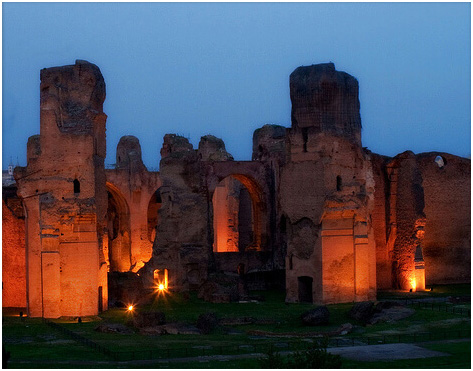
The Baths of Caracalla or Antoninian Baths were built by the Emperor Caracalla on the Aventine, between 212 and 217 A.D., as shown by the brick stamps. The external enclosure was, instead, the work of Elagabalus and Severus Alexander. Majestic and rich with precious ornaments, they were destined to the people of the nearby working-class quarters of the XII Regio and could contain about 1600 people. Polemius Silvius, in the V century, cited them as one of the seven wonders of Rome.

A unique complex

The baths were one of the favorite places of entertainment for the ancient Romans, where they regularly took care of their hygiene and improved their social relations.

From the structural point of view, they distinguished themselves from the “great imperial thermal baths” (a very common building typology, in fact, at the beginning of the V century A.D., there were 856 of them!) for a substantial novelty: the real thermal nucleus is clearly separated from all the other secondary and service rooms, that are not for bathing, which are located along the whole enclosure.

In the vast enclosure occupied by the Baths, citizens could not only use the public baths, but also devote their free time to sports, reading in the library, strolling through the gardens or paying homage to the god Mithras and other pagan gods by visiting the temple.

The Baths of Caracalla are an architectural and engineering marvel, especially when you consider their date of construction, with their water supply system, as well as heating and drainage. The wood-fired ovens, fed by slaves, were used to heat the floor and walls of the baths, as well as water.

The water supply was obtained from a branch of the Acqua Marcia: the Acqua Antoniniana, an aqueduct specially built in 212 A.D. and enhanced with a new spring. The heating of the water was provided by the fireplaces on the lower floors, the hypocaustics, which spread hot air in the cavities under the floor, supported by short brick pillars. Covered in marble and decorated with excellent works of art, those of Caracalla were the most sumptuous baths built in antiquity.

The thermal path
pianta Terme di Caracalla
Map of the Baths of Caracalla

One entered the central body of the building from four doors on the north-eastern facade. On the central axis you can observe different rooms in sequence: the calidarium, equipped with a large circular tank for immersion in hot water; here, to make the body absorb the moisture of vapors, the skin was sprinkled with water and a little soda, used instead of soap, cleansing with the strigilis, a metal scraper of curved shape suitable to remove the grease left on the skin by the combination of oils, ointments and sweat.

Continuing on, there was the tepidarium, equipped with tanks with lukewarm water to accustom the body slowly to the change in temperature, and then the frigidarium. This basilical hall (or cold room) is the focal point of the complex. Here the body was refreshed and invigorated, immersing itself in the four cold water tanks, placed at the corners of the room, which had to be covered. Finally, the natatio, where the ritual of bathing ended with a dip in the pool of very cold water.

At the sides of this central axis other rooms are arranged symmetrically around the two gyms. All the rooms were particularly well cared for and the spaces were enhanced with mosaic floors, walls covered with stuccoes, polychrome marble and, above all, hundreds of statues that decorated all the rooms. Sometimes special effects were also created. The mosaics, for example, often covered the interior and the bottom of the pools, perhaps with representations of fish and marine animals that the movement of the water made them seem alive!

ricostruzione
Reconstruction of the Baths of Caracalla

Tradotto da: https://archeome.it/archeologia-le-terme-di-caracalla-centro-benessere-dellantichita/

English Version

THEATRE | The Greek pearl of Taormina, the Ancient Theatre

The Ancient Theatre of Taormina is the second largest ancient theatre in Sicily, after the one in Syracuse. 

It was probably built around the third century B.C., during the government of Hiero II, tyrant of Syracuse: this is testified by the engraving on some steps of the name of his wife, Philistis. The whole structure was later restored and enlarged in Roman times, more precisely in the imperial age: in fact, in the second century A.D. columns, statues and roofs were added.

The structure of the Ancient Theatre

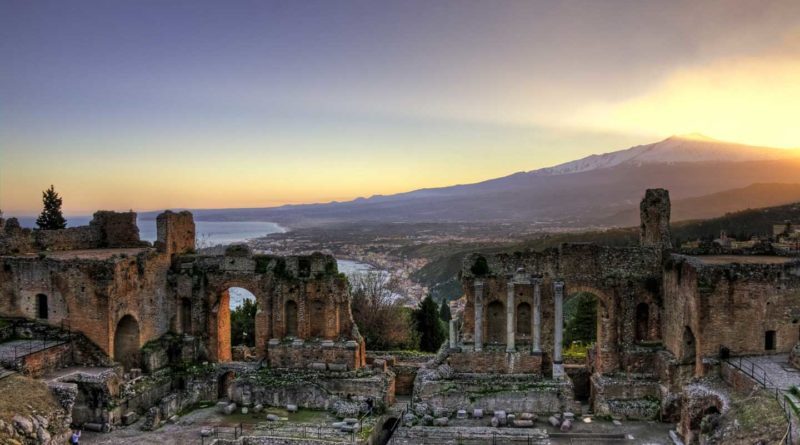
Originally the theatre was composed only of a small central structure, then it reached a maximum diameter of 109 meters; it was also built the space for the orchestra with a diameter of 35 meters. The cavea had a capacity of 10,000 spectators (today 4,500) and is divided into 9 sectors. At the top of the steps there is a double portico, on the wall of which there are 36 niches, which probably in the past had housed some statues. In the late antique period the portico behind the scene was built with the three large openings, delimited by some niches and columns, brought back in situ in the 19th century by the architect Cavallari.

The Greek shows and the Roman venationes

During the late-imperial age, the theatre, born to host performances of tragedies and comedies, was intended for the performance of venationes. These were performances of gladiator and ferocious animal fights: the arena took the place occupied by the orchestra and the lower steps were replaced with a vaulted scenic corridor leading to a hypogeum in the center of the esplanade. From here gladiators were introduced and special effects machines were installed during the fight.

The Ancient Theatre today

The conformation of the Ancient Theatre of Taormina lends itself to many destinations. Since the ’50s it has hosted various forms of entertainment, from theatrical performances to concerts, from award ceremonies (such as the David di Donatello) to opera and ballet. Its season, being an open-air theatre, is mainly summer. It has hosted concerts by many contemporary artists such as Elton John, Mika, Duran Duran, Sting and Renato Zero, to name a few.

concert
Concert at the Ancient Theatre


The “Taormina Film Fest”, an international film festival that attracts VIPs from all over the world, deserves a mention.

A curiosity: in 2017 it was home to the G7 parade, the international intergovernmental economic organization composed of the seven major economic powers in the world.

The strengths

Why is the Ancient Theatre of Taormina the best known and most admired in the world?

Etna in eruption (Photo credits: ANSA/Carlo Papale)

It can be defined as a pearl set in a breathtaking scenery: behind the scene nature creates a spectacular backdrop with its colors; the blue of the sea meets the Etna massif, which not infrequently gives evocative scenery with its rivulets of lava; on the other side you can see Giardini Naxos, which in summer comes alive with lights and colors. Visiting it during summertime, at sunset, is an experience worth living.

Tradotto da: https://archeome.it/teatro-la-perla-greca-di-taormina-il-teatro-antico/

English Version

ARCHAEOLOGY | Panarea, the oldest of the Aeolian Islands

Panarea, the ancient Euònymos, from the geological point of view is the oldest of the Aeolian Islands. It is also the smallest and the least elevated island of the Aeolian archipelago. It includes a whole series of islets (Basiluzzo, Spinazzola, Lisca Bianca, Dattilo, Bottaro, Lisca Nera and the rocks of the Panarelli and the Ants) which together form a micro-archipelago located between the islands of Lipari and Stromboli.

The history of Panarea

The oldest evidence of life on this island dates back to the end of the Neolithic period. The finds belong to the culture of Diana (end of the 4th millennium B.C.) and are located in Calcara and on Piano Cardosi, as well as on Lisca Bianca. It is only during the Eneolithic period that the first village is located in Piano Quartara, a place from which the culture that characterizes the final period of the Eneolithic period takes its name.

The ancient Bronze Age, represented by the culture of Capo Graziano, has left its traces in a series of wells dug in the fumaroles’ area: they are votive wells, related to the cult of a deity linked to the healthy power of fumaroles. Recently, thanks to sporadic discoveries on the tip of Peppa Maria, archaeologists thought that there was a small stable settlement here.

However, the most important prehistoric intervention is certainly on the Middle Bronze Age village of Punta Milazzese. The inhabitants of this village, like contemporary villages on the other islands, were dedicated to the control of commercial maritime routes. After the decay of the Thapsos-Milazzese culture, the island became a destination for Etruscan raids but remained uninhabited until the fifth century BC.

Little is known about the Panarea of the classical age. The only certain news is that, during the imperial age, the islet of Basiluzzo was chosen as location of a villa. Also to this period belongs the pier that, due to geological phenomena, today is four meters below sea level. As evidenced by a fragment of a Christian altar table, Panarea must have been inhabited at least until the Byzantine period.

The Museum

Panarea is home to a detached section of the Aeolian Regional Archaeological Museum. Inaugurated in 2006, it is located in two adjoining rooms belonging to the Church of St. Peter. The first room presents the life of the island under different aspects: geological, volcanic and naturalistic. In addition, there are exposed the testimonies of the material culture dating back to the Upper Neolithic and the Ancient Bronze Age. The second room, instead, exhibits the materials of the classical age. Most of them are ceramic fragments with black paint and African sigillata from the funerary contexts of Drautto. The exhibition is completed by a series of finds from underwater contexts: Greek-Italic amphorae, Dressel and Cretans, as well as black painted pottery that belonged to the loads of the Dattilo Wreck and the Alberti Wreck.   

Tradotto da: https://archeome.it/archeologia-panarea-la-piu-antica-fra-le-eolie/

English Version

EMINENT FIGURES | Edda Bresciani, the “Lady of the Fayyum”

Edda Bresciani was an archaeologist and Egyptologist, Professor of the University of Pisa and a true “myth” of Italian Egyptology.

Born in Lucca on September 23, 1930, after classical studies she enrolled in the Faculty of Humanities in Pisa. The Faculty, as Bresciani recalls, was at the time the only one considered really suitable for a woman, because it was considered not intellectually demanding. However, the very young Edda immediately managed to subvert the established order, preparing her thesis on a subject that was almost unknown in Italy in the ’50s: Egyptology, of which at the time there were only two professorships in Italy, one in Milan, the other in Pisa, both entrusted to Sergio Donadoni.

The first Egyptologist

Edda Bresciani, in fact, was in 1955 the first Italian graduate in Egyptology. This event was followed by three years spent abroad, during which the young Egyptologist moved between Copenhagen, Paris and Cairo, to deepen her knowledge in language (demotic and hieratic), epigraphy, philology and archaeology. In fact, the Professor used to say, since graduation her approach to the subject was always been interdisciplinary. The aim was to find a synthesis between archaeology, history and philology, including, however, also civilizations geographically close to Egypt.

In 1968, with the establishment of a teaching post in Pisa, Edda Bresciani became the first female professor of Egyptology in Italy (only Sergio Donadoni in Milan and Giuseppe Botti in Rome were already tenured since 1958).

Edda Bresciani's portrait
Edda Bresciani in a portrait of the ‘60s
Medinet Madi and the Fayyum

The life of Edda Bresciani was not only linked to the Pisan chair of Egyptology, but also, and perhaps above all, to the Fayyum region, where she worked until 2011.

Here, from the mid-60s, excavation activities were resumed, first with the University of Milan, until 1969, then with the University of Pisa. Already in 1966 Bresciani was Director in charge of the mission in Medinet Madi, the large site of the Fayyum region, already investigated by Achille Vogliano in the ’30s.

Medinet Madi has also been protagonist of a series of international cooperation projects with Egypt for restoration and musealization. In the 2000’s, in addition to field research, two projects were launched: the creation of a large Visitors’ Centre and a restoration project aimed at the creation of the Archaeological Park (ISSEMM project, in collaboration with the Egyptian Supreme Council of Antiquities and the Italian Ministry of Foreign Affairs). Since 2011 Medinet Madi is an Archaeological Park administered by the Egyptian government.

Edda Bresciani in Medinet Madi
Looking for another Egypt

In 1974 Edda obtained for the University of Pisa the concession to excavate in the area of the necropolis of Saqqara, excavating the tomb of Bakenrenef, vizier of Psamtik I – founder of the XXVI Saitic dynasty (664-624 B.C.) – which, although already plundered in 1800, returned splendid finds and wall paintings. Remarkable is the discovery of a large canvas painted in tempera, dating back to Roman times, currently on display at the Cairo Museum.

Since 1978 she also directed the excavations in Gurna, near Thebes, where the workers gave her a statuette, which depicts her as a Pharaoh, with her name written in hieroglyphs. In the same year she founded the journal Egitto e Vicino Oriente, of which she is still the director.

Her personality and the spontaneity with which she relates to colleagues and workers earned her, in the Fayyum, the nickname of Mudira (from the Arabic mudir, “boss”), a word that, in the feminine sense, did not exist until then.

Archaeology and the Arab springs

Although Edda Bresciani has never officially taken a position on the various political upheavals that followed the so-called “Arab Spring Season” from 2011 onwards, the archaeologist from Tuscany  continued to manage bilateral relations in the cultural sphere by working for the conservation and protection of the archaeological heritage that she had helped to rediscover for almost half a century.

The Egyptologist has been awarded numerous honors: from the Medal given by the President of the Italian Republic to the distinguished individuals for Science and Culture in 1996, to the “Campano d’Oro” prize of the University of Pisa in 2012.

Edda Bresciani  passed away on November 29, 2020. She worked to her researches until the end. 

Tradotto da: https://archeome.it/personaggi-edda-bresciani-la-signora-del-fayyum/

English Version

ANCIENT EGYPT | The metamorphosis of the Egyptian pyramid

The Egyptian funerary architecture developed in monumentality during the Old Kingdom with Djoser, pharaoh of the 3rd dynasty. Thanks to this sovereign, but especially to the ingenuity of his architect Imhotep, we have the transition from the mastaba (Arabic word meaning literally “bench”) to the pyramid, which becomes a royal burial or funerary temple.

The first pyramid

Djoser had the mastaba built inside his funerary complex in Saqqara, on a square plan; in a second time he added a stepped superstructure, raising the monument gradually with other levels, until it reached a height of about 60 meters. For this reason, it was necessary for the construction of the pyramid to choose a place with a solid rocky ground, which was able to support the weight of the structure.

Other pharaohs followed Djoser’s example, having other step pyramids built; then with Snefru, founder of the 4th dynasty, there was a turning point: from a step structure, the pyramid was transformed with smooth faces.

With Snefru’s successor, Pharaoh Cheops, perfection was achieved: the dimensions of the monument, in fact, are the result of complex geometric and astronomical calculations. The Greek historian Herodotus (5th century B.C.) states that it took thirty years to build it, involving a hundred thousand men (reliable figures, according to modern historians) for cutting, transporting and laying the stones.

What the pyramid was hiding
piramide interno
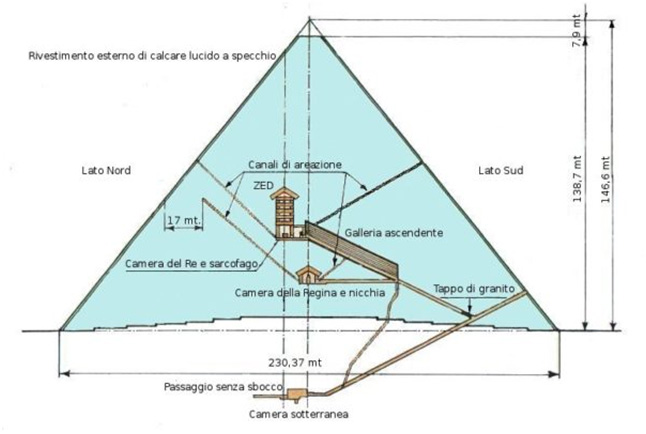
Inside the pyramid of Cheops

Like the other pyramids, the one built by Cheops was not accessible from the outside, while on the inside it contained some funerary rooms. The cell for the burial of the pharaoh, generally located at the base of the building, here is exceptionally almost at the center, surmounted by 9 granite monoliths. It was entirely covered by slabs of white limestone, on which hieroglyphs were carved. Finally, at the top of the imposing structure the pyramydion stood out, the tip of the pyramid, consisting of a single block of granite covered with electrum – an alloy of gold and silver – which reflected sunlight over long distances.

Egyptian architects designed a sort of labyrinth to try and make the pharaoh’s funeral chamber inaccessible. In spite of these precautions, however, the pyramid was repeatedly violated by grave looters, who, having penetrated the interior, took away everything precious that was kept there. The construction technique was realized through the method of the wrapping ramp, built around the pyramid and made with various layers of bricks, easily removable at the end of the works.

The funerary complexes of the 4th dynasty

The pyramids of Chefren and Menkaure (more commonly known as Mycerinus) in Giza reproduce, on a smaller scale, the features of Cheops’ pyramid, but with a richer aesthetic value, playing on the contrast of color between the granite used at the base of the structure and the layer of limestone above.

complesso funerario Chefren
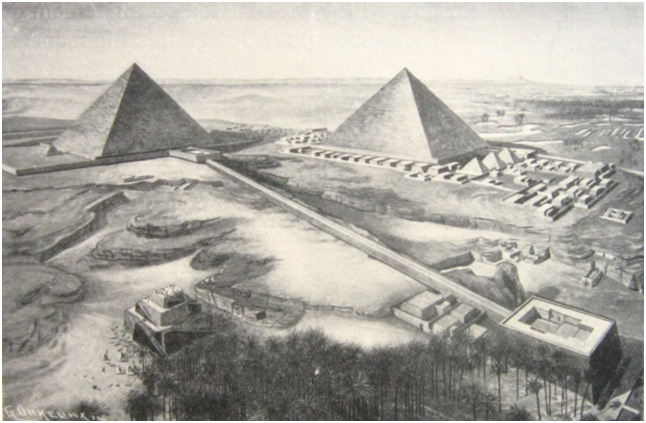
Reproduction of Chefren’s funerary complex; below on the right, the valley temple

Djoser’s successors also added an access ramp and the so-called “valley temple” or “lower temple” (also known as the “welcoming temple”), which became an integral part of the funerary complex; this was a building whose main function was to prepare the deceased ruler for the journey to the afterlife. To make the access easier, an artificial canal was often dug, connecting the Nile to the temple, on whose quayside the funeral procession or sacred boats docked to worship the sovereign.

Tradotto da: https://archeome.it/antico-egitto-la-metamorfosi-della-piramide-egizia/

English Version

BEHIND FASCISM | E42, the relationship between regime and architecture

The E42 project represents the most important episode of the fascist will; with its construction the relationship between regime and architecture is given a turning point. The Duce identifies the “Mussolinian city” with the architecture that recalls Roman classicism. The project was born from the idea of Giuseppe Bottai, Governor of Rome who proposed in 1935 to Mussolini the intention to organize a Universal Exhibition in Rome. The idea was to create the “Olympics of Civilizations”, which would formalize the arrival of Italy to peace and cultural confrontation with other nations. The Exposition is called E42 because the end of the work was in 1942, the twentieth anniversary of the seizure of power by the fascists.

The seat of E42

The E42 is a project consisting of permanent buildings, with the exception of the Palace of Water, Light and Tourism, which were to make way for further expansion of the city. An area of about 400 hectares was chosen, located in the southern part of Rome, near the Abbey of the Three Fountains, thus intensifying the connections between the city and the sea.

The project team

Mussolini appoints as commissioner Vittorio Cini, a man from industry and finance, and personally chooses the six architects to whom he entrusts the realization of the project: Pagano, Piacentini, Piccinato, Muzio, Rossi and Vietti. The construction of the E42 involved everyone, not only the insiders. The Duce on this occasion speaks of peace and collaboration between nations, but in reality he aims at economic success to strengthen the coffers of the State and cope with the war effort, not expected before 1943-1944.

The Roman Castrum

The E42 was conceived with the typical Roman castra scheme, with glass and steel palaces, all referable to a single style, the “E42 style” of the XXieth Fascist Era. An expression that revealed the trends of an era, therefore classical feeling, monumentality and grandeur.

Urban project of the E42

In the second version of the project, produced in 1938, Piacentini took direct control of the operation. The architect used classical styles such as the arch, the colonnade and the exedra. You were faced with an almost suspended atmosphere, tending towards solemnity. Much of the surface area was occupied by parks and gardens.

The entire project was based on the system of the cardo and decumanus maximus: the cardo was via Imperiale, which would connect Rome to the sea, while the decumanus was the axis that connected Palazzo dei Congressi with Palazzo della Civiltà e del Lavoro. At the intersection of the two streets, the Piazza Imperiale, the scenographic heart of the entire project, is grafted onto the four symmetrical buildings that were to house the Museums of Arts and Popular Traditions and the Museum of Science. This type of system recalls the acropolis of Selinunte and the agora of Miletus, while the pentagonal shape of the plant is inspired by the plan of Versailles by Blondel; lastly, the green areas recall those of Villa Aldobrandini in Frascati.

The Imperial Gate and the Sea Gate

The monumental entrances were the Imperial Gate and the Sea Gate, which led to the entrances of the Exhibition. For the Imperial Gate, the architects initially thought of an aligned sequence of towers, but then they opted for a line of fountains. Unfortunately, the interruption of work due to the war prevented its realization. The Sea Gate, on the other hand, was a monumental arch that was to cross Via Imperiale, south of the artificial lake. Among the various projects presented, the one that was approved was by the engineer Covre, with two aluminum alloy arches of 200 and 320 m of light. The final project was completed in March 1941, too late to carry out the work.

Project of the Sea Gate of Adalberto Libera, 1942
INA and INPS Palaces

The final structure of the Exhibition involved several changes in the arrangement of the first entrance square, with the introduction of the two opposing exedras that gave shape to the two buildings of the INA and INPS, in the area of the large artificial basin of the lake, where one can see a reference to the Trajan’s Markets. The double colonnade of the exedras did not have a static function, but only a decorative one and it was made of marble. In addition, the two buildings were adorned with four colossal bas-reliefs of square shape.

INA Palace, EUR
EUR in the fifties

In 1940, due to the outbreak of the Second World War, many monuments of the E42 were not completed and the immense building site was abandoned, taking on an almost ghostly appearance.

The works were resumed, under the guidance of Virgilio Testa, Secretary General of the Governorate of Rome, only in the ’50s. The entire area, renamed EUR, was transformed into a district for offices and residences and became the site of the Olympics in 1960.

The EUR area in the 1950s
The architecture of the E42

The architecture of E42 addresses the masses. It represented an instrument for their education in the fascist sense and a testimony to the mission of civilization. The architecture of the Empire symbolized the myth of Romanity, immediately grasping the link between the modernity of the present and the ancient Roman tradition. In ancient Rome the Duce saw the model of a relationship between the individual-artist and the community, to be taken up and framed in the totalitarian conception of the State.

Tradotto da: https://archeome.it/dietro-al-fascismo-le42-il-rapporto-tra-regime-e-architettura/

English Version

ARCHAEOLOGY | Cassiodorus’ Scolacium

Scolacium, the city of Cassiodorus, also known as Scylletium, is an ancient coastal city of Brutium, whose foundation dates back to the mid-sixth century BC by Greek settlers, perhaps from Athens or Kroton. We find ourselves in a scenic place, overlooking the sea on the Gulf of Squillace, where among centenary olive trees the monumental remains of a Byzantine basilica stand out. However, Scolacium has a history much more distant in time, that of Magna Graecia and ancient Rome.

History of ancient Skylletion

Because of its strategic position on the sea, it had great importance within the balance of Magna Graecia, being located between Kroton and Locri Epizephyrii, who contended for the primacy of maritime trade. At first linked to Kroton, then passed under the domination of Locri in the fourth century BC. The town was also involved in the Peloponnesian War, at the end of the 5th century, and therefore, had a role not only in the Magna Graecia events, but also in a wider context that concerned the whole Greek world.

The Romans recovered the city precisely because of its strategic position and transformed it: the emperor Nerva renamed it colonia Minerva Nervia Augusta Scolacium and reformed its urban planning and the surrounding agricultural territory. The city thrived in wealth in Roman times and also saw the birth of Cassiodorus, one of the most important authors of the late Roman period, an important figure for the recovery of ancient culture in these years of decadence.

What remains of the Roman colony

The Roman Theatre of Scolacium was built using the natural slope and the cavity offered by a clayish hill close to the Roman forum; it was built around the first century AD, once deduced the Roman colony of Scolacium, which replaced the ancient polis of Skylletion.

During the second century A.D. the emperor Nerva had the Roman colony restructured, within which the theatre was enlarged and equipped with a new stage, with renovations that continued until the fourth century AD.

From this area comes much of the marble and clay decoration of the same structure, including capitals, antefixes and columns, which are elements of the scene, as well as an epigraph of Fors Fortuna, all exhibited in the Antiquarium housed in Villa Mazza, in Roccelletta di Borgia.

The Amphitheatre and the Forum
anfiteatro
The Roman amphitheatre of Scolacium

The Amphitheatre, from the era of Nerva, a few meters from the Theatre, is followed by at least three thermal baths, necropolis and aqueducts. These are the remains of the only Roman amphitheatre in Calabria: the building stands in a marginal sector of the colony, where refined sculptures have been found, such as the statue of Fortune, the Genius of Augustus and a rare statue of Germanicus, the adopted son of the Emperor Tiberius.

In the eastern sector, a “hollow structure” sector was added, with elements on at least two levels, with arches and vaults in brick and stone concretion. The lower one, which develops along the major axis of the amphitheatre, also served as the entrance to the arena (Vomitorium). On its sides there were two other smaller vomitoria, which allowed the spectators to reach the upper sectors of the cavea.

ricostruzione foro
Digital reconstruction of the Roman Forum

The Forum, with its particular brick paving, which has no comparison in the whole Roman world, together with the remains of some buildings, including the Curia, the Cesareum and the Capitolium, consists of a rectangular area paved with bricks, surrounded by arcades, a small temple, a fountain and finally the court. Here were found statues and portraits that today are preserved in the Antiquarium.

Tradotto da: https://archeome.it/archeologia-la-scolacium-di-cassiodoro/

English Version

THEATRE | Discovering Teatro Massimo in Palermo, the largest theatre in Italy

Palermo, the county seat of Sicily, offers the traveller numerous wonders of architecture, from the Arab-Norman to the Byzantine, and there is no lack of masterpieces that have evolved over time, in a fusion of different stylistic trends.

Every corner has something to offer, but the historic centre certainly holds architectural jewels of cultural and artistic interest, such as the Teatro Massimo Vittorio Emanuele, better known simply as Teatro Massimo.

The structure of the Teatro Massimo

The Massimo is the largest theatrical building in Italy and the third largest in Europe, after the Opéra National in Paris and the Staatsoper in Vienna. 

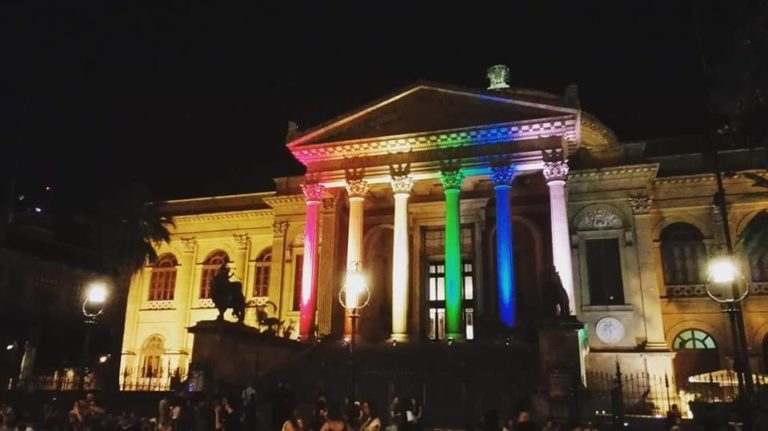
The entire external structure features elements in neoclassical style, with references to Greek and Roman religious architecture: the front façade is made up of a pronaos of six Corinthian columns, raised on a staircase, on either side of which there are two bronze lion-shaped sculptures, allegories of Tragedy and Opera. The vault with the enormous hemispherical dome is also in neoclassical style and a system of rollers allows the temperature of the interior to be regulated.

Façade of Teatro Massimo

The colossal dimensions of the theatre are due not only to the imposing monumental façade, but also to the set of halls, galleries and representative rooms that surround and complete the theatre itself.

The halls of the Massimo

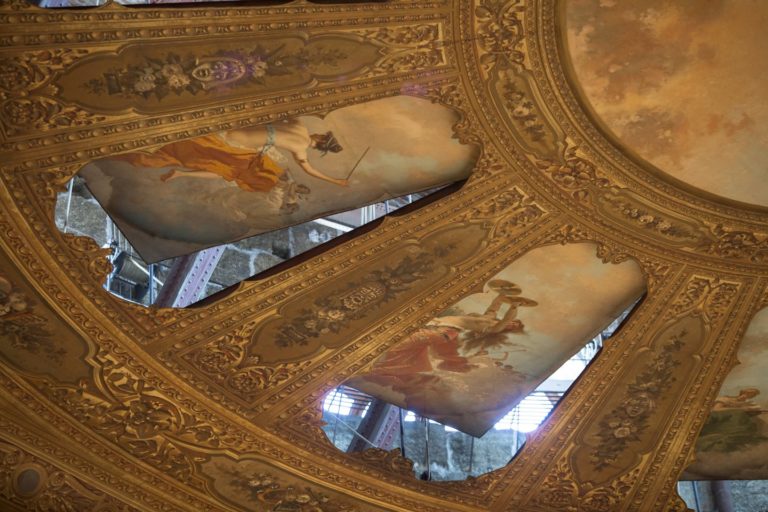
The main hall, or Great Hall, has a horseshoe shape and contains five orders of 31 boxes each, in addition to the gallery. It has a capacity of 1247 seats and the hall boasts perfect acoustics. The stalls are overlooked by the Symbolic Wheel, a special ceiling composed of eleven wooden panels frescoed in the shape of a petal representing the “Triumph of Music” by Luigi Di Giovanni. The petals are mobile: a mechanism modulates their opening upwards, so that warm air can escape and guarantee excellent ventilation of the theatre in a natural way.

Moving panels

At the centre of the second tier of boxes is the so-called Palco Reale, designed by Ernesto Basile, with 27 seats and a private foyer: the “Salone del Sovrano“, embellished with mahogany coverings and a sumptuous Murano chandelier; red brocade armchairs and sofas complete the furnishings and 9 mirrors are fixed on the walls. On the doors and capitals is affixed the Savoy royal coat of arms. 

The guided tour of the theatre also takes the visitor inside the Sala Pompeiana: the whole room is designed according to proportionality linked to the number 7 and its multiples. The symbolism of number 7 refers to the musical notes, the strings of the lyre, the days of the week and the deadly sins and Christian virtues.

Other rooms in the theatre include the Palco Bellini, once a meeting place and cultural circle, the Sala degli Stemmi, the Foyer and the Sala del Caffè.

Historical notes

Work began in 1875 and was led by architect Giovan Battista Filippo Basile, winner of the call for tenders issued in 1864. Upon his death, his son Ernesto Basile took over, who completed his father’s project at the request of the Municipality of Palermo.

The official opening of the theatre finally came on 16 May 1897 with Falstaff by Giuseppe Verdi, premiered in Palermo. This was followed by years of splendour and great performances, especially lyrical ones. In 1974 the theatre closed for restoration works: it remained abandoned for a very long period, until 1997, when it was finally reopened.

Curiosities about the Teatro Massimo

It is said that king Umberto I, on a visit to Palermo, did not want to enter the theatre during the inauguration, because he found inappropriate the presence of such a sumptuous building in a city he considered not to be as prominent as Palermo.

The Teatro Massimo was built by demolishing the church of San Francesco delle Stimmate and the convent of San Giuliano. During the demolition works, however, the tomb of the first Mother Superior of the convent would have been desecrated.

Legend has it that the restless soul of the nun, known as “la Monachella”, still wanders around the rooms of the theatre, casting curses. Many have claimed to have seen the shadow of a nun wandering behind the scenes or in the basement. Moreover, there is a particular step, entering the theatre, called “the Nun’s step”, in which it is said that all those who do not believe the legend stumble upon it.

The Sala Pompeiana, also called “Rotonda del Mezzogiorno“, was once reserved for men only. If you stand in the middle of the room and speak, you can hear your voice amplified out of all proportion; but to those who are in the rest of the room the sound arrives distorted, to the point of making the words incomprehensible. What is said at the centre of the Rotonda del Mezzogiorno is impossible for those outside to understand. This particular resonance effect is due to a slight asymmetry of the room, purposely intentional.

The Massimo is very close to the causes of the LGBT community: every year, during the week of the Pride celebrations, the columns of its façade are illuminated by the colours of the rainbow flag.

Tradotto da: https://archeome.it/teatro-alla-scoperta-del-massimo-di-palermo-il-piu-grande-ditalia/

English Version

ARCHAEOLOGY | Mount Sabucina, symbol of ancient Sikania

Mount Sabucina is located about 10 km northeast of Caltanissetta. Officially declared a Regional Archaeological Park by decree in 2001, together with the nearby Mount of Capodarso, the mountain constitutes a single system overlooking the valley of the Salso river, the ancient Himera.

Its plateau, at 720 m a.s.l., has constituted over time an important point of control and domination of the trade routes that crept into the territory of ancient Sikania. This characteristic has not escaped the populations that have inhabited this territory from the Ancient Bronze Age until the Roman Age. The first archaeological investigations date back to the 60s of the last century by Piero Orlandini.  

The Bronze Age

The very first site of the Ancient Bronze Age, at the foot of Mount Sabucina, is composed of several villages corresponding to the prehistoric culture of Castelluccio. Later, around the XIII century B.C., the village moved to the hillsides, probably for defensive reasons. Between the XIII and the X century the inhabited area, attributable to the facies of North Pentalica, evolved.

This unique large settlement consists of circular huts, placed both on the platform and on the slope of the hill. Among the huts, moreover, there are hypogea dug into the rock, used as burial places, deposits or shelters for animals. Lastly, some of the huts display moulds and ceramic objects that indicate their function as metallurgical workshops and ceramic workshops. During the X and IX centuries B.C., the huts were built with dry stone walls and the built-up area was more modest in size. Moreover, the site, equipped with terraces and small channels, was part of the cultural horizon of Cassibile.  

Mount Sabucina in the Iron Age


Clay model of a small temple from Sabucina


Between the VIII and VII century B.C. a new settlement was established on the top and slopes of Mount Sabucina. The houses are rectangular in plan and the inhabited area seems to be organized in specialized areas. In the sacred area there are two shrines, perhaps dedicated to the Chthonian divinities, which have been enlarged and modified over time.

Of considerable interest is one of the cells, which is oriented towards the east. It is a circular cell, built with irregular stones and reinforced at the base by a second ring that doubles the wall thickness. The remains tell us that it is a structure in antis (two columns on the front): this testifies the contacts between the indigenous world and the Greek one. The famous “Shrine of Sabucina” also comes from the sacred area: a clay model on a high foot of a small temple in antis with a rectangular plan, whose sloping roof is surmounted by figures of knights and decorated on the forehead by two gorgons.

The classic face of Sabucina
Sabucina
Archaeological area of Sabucina

The process of Hellenization, attested by the “Shrine of Sabucina”, ends around the VI century B.C., with the arrival of Rhodium-Cretan settlers from Gela. The settlement, even though it has fortification walls in the Greek style, lacks a regular urban plan. In fact, it appears as an agglomeration of irregular streets and alleys. This polis was violently destroyed by Ducezio in the V century B.C., during the uprising of the Sicilian cities against the Greeks.

During the IV century, like many other towns on the island, Sabucina also was repopulated with new settlers by Timoleon. The city was also rebuilt and protected with powerful fortified walls and equipped with rectangular and semicircular towers. After 310 B.C. the site was abandoned and the population returned to live at the foot of the mountain.

In Roman times, especially during the Imperial Age, the inhabitants continued to live in villas and dwellings that extended to the foot of Mount Sabucina. The residential centre of Piano della Clesia and the necropolis in the Lannari district, where the marble bust of Emperor Geta (209 – 212 A.D.) was found, testify to the continuity of life on the site.

Tradotto da: https://archeome.it/archeologia-il-monte-sabucina-cl-simbolo-dellantica-sikania/