English Version

English Version

EMINENT FIGURES | Sarah Belzoni, love and adventure in the shadow of the pyramids

The Belzoni couple portrayed in oriental clothes

Sarah Belzoni was an artist, archaeologist and explorer. Wife of the eclectic Paduan antiquarian and explorer Giovan Battista Belzoni, she continued to conduct research and edit publications even after the premature death of her husband.

Love at first sight with the beautiful Italian guy

Little is known about the youth of Sarah Belzoni, born Sarah Banne in Bristol in 1783. She probably did not attend any classical studies, but she was a woman of discreet culture.

In 1803 she met Giovan Battista, who had recently moved to England. Here the eclectic Italian traveller was performing in a circus, taking advantage of his mighty physical appearance (he was over two metres tall!). It seems that it was love at first sight. Sarah, described by Charles Dickens as a “delicate and good-looking” woman, sometimes performed together with her husband: the couple spent their first years of marriage in England, following travelling shows.

However, Belzoni, who had studied archaeology and engineering in Rome, wanted to be much more than a circus performer and, certainly, Sarah encouraged him to resume his aspirations and become an explorer and an antiquarian.

Egypt, at last!

In 1815 the couple reached Egypt, where Giovan Battista found employment as a hydraulic engineer in the service of Governor Alì Pasha. Soon, however, the Italian was hired by the English consul Henry Salt to recover Egyptian antiquities for the British Museum. At this point, a series of journeys and expeditions began which, however, did not include the presence of Sarah, punctually left in the nearest large city (Cairo, Rosetta, Aswan).

In the absence of her husband, the young Englishwoman devoted herself to deepening her knowledge of the customs and traditions of her host country, especially as far as women were concerned. This is testified by one of the very few writings we have left of Sarah Belzoni, a chapter entitled “Mrs. Belzoni’s trifling account of the women of Egypt, Nubia and Syria”, published in Giovan Battista’s “Narrative of the Operations and Recent Discoveries Within the Pyramids, Temples, Tombs and Excavations in Egypt and Nubia”.

During her stay in Egypt, Sarah showed great sagacity, intelligence and a spirit of adaptation, as well as being an acute observer of the civilization around her. The cultivated relationships with Egyptian, Arab and Nubian women are told to us with perspicacity and wit by Mrs Belzoni herself. Interesting is the story of how Sarah had begun to exchange artefacts and English costume jewellery, especially beads, with ancient necklace beads that the local inhabitants brought her as a gift.

At the front line, alone

Tired of being on the margins of the scene, at the beginning of 1818 she left alone, dressed as a man, for Palestine and visited, as the first European woman to do so, the esplanade of mosques in Jerusalem. Accompanied only by a local guide, always dressed as a young Turkish man, Sarah travelled along the Jordan Valley to Jericho.

Back in Egypt, she helped saving the wall paintings of the tomb of Sethi I, threatened by a flood; in the first months of 1819, she was stuck for a period of time in Rosetta, while her husband was in Libya, due to a plague epidemic. Here she spent the time of quarantine raising chameleons, which she apparently loved very much and even kept them as pets.

Sarah Belzoni at old age
Bitter return

In 1919 the Belzoni family returned to England, where two years later they set up a large exhibition at the Egyptian Hall in London with casts of the tomb of Sethi I, some scale models of the pyramids and Abu Simbel temple and a large collection of mummies and small finds.

In 1823 Giovan Battista Belzoni returned to Africa, where he found death, probably in Benin, while searching for Timbuktu and the springs of Niger. Sarah, who remained in England, continued to take care of her husband’s work, trying to show her discoveries in an exhibition in 1925, which however had very little success.

She spent the last years of her life first in Brussels and then on the Channel Islands, where she died in 1870. From 1851 the English Parliament granted her a modest pension for her husband’s cultural merits.

Tradotto da: https://archeome.it/personaggi-sarah-belzoni-amore-e-avventura-allombra-delle-piramidi/
English Version

ANCIENT EGYPT | The female universe in Ancient Egypt

The greatness of a civilization is given not only by those who govern it, but it is determined, in good measure, by its own people, who share its splendour and pay for its misfortunes, embracing the destiny to which it is guided, in good as well as in bad government. The Egyptian State, in its two components, male and female, has contributed to make great the pharaohs who have led it in the paths of the different historical events of which it has been protagonist over the millennia.

In ancient Egypt, unlike other ancient cultures, the birth of a female was not considered a misfortune: whatever the sex of the newborn child, in a society with a high infant mortality rate, the birth was considered a blessing of the gods and was accompanied by ceremonies dedicated to the protective gods of the puerpera and the newborn. The patron god of pregnancy was Bes, who was represented as a deformed and bearded dwarf.

Bes divinità parto
Bes, dwarf god protector of pregnancy
The role of women in the Egyptian civilization

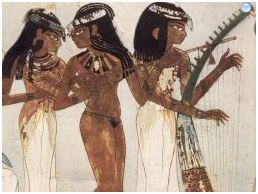
The Egyptian woman, in the different levels of society, has been a capable and active interpreter of the political and military choices of the sovereigns, allowing the accomplishment of their strategic designs of imperialistic grandeur. She enjoyed a social status equal to that of man, with a role within society of vital importance and considerable relevance at any level, whether she was priestess, queen, worker or simple wife.

Her role was opposed to that of man, not because she was considered inferior, but because the two sexes were opposed to each other, just as day is opposed to night and light to darkness. Each had specific functions, equally relevant, without overwhelming the other, but both contributed, without antagonisms, to a right balance.

From the social point of view, the woman had an active role and her education was equal to the male one. If gifted, the girls had the possibility to enter the palace and temple schools; this was also allowed to young women of modest origin, in possession of considerable intellectual capacity. In the schools they had access to different levels of education: from middle to specialized.

The “lady of the house”

The Egyptian woman had the same legal position as the man and exercised her main activities in the private sphere, as “lady of the house”. It was not only a formal courtesy title, because, to all intents and purposes, the wife organized daily life and administered common goods. Therefore, one can speak of a certain division of labor based on sex. Nevertheless, often the women of more humble extraction shared the husband’s job, as well as, of course, taking care of typically female chores, such as weaving, cooking, keeping the pantry provided and preparing ointments.

Already in the Old Kingdom the woman was, from the legal point of view, independent: in fact, she could assert her rights in court and freely express her will to dispose of private property. The marriage was sanctioned by a contract that, on the death of her husband, assured the widow her share of the estate.

In the Egyptian civilization, therefore, the woman always played a considerable role, often much more important than in other Mediterranean civilizations.

Tradotto da:  https://archeome.it/antico-egitto-luniverso-femminile-nellantico-egitto/

English Version

ARCHITECTURE | The Gothic in Sicily, the affirmation of a new style

Between the 13th and 15th centuries Sicily experienced a long period of political instability, during which numerous sovereigns reigned, including the Hohenstaufen of Swabia (1198-1266), the Angevins (1266-1282), the Aragonese (until 1516) and the Spanish (until 1713). They shared a welcoming spirit in a remote land, creating masterpieces which were disregarded in the rest of the peninsula. This is how the Gothic style developed in Sicily.

The military buildings of the Hohenstaufen family

Under the domination of Henry VI (1194-1197) and, above all, of Frederick II, whose reign lasted even longer (1198-1250), the numerous religious buildings and palaces inherited from the Normans were preserved. These rulers marked their era with the construction of strongholds, designed by architects from northern Europe: Gothic style arrived in Sicily in the 13th century in the form of fortified architecture.

The castles of Syracuse (Castello Maniace), Catania (Castello Ursino) and Augusta date back to this period, as do the fortifications of Enna’s castle, the strategic centre of the island, occupied since the Byzantine era, of which eight imposing towers remain. These buildings were characterised by a strongly geometrical plan (square structure with angular or median towers), portals or pointed arch windows, bare and austere walls, dominated by slits and merlons; finally, there were also rooms with ogival vaults.

The 14th century and the chiaramontano style

An important contribution to the development of Gothic architecture in Sicily was made by the Chiaramonte family. Powerful Sicilian lords for almost the whole fourteenth century, they established themselves thanks to the weakening of royal power. They also demonstrated their influence through the numerous constructions of civil and religious buildings; on these, they imposed as their artistic seal, which later became the family mark, the zigzag moulding, applied to portals, columns and mullioned windows, borrowed from the Arabs and adopted by the Normans.

From the second half of the 13th century, when the Sicilian population of Arab origin converted to Christianity, the Arab architectural influence in the construction of religious buildings and civil dwellings disappeared. The decorative zigzag motifs, imported from the East to Sicily, were applied by the Normans in many buildings: in Palermo, in the columns of the Palatine Chapel of the Palazzo dei Normanni, in the mullioned windows of the Monastery of San Salvatore in Cefalù and in the upper façade of the Cathedral.

In Agrigento and in several centres of the same province, this style, called “chiaramontano”, had a greater presence than other Sicilian sites; this is because the state owned city of Girgenti, for a certain period, was under the direct jurisdiction of the Chiaramonte family, who made it the artistic peak of 14th century architecture.

Among the buildings included in the so-called “chiaramontano style” Palazzo Chiaramonte is worth of special mention. It is called “lo Steri” and it is located in Piazza Marina in Palermo. It was the residence of an important Sicilian family; also worthy of notice is its façade of refined beauty, crowned by slits and decorated only with splendid windows with pointed arches. On the inside, there are various rooms and chapels with ogival vaults, a large room and ceilings with frescoes, recalling biblical and chivalrous scenes, attributed to the three Sicilian painters Simone da Corleone, Cecco di Naro and Darenu da Palermo.

All the subsequent urban palaces were built on the basis of these examples, characterised by mullioned and three-light windows, surmounted by drain arches both openworked and decorated with polychrome geometric motifs.

Gothic-Catalan art of the XV century

Catalan Gothic art developed in Sicily following the Spanish domination of the island from the end of the 14th century with the reign of the Aragonese. This development, clearly behind other European countries, was endorsed by the Catalan-Aragonese confederation, which became one of the greatest powers in the Mediterranean from the 13th century onwards. At the behest of the confederation, interest in a relatively sober Gothic style spread on the island, characterised by refined figures, a sense of proportion, breadth of form and large windows, open onto smooth, bare façades.

To this period belong the palaces Santo Stefano and Corvaja, in Taormina, the portal of the Cathedral of Palermo and the Bellomo palace in Syracuse. It seems useful to mention the artist Matteo Carnelivari, who, towards the end of the 15th century, designed the plans for the Abatellis, Aiutami Cristo palaces and, probably, also those of the Church of Santa Maria della Catena, in Palermo. These are the most representative creations of Gothic-Catalan art, characterized by Byzantine, Arab and Norman elements deriving from the most ancient local tradition.

Tradotto da: https://archeome.it/architettura-il-gotico-in-sicilia-laffermazione-di-un-nuovo-stile/

English Version

BEHIND THE FASCISM | Stone Fascism, Mussolini’s Forum

Mussolini had used the myth of Rome to provide historical legitimacy for fascism. The reference to the past was found in the looting carried out by the Duce to bring to light the glories of ancient Rome. One of the most important places of the fascist regime was Mussolini’s Forum. Designed by Enrico Del Debbio, it was one of the places created to last over time. It kept its original and symbolic function intact due to the architectural quality and the name itself, “Foro Italico”, with which it had been called starting from August 1943.

The location of the building

The place chosen for the construction of Mussolini’s Forum is the Farnesina plain, between Ponte Milvio and the districts of Piazza D’Armi, which are crowned by the hills of Monte Mario and Macchia. A place where the greenery and the silence of the woods helped to create a sort of classic utopia in which stadiums and theatres were usually located. A place not chosen by chance: in fact, the Via Flaminia connects the Forum with the city centre via the Duca d’Aosta bridge, which acts as a direction. However, a run down place as well, up to the time of the construction of the Forum, due to the stagnation of the water and the difficulty of drains towards the Tiber. For this reason, the whole area was raised by 5 metres.

The reference to the ancient

For the construction of the Forum the concept of the ancient Gymnasium was taken up, enlarged and modernized. Del Debbio does not create a kind of Forum in the classical way, with colonnades, arches and scenographic walls, but buildings corresponding to the modern conception of their function. For example the central buildings of the Opera Nazionale Balilla, where Italian teenagers had everything they needed for training and physical education. The Duce, like the great Roman emperors, had his own Forum built recalling the myth of the “new Caesar”. Mussolini’s Forum was, therefore, a group of listed buildings linked to the most solemn monuments of Roman antiquity for the richness of marble, works of art and grandeur of lines. We wanted to celebrate beauty through it, creating an immortal work, thanks to the use of pure white Carrara marble, which perfectly suited the green of the slopes of Monte Mario.

The architectural layout of the Forum
The Fascist Academy of Physical Education

Mussolini’s Forum had a pedagogical, sporting, political, monumental and symbolic function. It consisted of a central core, the Fascist Academy of Physical Education, made up of two symmetrical blocks, joined together by a diagonal and central block. The building was plastered in Pompeian red, with windows framed by thin columns, topped with broken gables of white marble.

The Stadio dei Marmi (Marble Stadium)

Through a passage, one entered the Stadio dei Marmi, consisting of 10 tiers of steps, obtained thanks to the difference in height derived from the backfill of the area. The stadium’s capacity was around 200,000 people. The foundations of the building were in reinforced concrete, while the supporting framework of the steps was in tuff and brick masonry. The steps were made of blocks of white Carrara marble and housed 60 statues, 4 m high, placed as a crown, on bases 1.20 m high and 2 m in diameter. The statues represented athletes, intent on various game actions, and were donated by the Italian Provinces. To complete the sculptural part, in correspondence with the heads of the entrances, there were two niches in which two bronze statues were placed, while on the sides of the tribune of honor stood two groups of bronze wrestlers.

Mussolini’s monolith

The entrance to the Forum was characterized by the presence of a large obelisk in Carrara marble, erected in 1932. Made from the drawings of Costantino Costantini, it is the largest block of marble ever extracted from the Apuan Alps. The entire project describes a solemn space, the heart of the entire complex of the Forum, a further demonstration of how Mussolini took inspiration from the majestic architecture of imperial Rome to manifest fascist power. Initially placed in the centre of the Forum, it was then moved to the entrance.

The Avenue of Foro Italico

Located between the monolith and the Fountain of the Sphere is the Avenue of Foro Italico. Made in 1937, it is decorated with black and white mosaics which, together with the symbols and slogans of the regime, illustrate the historical phases of the conquest of power, the Balilla, the subjugation of Ethiopia, the arts, the activities sports and the achievements of the regime. The dowels used are the same used in ancient Rome, about one centimeter in size.

The Fountain of the Sphere

At the western end of the square stands the Fountain of the Sphere. It consists of a large circular basin of 3 metres in diameter and a large sphere, made from a single block of marble from the Carrara quarries. The ring-shaped basin of the fountain is decorated with a mosaic of black and white marble tiles with marine subjects.

The Stadium of the Cypresses

Behind the Academy is the Stadium of the Cypresses, formed by terraces cut into the side of the hill, with a capacity of one hundred thousand spectators. During the war the construction site was abandoned and used as a car park by the allied troops until 1949. Then, CONI, its owner, entrusted the completion project to Annibale Vitellozzi, who completed it in 1953. After reopening it was known as “Stadio dei Centomila”, given its capacity, but was renamed “Olympic Stadium” when, in 1960, the 17th games were assigned to Rome.

The southern part of the Forum

In a symmetrical position with respect to the Fascist Academy is the building intended for the Baths and the Academy of Music, built in 1937. Then there are the sports facilities dedicated to tennis, which consisted of the monumental Olympic Stadium, a stadium containing six training fields and a building used as the service areas of the two fields. The southern side of the Forum ended with the Casa delle Armi, assigned to the discipline of fencing, and the guesthouses used to host the athletes.

Mussolini’s Forum is one of the major urban interventions carried out during the regime and all of its works must be evaluated from an architectural point of view. Originally created as a Sports Forum, it became one of the places of mass mobilization, taking on great political and symbolic value. Sport is also used as a propaganda tool, capable of appealing to people. Courage, sacrifice, will, strength, which are the typical aspects of sport, became the identifying features of the Italian race and the constituent elements of the new Mussolini man.

Tradotto da: https://archeome.it/dietro-al-fascismo-il-fascismo-di-pietra-il-foro-mussolini/


English Version

ARCHAEOLOGY | Veleia Romana (Piacenza), the city of longevity

Veleia Romana (460 m below sea level), in the Chero valley, an ancient city whose name derives from the Ligurian tribe called Veleiates, was founded in 158 BC, after the definitive submission of the Ligurians to Rome. A Prosperious Roman municipality and important administrative capital, it ruled over a vast hilly and mountain area located between Parma, Piacenza, Libarna (Serravalle Scrivia) and Lucca.

The territory and its resources

The presence of saline waters, which the Romans have always been able to exploit with ingenuity, undoubtedly helped urban development, in which it is possible to identify various baths. This natural resource, along with the tranquility of the place, made Veleia a favorite holiday destination for various consuls and proconsuls from Rome, who were under the illusion, perhaps, of being able to extend their lives. In fact, it was known that among the population of Veleia, as confirmed by the last census of the emperor Vespasian (72 AD), there lived six people aged 110 and four even 120.


Remains of the Bathes

The urban sector of the city of Veleia is spread over a series of terraces along the “boreal slope of the knoll” of the Moria and Rovinasso mountains. The toponyms of these two peaks, which in ancient times seem to have been a single mountain, allude to a catastrophic event whose memory has unfortunately been lost in the haze of the times. This Apennine area, like many others in the Apennines, is known geologically for its tendency to landslides: many experts claim, in fact, that the decline and end of Veleia was caused by a large landslide or a series of landslides along the coast of the mountain above.

The archaeological area of Veleia


View of the excavations of Veleia

The forum, dating from the Augustan-Julian-Claudian age, extends over a plane obtained artificially by means of a massive excavation, as revealed by the readable stratification under the staircase on the eastern side. The paving, with four rainers, drained by a perimeter gutter with settling wells at the corners is well preserved. It is surrounded on three sides by a portico, dilated in ancient illusionistically by murals, on which there are shops and rooms for public use, almost all equipped with heating systems.

The whole is completed by the lowest of the terraces, formed by the accumulation of materials coming from the excavation of the slope above, contained by robust substructures, still clearly visible in the eighteenth century. Connected to the upper one by an imposing entrance with double tetrastyle elevation, inserted in the colonnade of the forum, the terrace was perhaps reserved for religious functions.

The final destination of an upward path that comes from the valley floor is the basilica that closes the complex to the south: a building with a single nave, with rectangular exedras at the ends, was the seat of the imperial cult; in fact, the twelve large Luni marble statues depicting the members of the Julio-Claudian family rose against the back wall.

To the west of the forum, recent excavations have again brought to light the remains of buildings, recognized as prior to its creation, as well as traces of its original entrance, replaced after the middle of the 1st century. AD from the monumental one located on the northern side. Upstream of the forum there are residential quarters.

The terrace on which a parish church dedicated to S. Antonino has stood since the Middle Ages probably housed a building of worship already in antiquity. Higher is placed a building, identified, already at the time of its discovery, as a water reservoir, later mistakenly interpreted – and consequently rebuilt – as an amphitheatre.

Inside the archaeological area, an Antiquarium has been set up, where casts of the Trajan’s Tabula Alimentaria and the bronze table containing the lex de Gallia Cisalpina, as well as furnishings and architectural elements relating to Roman cremation burials, are kept.

Tradotto da: https://archeome.it/archeologia-veleia-romana-la-citta-della-longevita/

English Version

THEATRE | The curtain falls to the theatre Vittorio Emanuele of Messina in 2020

The curtain fell before their start on many of plays and ballets scheduled in the 2019/2020 artistic season of the theatre Vittorio Emanuele of Messina. Like all other national theatres, even the historic one in the city of the Strait closed its doors for the second time this year, in compliance with the new Prime Minister’s Decree that establishes and tightens measures to contain the spread of COVID-19. The theatre season showed a great start in October last year with Bram Stoker’s “Dracula”, directed by Sergio Rubini together with Luigi Lo Cascio. Full house and a warm welcome from the audience.

Before the closing of the theatres last March, the brilliant and hilarious “Massimo Lopez and Tullio Sollenghi show” amused, entertained and even touched the loyal visitors of the former trio, now a duo, of italian comedians, for two hours and non-stop.

Indeed, the curtain fell but not the desire to go back to sit on the red armchairs, enjoy the darkness in the audience in the moments before the start of a show, as much a play, ballet as opera, and then witness the magic that only the stage of a theatre can give to fans of the genre. The shows, scheduled for the 2020/2021 season, are for now suspended and postponed to a later date. Let us hope that it will be as soon as possible.

History

The Vittorio Emanuele Theatre of Messina was commissioned by Ferdinand II of Bourbon in 1842 and saw its inauguration ten years later. Due to the devastating earthquake of 1908 it was seriously compromised and underwent extensive restoration work, which almost entirely rebuilt it and ended only in 1980. It was inaugurated again in 1985 and the first opera represented was “Aida”, the last to be performed before the earthquake.

The layout of Vittorio Emanuele Theatre

The entrance to the theatre is characterized by a three-arched portico, surmounted by the marble sculptural group “Time that discovers the Truth and Messina” created by the Messina sculptor Saro Zagari. The internal ceiling is decorated with a huge work by Renato Guttuso, depicting the myth of “Colapesce”, which dives into the waters of the Strait, surrounded by sirens. The fresco overlooks the stalls and offers a glimpse, with fairytale tones, of the depths of the sea and legend has it that the heroic swimmer supports even today the Messina tip of the island.

Tradotto da: https://archeome.it/teatro-il-vittorio-emanuele-di-messina-cala-il-sipario-sulla-stagione-2020/

English Version

ARCHAEOLOGY | The wonders of the Archaeological Museum Luigi Bernabò Brea in Lipari

Luigi Bernabó Brea and Madeleine Cavalier

The Regional Aeolian Archaeological Museum Luigi Bernabò Brea, born from a previous Antquarium and located on the plateau known as “Il Castello” (The Castle), was inaugurated in 1954.

Its arrangement was strongly desired by the scholar Bernabò Brea, to whom it was later dedicated, and by the famous Madeleine Cavalier. The latter, after having carried out prehistorical excavations and research in Liguria, was his research partner since 1951, when she took over the scientific direction of the excavations in Lipari and of all the archaeological activity in the Aeolian Islands. The collaboration between the two significantly allowed so much the expansion of the previous museum collection that it was necessary to open new centres. Today, the Archaeological Museum of Lipari consisting of six pavilions that contain respectively: Prehistory, Epigraphy, Minor Islands, Classical Age, Vulcanology and Paleontology of the Quaternary which are located in as many buildings. The exhibition makes use of a rich and exhaustive information that spread across captions in Italian and English. It documents the development of human settlements and the development of the successive civilizations in the Aeolian Archipelago.

The Prehistoric Section

This Section is located in an eighteenth century building which, built on the ruins of the Norman monastery, was the seat of the “Palazzo Vescovile” (Bishop’s Palace). The finds preserved in it show the succession of cultures from the Neolithic age (end of the 5th millennium BC) to the Late Bronze Age (11th-10th century BC). The materials come from excavations carried out in the area of “Il Castello”and in the areas that have given their names to successive cultures. From Piano Conte, for example, we get the typical ceramics of the homonymous Middle Eneolithic culture; from Castellaro Vecchio, on the other hand, the traces of the most ancient Neolithic settlements come. To these are added the artifacts found in Contrada Diana and Spatarella. In this section, for the Bronze Age, the finds from the settlements of the culture of Capo Graziano (Filicudi) and the culture of Milazzese (Panarea) are also exhibited.

The exhibition itinerary of the Prehistoric Section of the Museum continues with the evidence of Ausonius I and Ausonius II, whose handcrafted ceramics seem similar to those of the Late-Apennine and to the Protovillanovian culture of the Italian peninsula. Finally, the itinerary ends with the interesting votive offerings, found inside the bothros dedicated to Aeolus, dating back to the Cnidian foundation of Lipàra (580-576 BC).

The Epigraphical Section of the Museum

The Epigraphical Section of the Archaeological Museum of Lipari is also located in the former “Palazzo Vescovile”, inside Room X. This exhibits numerous memorial stones and funerary stelae from the Greek and Roman age, found in the archaeological area of Contrada Diana. The inscriptions bear the names of the deceased, to which, at times, dedicatory or auspicious formulas are added. The large number of finds made it necessary to place the numerous stelae also in the adjacent garden, where they are accompanied by numerous sarcophagi from the same necropolis.

The Minor Islands Section

This section, on the other hand, is located in a small building opposite the Pre-Historic Section. Inside its showcases, there are numerous finds, coming from the archaeological contexts of the smaller islands and datable between the Upper Neolithic and the Middle Bronze Age. The highlight of this exhibition is the reconstruction of a Bronze Age hut. This reproduction, which occupies the central area of the pavilion dedicated to the archaeology of the smaller islands, was made possible through the joint study by archaeologists and archaeobotanists.

The Classical Section of the Museum


Room XIX with reconstruction of the excavation trench of the Bronze Age necropolis

The Classical Section is certainly the largest and occupies the largest number of rooms inside the main twentieth-century building of the Museum. Through the three floors dedicated to it, the finds are exhibited in order to reconstruct the rich historical-cultural framework of the Greco-Roman city. Beyond Room XX, in which the different types of burial are exemplified (sarcophagi and vases of medium and large dimensions), there is Room XIX, which offers a faithful reconstruction of the excavation trench of the Bronze Age necropolis, located below the former Piazza Monfalcone. On the upper floors are exhibited the numerous finds from the rich funeral objects, including the magnificent masks, divided by age and type: they are masks of Greek and Roman comedy and tragedy. Other exhibition spaces are dedicated to the numismatics and jewellery objects.


The great pyramid of the amphorae of Wreck A Roghi on display in room XXVII

Finally, the large room dedicated to underwater archeology is part of the Classical Section. In this room Greek and Roman ships are showcased unfortunately shipwrecked in the waters of the Archipelago, as well as materials from various eras, coming from port dumps in landing areas that have now disappeared. The visitor is immediately attracted by the pyramid-like display of the wreck amphorae of A. Roghi of Capo Graziano , which occupies the centre of Room XXVII. Subsequently, the visitor continues the exhibition itinerary through the finds from different eras, masterfully displayed in chronological order.

The Vulcanological Section

The Vulcanological Section is based in a 14th century building, next to the Minor Islands Section, which was later enlarged in the 17th century. The collection is named after the great vulcanologist Alfred Rittmann and showcases the geomorphology of volcanic origin of the Aeolian archipelago. The exhibition itinerary leads the visitor to observe a series of geological samples – including the famous obsidian – and the plastic reconstructions, which have the didactic purpose of getting him in touch with the productive and economic aspects of the various human settlements that have occurred on the islands .

The Paleontology of the Quaternary Section

Finally, this Section currently occupies a small room located in the south-western sector of “Il Castello”. The collection includes a series of sediments and fossils that must have been present on the various islands of the Aeolian Archipelago during the Quaternary. Of considerable interest is a fragment of the shield of a terrestrial turtle, incorporated in the pyroclasts of Valle Pera di Lipari and dating back to a time period between 127,000 and 104,000 years ago.

https://archeome.it/wp-admin/post.php?post=3346&action=edit

English Version

EMINENT FIGURES | Antonia Ciasca, The Mediterranean between Etruscans and Phoenicians

The November column

We would like to dedicate the November Eminent Figures column to the women who have made the history of archaeology and culture in Italy, starting with an archaeologist who, without a doubt, has left an indelible mark in her studies on the Phoenician and Punic Mediterranean.

Antonia Ciasca

Antonia Ciasca was one of the most prominent archaeologists in the Italian and Mediterranean panorama of the second half of the 20th century. Etruscologist and scholar of the Phoenician civilization, student of giants such as Massimo Pallottino and Sabatino Moscati, she left her mark on the history of the excavations on the island of Mozia in Sicily.

She was born in Melfi (PZ) on 21 March 1930 from Raffaele Ciasca (historian and Senator of the Italian Republic) and Carolina Rispoli (writer, essayist and novelist). Following the relocation of her father, a university lecturer, she attended schools first in Genoa and then in Rome, where she obtained her classical high school diploma.

Between Etruscans and Phoenicians

In Rome she graduated from the University La Sapienza, where she was a pupil of Massimo Pallottino and Sabatino Moscati and participated in the excavations of the Etruscan centre of Pyrgi (Santa Severa). Pyrgi, a very famous centre in which, a few years later, gold foils with bilingual inscription in Etruscan and Phoenician were found, is a first thin thread which, uniting the Etruscan and Punic worlds, brought the new Ph.D. Ciasca closer to studies on the Phoenicians.

She soon became assistant professor to Sabatino Moscati, at the time teacher of Semitic epigraphy, and with him began the path that would take her to the East, until she became one of the field archaeologists, in 1959, of Ramat Rahel’s archaeological expedition in Israel.

A youthful portrait of Antonia Ciasca with Palestinian kefiya (from http://www.lasapienzamozia.it )

Since 1963, for six consecutive years, she directed the excavations of the first Italian archaeological mission in Tas Silg (Malta): here she identified the sanctuary of Astarte, known by classical sources (Cicero speaks of it) as a well-known place of worship where the faithful from all over the Mediterranean landed.

The following year she became director of the archaeological mission in Mozia (TP), a site to which she dedicated a large part of her work. In Mozia Antonia Ciasca chose to start her research from a place that was a symbol of Phoenician and Punic civilization: the Tophet, the burial place of children and, according to some ancient texts, the place where infants were sacrificed to the god Baal Hammon. At the same time, however, he began to systematically excavate the inhabited area of the Punic city, starting the first discoveries concerning the urban planning of the island. A brilliant and methodical archaeologist, Antonia Ciasca published annually the preliminary reports of her researches in the field, showing that she mastered the stratigraphic method in a commendable way. Her devotion to work led her, in 1966, when she was only 36 years old, to take up, first in Italy, the newborn chair of Punic Antiquities at La Sapienza University.


A historical image of the excavations of the Tophet of Mozia


Mozia in the context of the Western Mediterranean

The studies and research in Mozia led the Lucanian scholar to participate in excavations and research in other Punic centres in the Mediterranean, in order to have a wider vision of the Punic culture that the Sicilian island was returning. In 1975 Ciasca went to Tharros (Sardinia), in the 80’s to Algeria and Tunisia, to Cap Bon and Ras ed-Drek; finally, in 1998 she resumed the research in Tas Silg.

https://archeome.it/wp-admin/post.php?post=8437&action=edit

English Version

ANCIENT EGYPT | Hatshepsut and the damnatio memoriae

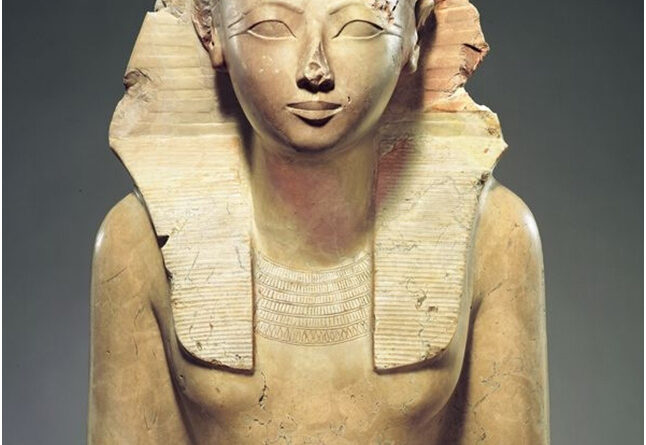
Hatshepsut was the pharaoh-woman who reigned over Egypt between 1473 and 1458 BC. Her name is linked to the building program that culminated with the construction of the great Temple of Deir el-Bahari in West Thebes.


Her life

Hatshepsut, exclaimed her mother Ahmes giving birth to her, in other words “She has the face of the Noble Ladies”. Daughter of Thutmose I, from an early age she proved to be more gifted than her half-brothers, but to access the throne she had to marry the eldest of them Thutmose II, physically and mentally weak, who soon left her a widow. He then assumed the regency in place of Thutmose III, but gradually he was acquiring more and more the characteristics of a king: in fact, he was represented with the false beard typical of the pharaohs.

For her coronation the queen had a mythological text written, in which she justified her coming to the throne at the behest of the gods. Furthermore, in this text she claimed to be the result of the union between her mother and the god Amun and that her father Thutmose I had named her his successor before his death.

Despite the apparent success of her reign and a burial in the Valley of the Kings, the monuments dedicated to her were marred after her death with a drastic damnatio memoriae, apparently desired by her co-ruler and stepson or grandson, Thutmose III.

The fact that a woman had become pharaoh of Egypt was very unusual. In the history of Egypt, during the dynastic period, there were only two or three women who actually managed to rule as pharaohs rather than to exercise power as the “great wife” of a king.

Hatshepsut launched a new artistic movement, called for a theological reform, administered state finances with rare effectiveness and organized very profitable expeditions, such as those in the mysterious land of Punt, from which Egyptian ships returned full of incense and strange animals. An activism that undermined the already delicate political-religious equilibrium and that procured her dangerous enemies: the young pupil, the priests of Osiris and all those who could not stand the influence of Senenmut, the powerful adviser who, perhaps, was something more for the Queen.


Architecture

The queen worked in the temple of Karnak, where she had chapels built, a sanctuary for the sacred boat and erected two obelisks. Deir el-Bahari was the site chosen by the sovereign to place her mortuary temple, while her tomb was built in the valley of the Kings.

The Mortuary Temple, also known as djeser-djeseru (“holy among the saints”), is a temple located close to the rocky heights of Deir el-Bahari, on the west bank of the Nile, near the Valley of the Kings. It is dedicated to the solar deity Amun Ra and is located near the temple of Pharaoh Mentuhotep II.

The complex exploits a revolutionary planimetric solution of dividing the structure on different levels, in harmony with the underlying rocky scenario. The temple is considered the point of greatest contact between Egyptian and classical architecture: an example of the funerary architecture of the New Kingdom, it marks a turning point, abandoning the megalithic geometry of the Old Kingdom to move to a building that allows worship active.


Deir el-Bahari, view from above

damnatio memoriae hatshepsut
Inscription from the Chapel of Anubis, Deir el-Bahari: on the left, the names of Hatshepsut deleted; on the right, those of Thutmosis III left intact.

English Version

HISTORY | His Majesty, Etna

The superb peak of Mount Etna that soars up to the sky, and its valleys that are already all black, and its snows that shine with the last rays of the sun, and its woods that tremble, that murmur, that stir. G. Verga, Story of a Capinera

This is how Verga describes Etna, the highest active volcano in Europe with its 3326 mt. Declared World Heritage Site by UNESCO in 2013, the Mongibello (another name of the Sicilian volcano), rises majestically and bursting on the Ionian coast. From its top you can admire a wonderful panorama, which includes not only the Ionian coast and the sea, but also Calabria, the Nebrodi mountains, the mountainous ridge of the Madonie and the inland areas of Sicily.

Called by the Greeks Αἴτνη (Aítnē), the Romans Aetna, and the Arabs Mongibello, Etna has inspired legends, myths, stories and tales in anyone who saw it.

It is quite difficult to reconstruct the etymology of the name, which seems to derive from the Greek toponym Aitna (Aἴτνα-ας, a name also attributed to the centre of Catania), which derives from the verb αἴθω (aitho, “to burn”). Another possible origin is from the noun “sicano” aith-na (“burning”). Perhaps the most evocative denomination is that of the Arab authors who called it Jebel al-burkān (“mountain of the volcano”), Jebel Aṭma Ṣiqilliya (“sum mountain of Sicily”) or Jebel an-Nār (“mountain of fire”). From these expressions it is possible to trace the dialectal name “Mongibello”, which seems to derive from the fusion of the Latin word Mons (“mountain”) and the Arabic word Jebel, with the same meaning. Today, instead, Sicilians often refer to the volcano with the appellation “a Muntagna”.

Etna (geologically a volcanic stratum) has its origins around 570,000 years ago, in the Quaternary period (during the middle Pleistocene), when construction and destruction processes took place, which started violent eruptive activities. Today Etna is one of the main places for geology studies: in fact, in Catania there is the important National Institute of Geophysics and Volcanology which monitors its activities. In this regard, the presence of the Astronomical Observatory at an altitude of 2900 mt. cannot not be forgotten. This one, no longer in operation today, is one of the oldest in Italy.

To inspire more the works of ancient and modern writers, poets and directors is precisely its grandeur and its unpredictable behaviour.

Particularly suggestive are the explanations of the eruptive activity of the volcano, described by ancient authors such as Thucydides, Diodorus Siculus and Pindar. For example, it is said that the god of the winds Aeolus had reclosed, after a bitter fight, some winds in the caves below Etna.

Hesiod, Aeschylus and Virgil, instead, tell that the reason for the eruptions is linked to the rebellions of some giants like Enceladus. This one, defeated by the gods after a war, was buried under an enormous heap of land, the island of Sicily. Under Etna would be found, therefore, his head and the crater would coincide with his mouth. The eruptions would be the cries of pain of the defeated giant. The ancients, however, also thought that in the belly of the Mountain there was the workshop of Hephaestus (or Vulcan), god of fire, metallurgy and blacksmith of the gods.

The Volcano

Today there are four slopes of Mount Etna that can be visited, but the most easily reached are the northern slope (Linguaglossa) and the southern slope (Nicolosi).

Characterized today by a variegated flora and a very rich fauna, Etna represents a unique place in the world. It satisfies, in fact, the interest of mountain and winter sports enthusiasts (alpine skiing, cross-country skiing, ski touring, snowboarding), nature lovers and hikers (Etna Park). Moreover, the most demanding “palates” can enjoy unique dishes and taste the famous “Nero dell’Etna” wine, both during local festivals (Sagra del Pistacchio di Bronte, etc.) and in very characteristic places. For art lovers it is possible to buy works of the typical Etnean handicraft and to admire in the ethnic villages (Bronte, Randazzo, Maletto, Milò, Paternò, Adrano, just to name a few), numerous sanctuaries, churches, fountains or the wonderful buildings built in lava stone.


BIBLIOGRAPHICAL REFERENCES 

– Patanè, S. La Delfa, J. Tanguy, L’Etna e il mondo dei volcani’, Catania, Giuseppe Maimone editore, 2004.

– AA VV, Etna, myth of Europe, Catania, Giuseppe Maimone publisher, 2000.

– Etna Cooperativa Etna Sud – Environment, history, traditions, 1990, Tringale Editore.

– Carlo Gemmellaro, La vulcanologia dell’Etna (anastatic reprint by Salvatore Cucuzza Silvestri), Catania, Giuseppe Maimone Editore, 1989.

– Pierre Grimal, Mythology, Garzanti, 2005.