English Version

English Version

EMINENT FIGURES | Father Michele Piccirillo, the friar who built peace with stones and mosaics

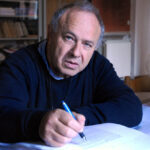
Father Michele Piccirillo

Father Michele Piccirillo was a Franciscan friar of the Custody of the Holy Land, archaeologist and professor at the Studium Biblicum Franciscanum in Jerusalem. He has inextricably linked his name to Christian archaeology in the Middle East and to public archaeology, dialogue and peace building activities in Palestine and Israel.

Youth and the “call”

Born in Carinola, a town in the province of Caserta, on November 18th, in 1944, he felt the religious vocation from a very young age. At the age of 16 he moved to Palestine, to the Custody of the Holy Land, where he undertook the novitiate in the order of the Friars Minor: already during the years of high school Michael had felt the religious vocation but, above all, the deep interest in Palestine, the land of Jesus, rich in archaeological evidence which the young novice was immediately interested in.

Father Michele finished his high school studies in Bethlehem in 1965 and then attended the Faculty of Theology at the Studium Biblicum Franciscanum in Jerusalem, where he obtained his license in 1969. In June 1967 he had made his vows at the church of the Upper Room in Jerusalem. A few months later, the “Six Day War” led the Israeli army to occupy East Jerusalem, hitherto under Jordanian sovereignty. During fightings, Father Piccirillo brought relief, together with his brothers, to the victims of the conflict in Jerusalem, Hebron, Jenin and other places in Palestine.

Returned to Rome, in 1969 he was ordained a priest, he obtained a degree in Sacred Scripture at the Pontifical Biblical Institute in 1973 and that in Archaeology at Sapienza, with relator Paolo Matthiae, in 1975. In 1974 he had already returned to Jerusalem, where he had taken up teaching at the Studium Biblicum Franciscanum, a role he will cover for his entire life, becoming, in 1984, Full Professor.

The mosaic of the diakonicon in the basilica of Mount Nebo, 530 A.D.

The first digs and the discovery of Mount Nebo

In the early 1970s, the Franciscan had conducted the first archaeological digs at some proto-Christian buildings in Jordan, on the slopes of Mount Nebo, the mountain from which, according to the Bible, Moses would have seen the Promised Land and on which he would have been buried.

Mount Nebo, since then, has always remained a very important place in the life of Father Piccirillo: in 1976 he took over the direction of the excavations at the memorial of Moses on Mount Nebo, bringing to light the important mosaic of the baptistery. Since that year, the restorations and findings made by Father Michele and his collaborators have not been counted: the identification of Umm ar-Rasas – the biblical Kastron Mefa’a – in ’86; the start of the Mosaic School in Madaba in ’92; the publication of the volume “The Mosaics of Jordan”, with the preface by King Hussein of Jordan in ’93; the work on the area of the ancient sanctuary of the Baptism of Jesus in Bethany, beyond the Jordan, in ’96; the organization of the International Congress for the centenary of the Madaba Charter in ’97.

The mosaic of the “Map of Madaba” from the church of St. George (Madaba), 6th century

The mosaics of peace

Although he was an excellent epigraphist, historian and theologian, Father Michele certainly had a predilection for the study and restoration of Byzantine and early Christian mosaics in Jordan and Palestine. Since 1976 he never abandoned his research on Mount Nebo, where he also wanted to build a new guesthouse for pilgrims, as well as his “headquarters” for research in Jordan.

The “archaeologist friar” had the fortune of living most of his life in occupied Palestine, a land of conflict, yet he was able to maintain excellent cultural and diplomatic relations with all the parties involved, so much so that he was one of the few to whom he was allowed to move freely between Syria, Jordan, Palestine and Israel.

According to Father Michele the scientific study of archeology was a vehicle of faith: archaeology allowed him to know the past, but also, and above all, to witness a complex and troubled present. The archaeological research was an important means of returning the monument to local communities, creating tourist itineraries that could incentivize sustainable development, create awareness and pride in a past too often distant from colonial archeology, conducted for almost a century on both sides. shores of the Jordan. In the projects of the Custody of the Holy Land, the Franciscan archaeologist introduced workshops for young people, professional courses for the restoration of the mosaic (in Madaba and Jericho) and guided visits for schools.

In this sense, archeology was for Father Piccirillo a way to build peace. In one of his latest diaries he writes: “Among the ways to contribute to understanding and peace among the peoples of the Middle East, on Mount Nebo we have chosen the one that is most congenial with our work as archaeologists (…), and we are amply rewarded not only professionally, but also as friars minor followers of Francis, who went to Egypt to speak peacefully with Sultan Malik al-Kamil, Saladin’s nephew. The restoration of the mosaics, mostly floors of the churches built in the region from the 5th to the 8th century, has given us the opportunity to preserve a heritage of art and faith and to develop at the same time a work of dialogue and friendship that are the foundations of peace “.

The memorial of Moses on Mount Nebo, where Father Piccirillo is buried

Death

In 2008 Father Piccirillo had to return to Italy due to an incurable disease. He died on October 26th,in 2008, in Livorno, where he was being treated. Many fellow archaeologists, architects, historians and restorers took part in the funeral. The body was buried at the sanctuary of Mount Nebo, from where we imagine that his soul looks over the Jordan Valley, waiting to see a Holy Land that shines with a just and free peace.

English Version

ANCIENT EGYPT | Deir el-Medina and the artists of the afterlife

Everyone knows the Valley of the Kings, which houses the burials of the pharaohs of the 18th, 19th and 20th dynasty; not everyone, however, knows Deir el-Medina, the village where workers and artisans responsible for the construction of the royal tombs lived. This village is a very important source of documentary information regarding urban planning, social, funerary customs, and literature in ancient Egypt.

A village hidden in a small valley, between the spurs of the Thebes mountain and the hill of Gurnet Murai, Deir el-Medina owes its present name to a small monastery, built not far from the Ptolemaic temple consecrated to Hathor-Maat. The Arabic toponym that indicates this place, in fact, means “monastery of the city”.

The layout of the village

The complex includes about 120 houses and is surrounded by a wall, while inside there are walls that separate the different districts; from the point of view of the dimensions it is rather modest, but what is striking is precisely the careful planning of the spaces, used for housing and for public use, a division that guaranteed the isolation of the community from the outside, fundamental for the protection of the royal necropolis.

Deir el-Medina was inhabited by about 500 people, divided into two sections through a main road running from north to south; on the spot there was the team of “workers”, but actually they were not considered as such, since they were made up of scribes, painters, engravers, sculptors, draftsmen, that we would refer to them today as “artists”, flanked by the workforce of unskilled workers, quarrymen, cement workers and miners, who took turns periodically.

The houses were made of raw bricks (bricks whose mixture of clay and chopped straw was left to dry in the sun), on a base of rough stone that rested directly on the ground, without foundations, and they are all very similar.

Those of the workers, despite being small and simple, are composed of an entrance hall, where an altar was located for domestic offerings, as a place of welcome and prayer. Continuing the exploration, we find a main room with a high ceiling, supported by a central column and equipped with a window with a grate for lighting, then a living room, a kitchen with a cellar below and, finally, the terrace, a place of meeting and refreshments.


Section (top) and partial plan (bottom) of a house in Deir el-Medina

Religion come into houses

Ancestor worship at home was very important, and so was the religion in general; we have the cults of Osiris, the God of the Underworld and prince of eternity as he reflects the incarnation of the life cycle; Ptah, the God of Creator and patron of cratftmens; Thoth, god-ibis patron of the scribes; Hathor, the celestial cow that swallows the sun at sunset to give it life in the morning, as well as the “lady of the necropolis”, who welcomes the dead into the afterlife, as well as Amon-Ra, king of all the gods of the Egyptian pantheon. The devotion to these deities was manifested through some stelae, in which various hymns and prayers appear: forgiveness for sins, as well as protection and health are asked.

A school in Deir el-Medina

In addition to stelae, Deir el-Medina has left us many other evidence, not only administrative documents, but also private ones, mainly in the form of ostraka (pottery shards). There are scholastic ostrakas, which therefore attest to the presence of a school (for painters and scribes) in this village, and which report passages from the Kemit, a text that contains models of letters, advice and rules of life, useful for future scribes .

Among the literary texts reproduced in these ostraka, there are mainly passages from the “Satire of the Trades” and the “Teaching of Amenemhat”. The Satire of the Trades includes writings that exalt the virtues of one’s trade, the scribe, compared to other trades, often described in sarcastic terms; this trade is therefore exalted, since an official like this is considered a true teacher of life. The “Teachings”, on the other hand, are a very widespread typology of texts, in which life advice, instructions and teachings are given, in fact, from father to son.


The democratization of funerary architecture

The maximum artistic expressiveness, however, must be sought in the tombs of the workers: in this period we are witnessing the birth of a real workers ‘ necropolis, in which the burials have nothing to envy to the noble tombs, in terms of decoration. Originally, there was no pre-established overall plan, only with the nineteenth dynasty the family tombs will be concentrated on the north-western side of the necropolis.

These are tombs with so-called “composite” architecture: the superstructure consists of a small pyramid (hence the definition of “pyramid tomb”), built in poor and perishable material, which demonstrates the democratization process started with the transcription, on papyrus, of the “Book of the Dead; then there is a hypogeum with an underground room, covered by a brick vault. The reliefs and pictorial works on the walls are often of the highest quality and, rare in Egypt, we are witnessing the use of “fresco” painting by the pisé technique (clay mixed with mud on which plaster is applied, which serves as a basis for painting).


Diagram of a burial in the Workers’ Village of Deirel-Medina:
a. Pylon; b. Courtyard; c. Water well; d. Hypogeum that housed the mummy / s; e. Chapel; f. Heliopolitan pyramid; g. Dormer window

https://archeome.it/wp-admin/post.php?post=7469&action=edit

English Version

ArcheoMe Magazine – Year I n. 5 – August 2020

Here is the fifth issue of our archaeological magazine, translated into English for our beloved readers who globally follow us.

The magazine you are about to read was translated from Italian to English. A choice that we hope will be able to bring in a large international audience in relation to archaeology, history and Italian cultural heritage.

The most beautiful and carefree moment of the year, August, named in honor of Emperor Augustus, could only coincide with the theme “Mare Nostrum”. Our sea, so cherished to the Romans and the Greeks, the scenes of battles and expeditions, of discoveries and conquests, are analyzed in this issue from different points of view.

Enjoy the reading!